
Today I present to you one of the latest creations in my kitchen, which, for some years now, has had to necessarily split between recipes with gluten and others without gluten and lactose. This time it’s the turn of Neapolitan roccocò, which I have successfully revisited in a “gluten-free” key. They have nothing to envy their traditional “cousins”, because they are just as good, aromatic, easy, and quick to make. The characteristic note of Neapolitan roccocò, the ingredient that absolutely must not be missing is the “pisto”, a blend of measured spices that can be bought ready-made in grocery or specialty stores. The only precaution I want to emphasize is to respect the quantities of liquids to avoid ending up with too soft a dough. For those unfamiliar with this type of preparation, roccocò are hard Christmas pastries from Campania, distinctly spiced, ring-shaped but slightly flatter, with a very compact and crumbly texture at the same time. They pair well with liqueurs such as limoncello, arancello, mandarinetto, vermouth, Vinsanto, and so on (I love them soaked in milk). Thanks to their consistency, they can be prepared well in advance (they become tastier over time), then stored in tin boxes or food bags so they can be enjoyed starting on Christmas Eve.
Happy reading
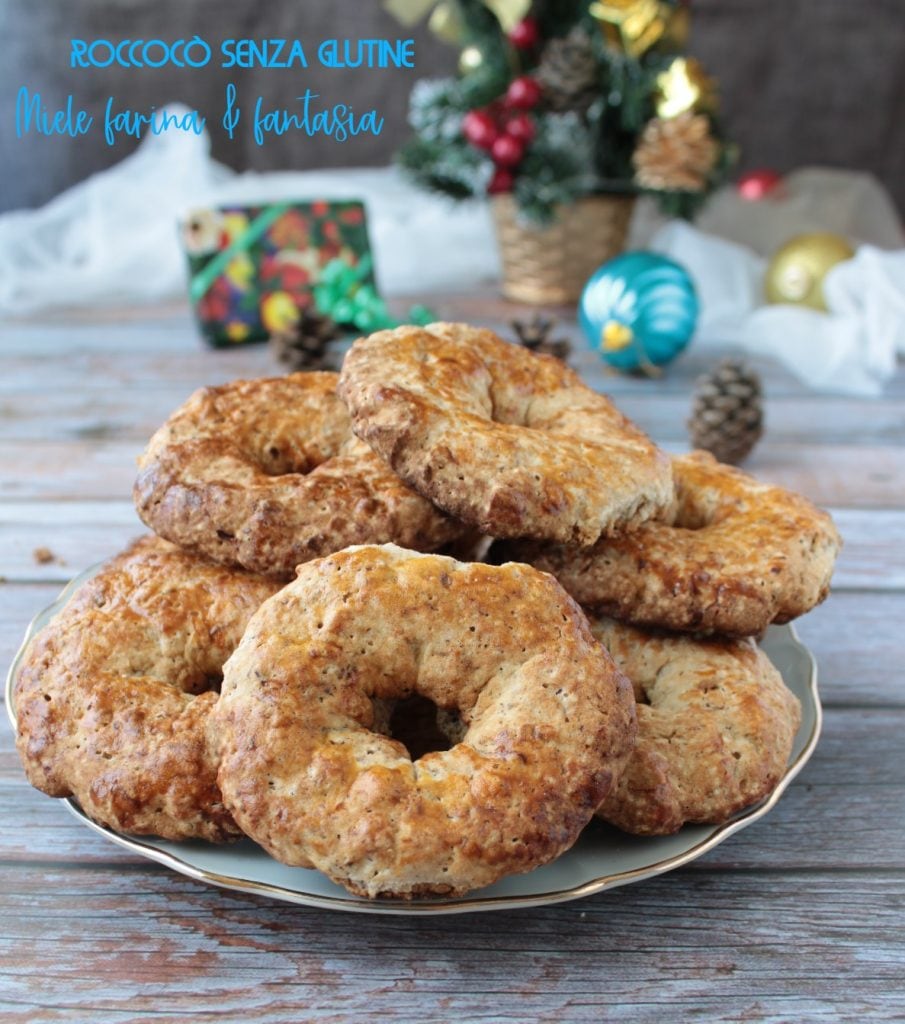
- Difficulty: Very Easy
- Cost: Medium
- Preparation time: 30 Minutes
- Portions: 15
- Cooking methods: Oven
- Cuisine: Italian
- Seasonality: Christmas
Ingredients
- 1.6 cups gluten-free rice flour
- 1/3 cup gluten-free corn starch
- 3/4 cup granulated sugar
- 1/5 cup orange juice
- 1.4 oz mandarin juice
- 1 tsp baking ammonia
- 1 tsp pisto
- 3.5 oz mix of toasted hazelnuts and almonds
- 2 tsp anise or Strega liqueur
- 1.7 tbsp room temperature water
- 1 tsp fine salt
- 1 egg yolk for brushing
- 1 tsp wildflower honey
- to taste orange and mandarin zest
Steps
To prepare gluten-free Neapolitan roccocò, get toasted hazelnuts and almonds and chop them coarsely, without leaving too large pieces.
Wash the orange, grate the peel very finely; then squeeze the juice and measure it.
Wash the mandarin, peel it and finely chop the peel with a knife (because, unlike orange or lemon, it’s not at all easy to grate the peel of a mandarin). Squeeze the mandarin juice and measure it as well.
Preheat the oven to 350°F.
Line a baking sheet with parchment paper
Roccocò can be prepared by hand or with a stand mixer, but I recommend using your hands to immediately understand if and when the dough is ready and avoid it becoming too soft.
In a large bowl, place the dry ingredients: the chopped nut mix, the zest of the two citrus fruits, the rice flour, the corn starch, the sugar, the pisto, the baking ammonia, and the salt.
Mix the dry ingredients well, even with your hands.
Now add the liquids, remembering that the roccocò dough must be hard and compact, meaning the liquid part must be completely absorbed by the dry ingredients.
First, pour the liqueur and the citrus juices in the indicated amounts above.
Continue to mix with one hand, while pouring a teaspoon of water at a time with the other.
Each time you add the water, knead for about 30 seconds. If you realize that you really can’t absorb the flour or that you can’t create a homogeneous and compact dough, then add another.
This precaution is not pedantry, but necessary.
With gluten-bound flours, it’s immediately apparent if you’ve overdone it with the liquids; however, it’s not the same with gluten-free ones. At first, it will seem like you have a solid, compact dough, but then, as seconds (or minutes, in the case of resting doughs) go by, or as you continue to handle them, they will release the absorbed moisture, and you’ll end up with mushy and unmanageable doughs.
If in doubt, I advise you to add a teaspoon less water rather than one more.
If the dough has become too soft, don’t panic. With the help of two spoons, take an amount as big as a small mandarin, place it on the parchment paper on the baking sheet, and continue like this until the dough is finished, spacing them two fingers apart. Even if they don’t have the classic shape, what matters is the unique taste and aroma.
Once we have our dough, transfer it to a work surface and, using additional rice flour when necessary, separate pieces weighing about 50 grams each.
Roll each piece gently with your hands until forming a kind of cigar, about 5 inches long and as thick as a finger and a half (it’s important they are thick because they will flatten during baking).
Shape them into rings and place them on a parchment-lined baking sheet, spacing them about a finger and a half apart from each other. Continue until all our roccocò are formed.
Finally, brush them with a tiny bit of beaten egg yolk, flavored with cinnamon, liqueur, or a little milk.
Bake them immediately at mid-height in the hot oven at 350°F for 30 minutes.
The roccocò are ready when the dough has completely lost its shine and detaches from the parchment paper, but frequently check the bottom as rice flour and corn starch tend to darken quickly and may burn; in this case, immediately lower the temperature to 340°F or place them a bit higher if using ovens that cook only from the bottom.
Don’t worry if, just taken out of the oven, the roccocò are very soft to the touch; they will harden as they cool.
Bon appetit
