
Perfect Royal Icing, an easy and quick recipe to decorate Christmas Cookies
Royal Icing for Cookies: The Perfect Recipe That Doesn’t Crack
The biggest problem in preparing royal icing is achieving a stable and smooth consistency that doesn’t dry too quickly creating unpleasant crusts on the surface, or that doesn’t crack (a phenomenon known as “crackles”) once dry on the cookie.
The solution lies entirely in the precise weighing of the egg white and the use of lemon, which stabilizes the mixture.
This recipe guarantees a thick, very white, and shiny glaze, ready for precise decorations.
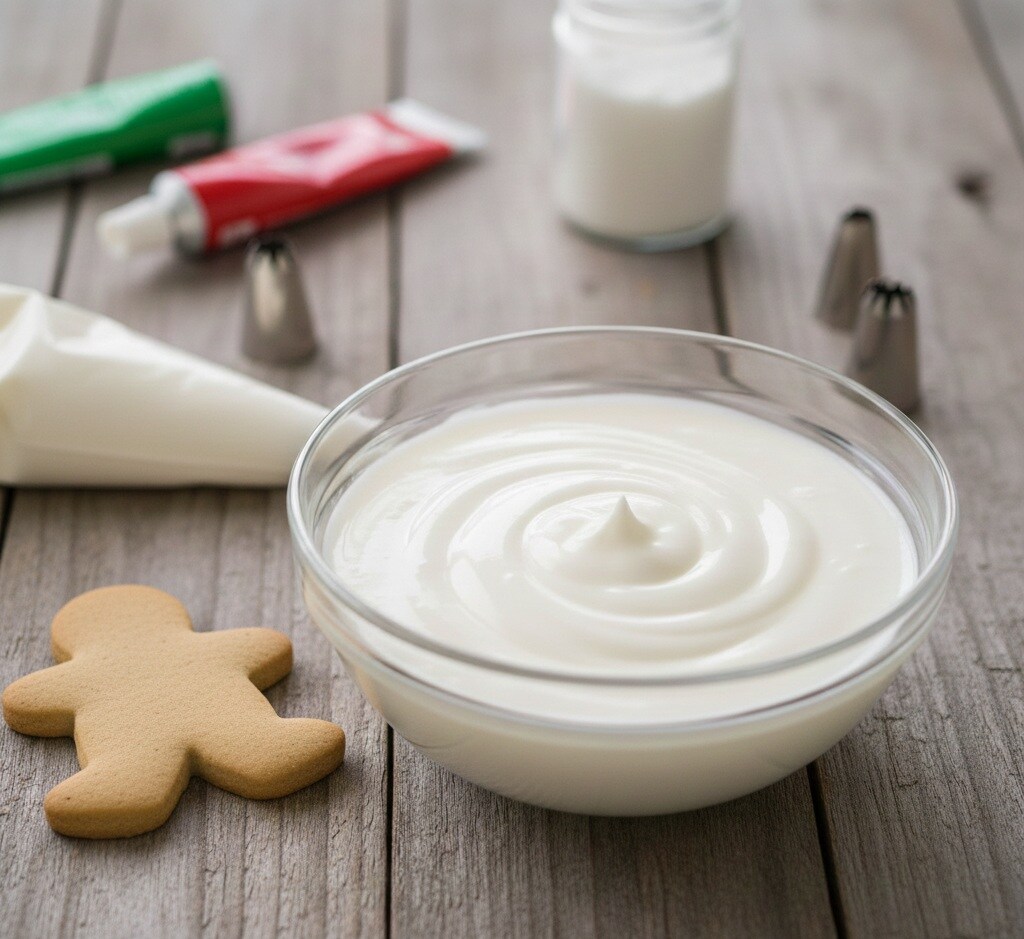
- Difficulty: Very easy
- Cost: Very economical
- Preparation time: 10 Minutes
- Portions: sufficient to decorate 50-70 small cookies
- Cooking methods: No cooking
- Cuisine: English
Ingredients for Stable Royal Icing
To have stable and perfect royal icing, it is essential not to modify the quantities of the ingredients, especially the egg white (do not use 1 egg white, for example, but weigh it) otherwise the result would not be the same.
- 1 cup powdered sugar (sifted, to avoid lumps)
- 1 oz egg white (the weight is fundamental: it's about less than one large egg white)
- 3 drops lemon juice (stabilizes the mixture and adds shine)
- A few drops food coloring (in gel for colorful decorations)
Tools
- Food scale
- Bowl
- Electric whisk
- 3 Small bowls
- Piping bag
Detailed Procedure: Assembling and Preparation
Pour the sifted powdered sugar, precisely weighed egg white, and 3 (maximum 4) drops of lemon into a bowl. Use an electric whisk or stand mixer and start mixing at medium speed.
Let the mixture whip for a few minutes. The icing is ready when it is slightly whipped, very thick, and has reached a very white and shiny color. It should not be as stiff as meringue, but should have a thick and fluid consistency that holds its shape.
If you wish to color the icing, divide the white mixture into separate small bowls. Add a small pinch of gel food coloring to each bowl and gently mix until homogenized and a uniform color is achieved. NB: Use gel food coloring; liquid ones would alter the density, and powdered ones might leave visible specks if not completely dissolved.
Transfer the icing (white or colored) into a parchment paper cone or a piping bag equipped with a fine tip. Securely close the upper end of the cone with a couple of folds and slightly cut the tip (or use a nozzle) to allow the glaze to flow out in a controlled manner.
Essential Tips, Notes, and Substitutions
Important Notes and Pastry Tricks
Weigh the Egg White: 1 oz of egg white corresponds to slightly less than one egg white. To obtain stable icing, it is essential to weigh this exact amount.
Anti-crust Coverage: Always cover the icing! When it’s ready, if you need to wait even just 10 minutes before using it, cover it with a cling film directly touching its surface to prevent it from starting to harden and form an unpleasant crust.
Drying: Do not place anything on top of the cookies decorated with the icing until it is completely hardened (it takes several hours at room temperature, depending on humidity).
Substitutions and Variations
Fresh Egg White Pasteurized egg white (in carton) Safer and more hygienic for a no-bake preparation.
Powdered Sugar-Not substitutable: its fine granularity is necessary to achieve the consistency.
Lemon Juice White Vinegar (a few drops) Acts as a stabilizing acid, but lemon is preferable for its flavor.
Gel Food Coloring Powdered Food Coloring Usable, but ensure the powder dissolves completely to avoid grains.
Preservation
Room Temperature: Prepared royal icing must not be stored in the refrigerator because it loses consistency and stability.
Short-term Storage: If you need to store it for a few hours, put it in an airtight container and cover the surface with direct cling film (as explained above), keeping it in a cool room temperature. Use within a few hours.
FAQ (Questions and Answers)
The royal icing is too runny, what do I do?
Add a teaspoon of sifted powdered sugar at a time and mix until you reach the desired consistency. If it is too thick, add a drop of water (or lemon juice).
How long do I need to whip the icing?
No more than 5-7 minutes in total. It must become dense and white, but not too stiff like a meringue. Over-whipping would make it too dry and difficult to use.
How do I achieve the “flood” consistency (for filling)?
The icing prepared with these amounts is for outlines. To obtain a more liquid consistency (flood) suitable for filling outlined areas, take a portion and add a few drops of water at a time, mixing until you get a glaze that self-levels in about 10 seconds.
Is Royal Icing suitable for building a gingerbread house?
The royal icing from this recipe is perfect for decorating cookies (for outlines, writing, and details), but to glue the gingerbread house walls, it must be much, much stiffer. If the icing is too liquid, the house pieces will not stand up and the structure will collapse. To adapt this recipe (for Gluing) and make it strong enough to act as glue, you will need a higher amount of powdered sugar compared to the egg white.
Tip: Prepare the icing as usual. Gradually add more sifted powdered sugar (a few spoonfuls at a time) and whip until the icing reaches a consistency so stiff that it perfectly holds its shape when lifted with a spoon. It should not collapse when squeezed from the piping bag. It must be very dense and stable, almost like a thick paste.
Remember: Apply plenty of icing along all the edges you need to join and perhaps use a glass or another object as a temporary internal support until the walls have partially dried.
