
Perfect Vegetable Broth: Grandma’s secret for a clear, unmistakable flavor
Who among you has never sighed at the thought of vegetable broth? We often treat it as a mere side task, a “Step 1” to rush through, perhaps using a bouillon cube.
But let me share a secret: homemade broth is not just a liquid, it’s the beating heart of every great recipe! It’s that savory, aromatic base that makes the difference between a “good” dish and an “unforgettable” one.
From the creamiest risotto to festive tortellini, and through soups and purees, a perfect vegetable broth is the invisible ingredient that elevates everything.
In this recipe, I’ll guide you step by step to achieve a broth as clear as crystal and so rich in flavor you’ll wonder why you never made it before.
Forget industrial bouillon cubes, full of salt and artificial flavors! With the freshest vegetables, a few spices and the trick of slow cooking, we’ll obtain a golden elixir that will perfume your whole home.
Prepare large pots and fresh vegetables: I promise that once you’ve tried “your” homemade broth, you won’t go back. Ready to create some magic?
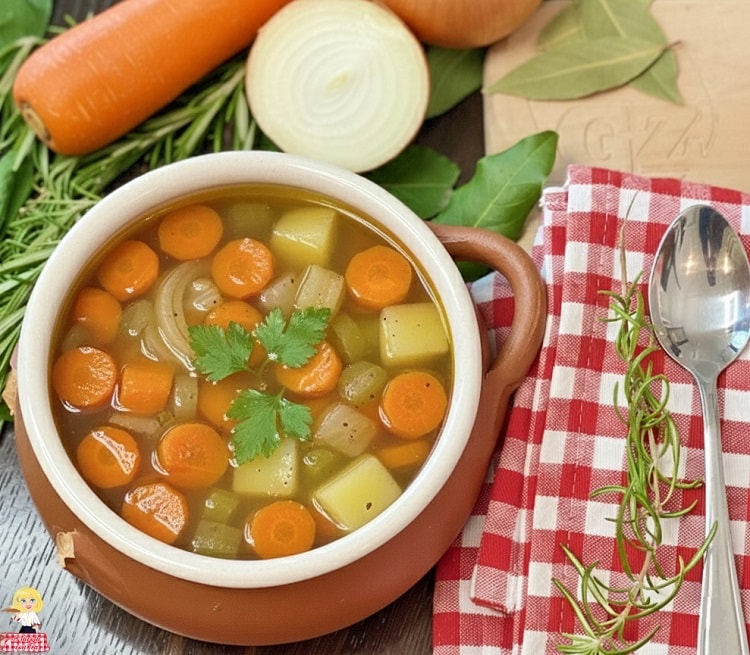
- Difficulty: Very easy
- Cost: Very inexpensive
- Preparation time: 15 Minutes
- Cooking methods: Stovetop
- Cuisine: Italian
Ingredients for PERFECT VEGETABLE BROTH
- 21 cups (about 5.3 qt) water (cold)
- 2 cups carrots
- 2 cups celery
- 1.1 lb potatoes (about 3 medium potatoes)
- 7 oz onions (about 2 medium onions)
- 4 leaves bay leaves
- 5 cloves
- 2 tbsp whole black peppercorns
- 1 bunch parsley
- to taste coarse salt
Tools
- Pot
- Cutting board
- Knife
- Fine mesh strainer
Procedure for a clear and flavorful Vegetable Broth
Thoroughly wash the onions without removing their skins. Remove only the root end and cut them in half. Gently insert the cloves into the flesh of one half like little pins so they won’t fall out. Place the onions in a large pot. Peel the carrots, trim the ends and cut into large chunks. Wash the celery and chop into pieces. Add everything to the pot. Wash the potatoes well (no need to peel) and the bunch of parsley. Add them to the pot. Add the whole peppercorns and the bay leaves.
Cover all the vegetables with 21 cups (about 5.3 quarts) of cold water. It’s essential to start with cold water so the vegetables release their aromas gradually during gentle heating. Place the pot over the lowest heat. Let it simmer for at least 2 hours without fully covering the pot (a small vent helps prevent cloudiness). During cooking, you can gently skim any impurities that rise to the surface.
When the broth is ready, turn off the heat. Carefully remove the vegetables (you can use them for other preparations!) and strain the broth through a fine-mesh strainer or, even better, through a kitchen cheesecloth. This will ensure perfect clarity. Taste the broth and add coarse salt only now, adjusting based on how you plan to use it. If you will use it for risottos, keep it slightly less salty.
Storage, Uses and History
How to Store the Perfect Broth
Homemade vegetable broth is a kitchen blessing!
Refrigerator: In airtight containers, it keeps for 3-4 days.
Freezer: It’s your best friend! Freeze in single-portion containers (paper cups, small containers or freezer bags) or in ice cube trays. It will keep up to 3 months.
Notes on Ingredients and Quick Substitutions
Vegetables: Always use the freshest seasonal vegetables. Don’t skimp on quantity: the more vegetables you use, the more flavorful the broth.
Onion: Do not remove the onion skin! It is rich in anthocyanins and will give the broth a beautiful golden color as well as extra flavor.
Aromatic herbs: Bay leaves and parsley are the base, but you can enrich with a sprig of thyme or rosemary (use sparingly).
Salt: Add it only at the end of cooking. The vegetables will release their flavor and you can adjust seasoning according to how you plan to use the broth.
Ingredient Substitute Suggested Notes and Quantities
Potatoes or Zucchini: Substitute with about 2 cups (300 g) of zucchini. It will make the broth slightly sweeter and less “heavy” in flavor.
Leek or White Onion or Shallot: For a milder broth, you can use 1 large leek (white part only) instead of one of the onions.
Whole Black Peppercorns or Mixed Peppercorns: Use a pepper mix (green, pink) for a more complex aromatic note.
Parsley leaves or parsley stalks: If you only have leaves, you can use just the stalks as well; they are full of flavor and less bitter.
A Dip into the Past: Origins of Broth
Broth, in all its variants (vegetable, meat, fish), is probably one of the oldest culinary preparations of humankind. It was born from the need to recover and enhance every part of ingredients, extracting maximum flavor and nourishment. In peasant homes, the broth pot was almost always on the stove, a symbol of abundance and a way to warm up during long winter evenings. Vegetable broth, in particular, is a hymn to simplicity and to the richness the land offers us—a humble but indispensable base in Italian culinary tradition.
Additional Section: Waste Not! (The Broth Vegetables)
Friend, the broth is ready, but the vegetables are not to be thrown away! They’re rich in fiber and still have good flavor.
“Recycled” side dish: Dress them with a drizzle of extra virgin olive oil (EVOO), salt and pepper and a little balsamic vinegar. They’ll make a light and delicious side.
Base for patties: Blend them and mix with stale bread softened in broth, an egg and some grated cheese. Great vegetarian patties!
Vegetable purée: Pass them through a food mill and add a little broth to create an instant vegetable cream.
FAQ (Questions and Answers)
1. Can I use other types of vegetables for the broth?
Answer: Absolutely yes! Vegetable broth is very versatile. You can add zucchini, cherry tomatoes, cabbage, fennel. Be careful, however, with vegetables that have a very strong flavor (like broccoli or cauliflower) or very intense color (like beets) that could overly change the taste or the clear color.
2. How can I make the broth even clearer?
Answer: The secret is not to let it boil too hard, but rather to simmer gently. If you want a crystalline broth, after straining you can “clarify” it with an egg white: whisk a lightly beaten egg white into cold broth, bring to a simmer while stirring, then remove from heat and strain again through a cheesecloth.
3. Can I prepare the broth without salt and salt it only when using it?
Answer: Great idea! It’s a practice I strongly recommend. By preparing the broth completely without salt, you’ll have maximum flexibility for using it in different recipes, salting only at the end according to the dish you’re creating. It’s perfect if you intend to use it for children’s recipes or for people with specific dietary needs.
