
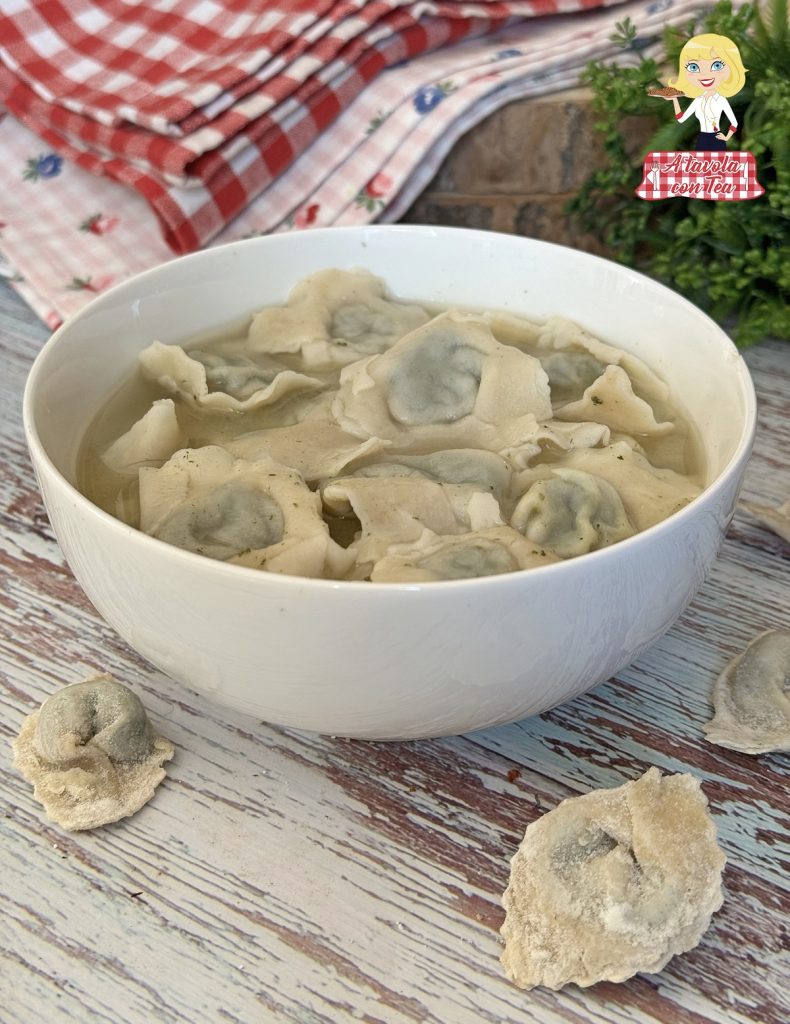
Homemade Tortellini in Broth: The true classic recipe as our grandmothers made it
There are recipes that go beyond simple nourishment: they are stories, memories, the scent of celebration. Tortellini in Broth are exactly that.
Don’t call it a first course, it’s a ritual, an institution, the warmth of the family enclosed in a golden little ring of pasta!
Even though my grandmother was from Genoa, she was excellent at making them.
I still remember, a few days before Christmas, that if you arrived at her house you would see every surface and the table full of tortellini she prepared in advance for the celebration.
This is the recipe I offer you today: the real one, which requires time, love and quality ingredients.
Don’t be intimidated by the length of the procedure.
It’s true, you have to roll the dough and fold the tortellini, but I assure you that the pleasure of tasting a concentrated, wonderfully fragrant capon broth enveloping a flavorful filling is priceless.
The secret of a perfect tortellino hides in three crucial steps you must respect:
The Broth: It must simmer slowly for hours. Don’t rush it.
The Dough: It must be so thin you can almost see through it. That’s the trick for a tortellino that stays light and not gummy.
The Filling: It must be a skillful balance of Mortadella, Prosciutto Crudo and pork, enriched with nutmeg, which is the distinctive aroma.
There’s no greater joy than forming those tiny tortellini with your own hands. Even if they aren’t aesthetically perfect, they are a journey into a tradition that must not be forgotten.
- Difficulty: Difficult
- Cost: Medium
- Rest time: 30 Minutes
- Preparation time: 2 Hours
- Cooking time: 3 Hours 20 Minutes
- Portions: about 80 tortellini
- Cooking methods: Stovetop
- Cuisine: Italian
Ingredients (for about 4 people)
- 2.2 lbs capon (or other meat for broth)
- 12.7 cups water
- carrot (1 medium)
- 1 onion
- 1 stalk celery
- rosemary (1 sprig)
- 2 leaves sage
- 1 sprig thyme
- to taste salt
- spices (Bay leaf, juniper berries, cloves, whole peppercorns)
- 1 1/4 cups 00 flour (or semolina or a mix for a stronger dough)
- 1 egg (medium)
- 1 egg yolk
- 1 oz Mortadella di Bologna
- 1 oz Prosciutto Crudo DOP, Parma
- 1 oz pork (loin or shoulder)
- 1/2 cup Parmigiano Reggiano DOP (aged 24 months)
- 1 egg yolk
- 1 1/3 tbsp butter
- to taste nutmeg
Tools
- Kitchen scale
- Pot
- Fine sieve/strainer
- Bowl
- Saucepan
- Chopper
- Stand mixer
- Rolling pin
- Pasta machine
- Pastry wheel
Procedure HOMEMADE TORTELLINI IN BROTH
In a large pot, place the meat (capon) and the vegetables (carrot, onion, celery) and the aromatic herbs (rosemary, sage, thyme). Cover with the 12.7 cups of cold water. Bring to a boil, skim if necessary, then reduce the heat to the minimum: the broth must simmer gently for 2–3 hours. Season with salt only at the end of cooking. When ready, remove the capon and strain the broth through a fine sieve. Place the broth in a container and, if time allows, chill it in the fridge so excess fat solidifies on the surface and can be removed.
Cut the pork into pieces and brown it together with the butter in a saucepan. Let the browned meat cool completely. In a food chopper put: Mortadella, Prosciutto Crudo, the cooled browned pork, Parmigiano Reggiano, nutmeg and the egg yolk. Pulse the chopper until you obtain a rich, homogeneous, malleable but dry mixture. Transfer the filling to a bowl and cover.
In a stand mixer or on the work surface, pour the flour, the whole egg and the yolk. Work the dough until you get a compact ball. Knead the ball by hand for a few minutes and let it rest for half an hour in a bowl covered with a clean cloth: this is fundamental so the dough doesn’t spring back. Roll the dough with a rolling pin or with a pasta machine on a lightly floured surface. The sheet should be extremely thin (less than 0.02 in). Immediately cover with plastic wrap the portion of dough you’re not working on.
Work with only one portion of the sheet at a time. Using a pastry wheel, cut squares of 1 3/16 in per side. Take about 0.07 oz of filling (the size is important!) and place it in the center of the square. If the dough is dry, moisten the edges with very little water.
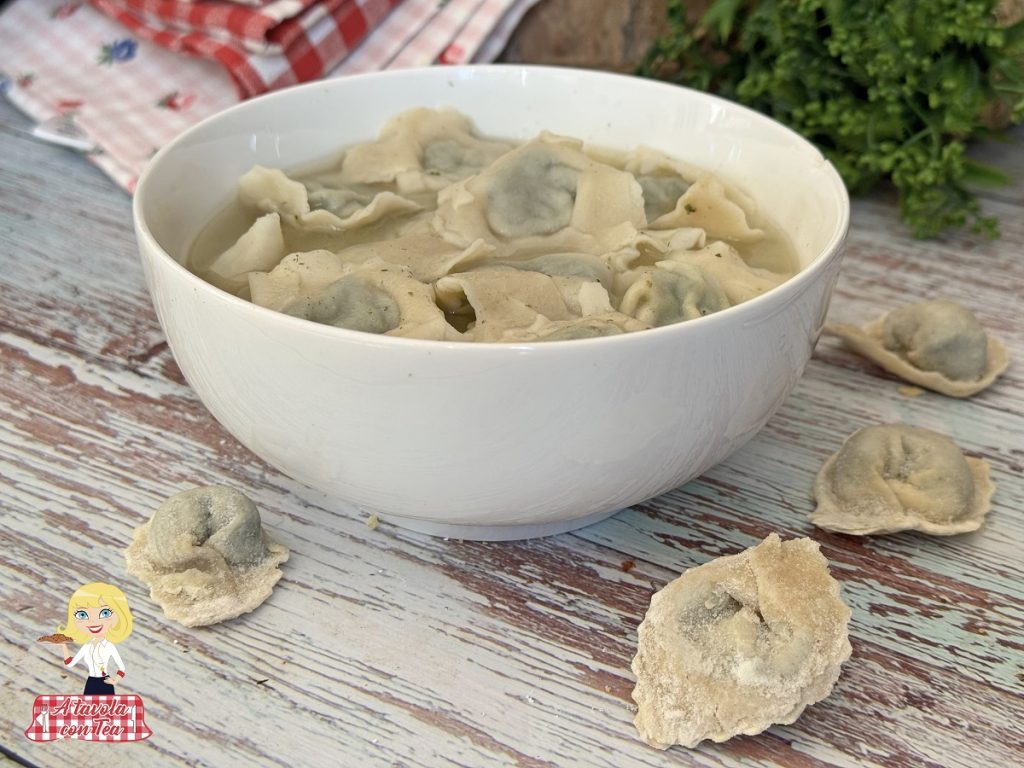
Fold the pasta over the filling by joining two opposite corners to form a triangle, pinching the edges well. Shape the tortellino: fold the triangle’s tip towards you and bring the two tips at the base together, making them meet and sealing them.Heat the capon broth in a large pot until it reaches a boil. Drop the tortellini directly into the boiling broth. Being fresh, they will cook in just 2–3 minutes. Serve your tortellini immediately and piping hot, with a generous sprinkle of grated Parmigiano Reggiano (if you like).
Ingredient Notes and Substitutions
For fresh pasta, preferably use “00” flour or a mix with re-milled semolina (about 3/4 cup + 1 tbsp of 00 and about 1/3 cup of semolina) to make the sheet stronger and easier to work with. Capon broth is traditional, but you can use beef, hen or mixed broth. For the filling, use high-quality meats!
Possible Substitutions:
Capon: alternatively hen, beef (brisket or chuck). For a leaner, more “everyday” broth.
Pork: you can also use fresh pork sausage. Remove the casing and use it directly in the chopping (do not brown it).
00 Flour: or “0” type flour or 00 mixed with semolina. For a more resilient sheet and a more intense color.
Butter (in the filling): alternatively extra virgin olive oil, to brown the meat and make the filling lighter.
Storage
Fresh raw tortellini can be stored in the refrigerator on a floured tray (covered) for up to 24 hours.
If you want to prepare them well in advance, you can freeze them: arrange them on a floured tray, put them in the freezer and, once frozen, transfer them into freezer bags. They cook directly from frozen in boiling broth, extending cooking time by 1–2 minutes.
The broth, once cooked and strained, keeps in the refrigerator for 4–5 days or can be frozen in portions.
Alternatives and Variations
1 – Tortellini in Parmesan Cream: If you want to try the tortellini dry, serve them with a Parmigiano sauce: melt 1 cup (about 3.5 oz) of grated Parmigiano Reggiano with about 3.4 fl oz (100 ml) of fresh cream. Toss the cooked tortellini in this sauce.
2 – Vegetarian Filling: Replace the meat with a mix of ricotta and spinach (about 3.5 oz ricotta, well drained, 1.8 oz cooked and squeezed spinach, 1.8 oz Parmigiano, nutmeg).
Pairings and Uses
Tortellini in Broth are traditionally the centerpiece of Christmas or Easter lunch, served as a first course.
Main Course: The capon meat used for the broth can be served as a second course, accompanied by a green sauce or mashed potatoes.
Wine: In broth, tortellini pair well with a dry, not overly aromatic white wine like Grechetto or an Albana Secco. If served dry (no broth), a Lambrusco Grasparossa (the classic Emilian pairing) is perfect.
Origins and History: The Myth of the Tortellino
The Tortellino is an excellence of Emiliano cuisine, with a long-standing dispute between Bologna and Modena over its origin. The most romantic legend tells that a tavern keeper from Castelfranco Emilia (located between the two cities), spying through a keyhole the beautiful Venus, was so struck by the shape of her navel that he wanted to reproduce it in the kitchen with a piece of pasta.
The traditional filling, the so-called “battuto”, is codified and includes roasted pork cuts (roasted pork loin), prosciutto crudo, mortadella and Parmigiano Reggiano. Symbol of opulence and celebration, capon broth has always been the ideal vehicle, enhancing the flavor without covering it.
The Secret for Tortellini That Don’t Open While Cooking: Don’t Overfill!
The most common mistake with tortellini is putting too much filling. Remember: a true tortellino is small! The 0.07 oz portion is indicative, but the important thing is that the filling is a small hazelnut-sized amount, because the dominant taste must remain the dough and the silky sensation of the broth. An overfilled tortellino becomes heavy and loses its elegance. Work precisely and tradition will reward you!
FAQ (Questions & Answers)
1. My sheet tears while I’m rolling it, what am I doing wrong?
Most likely the dough is too dry (add an extra yolk next time) or it hasn’t rested enough. The half-hour rest is crucial so the gluten relaxes. Also, use good-quality flour and work quickly to avoid warming the dough.
2. Can I use vegetable broth instead of meat broth?
Of course, it’s fine as an alternative, but consider that you’ll lose the intensity and richness of the traditional flavor. To make a vegetable broth more “full-bodied”, add dried porcini mushrooms (reconstituted) and a tablespoon of miso at the end of cooking.
3. How long do tortellini last once cooked?
Tortellini should be eaten immediately. If you have leftovers, they keep in the broth in the refrigerator for 1 day, but the pasta will tend to absorb the liquid and swell. Reheating is not recommended, but if you must, add fresh broth to prevent them from becoming too mushy.
