
How to Achieve the Perfect Mashed Potatoes (and Say Goodbye to Glue)
What is the biggest problem when making mashed potatoes?
The glue tragedy! Instead of getting smooth and fluffy mashed potatoes, we end up with an elastic and dense mass, often full of lumps.
This almost always happens when you overuse the whisk or immersion blender, which break the starches excessively and turn them into a sticky disaster.
But grandma’s mashed potatoes were not like that! They were a cloud, a wrapping side dish that needed nothing else.
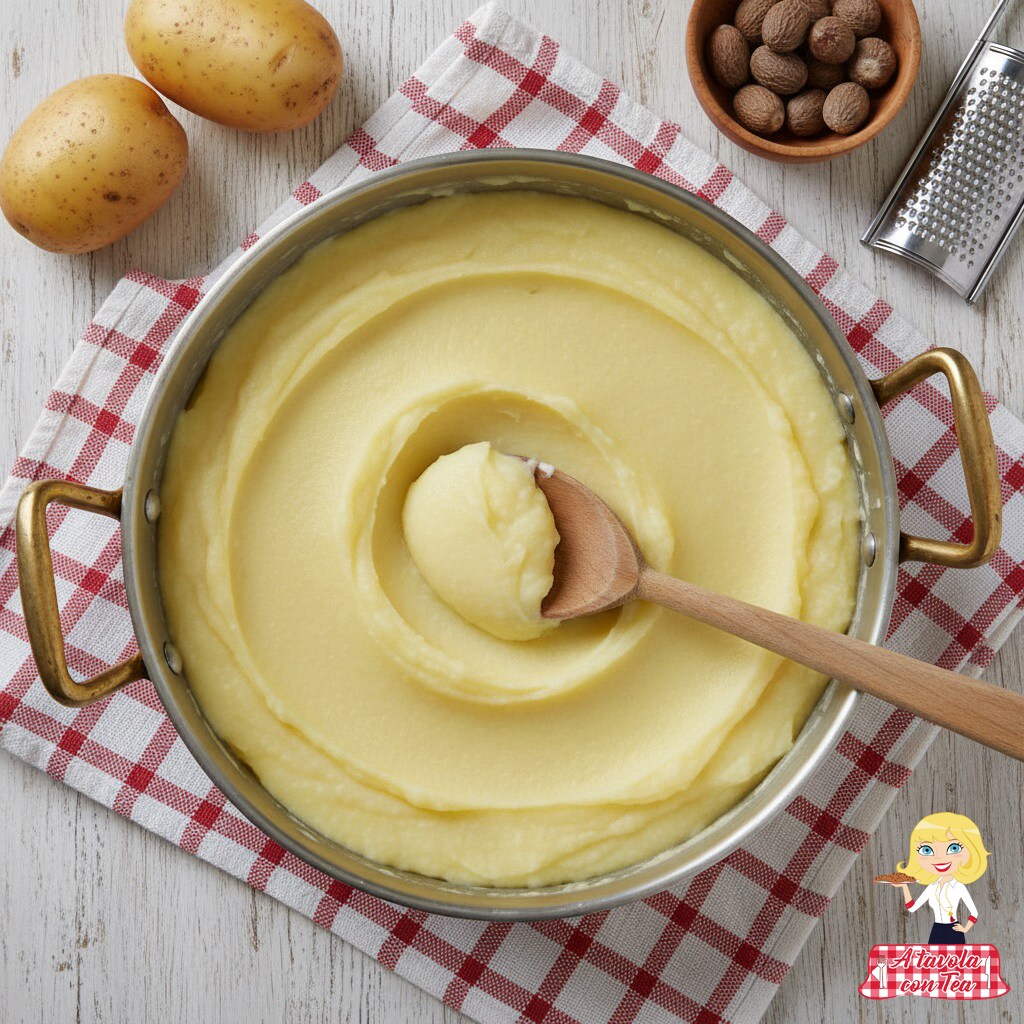
Fortunately, the secret to achieving that dreamy, creamy and lump-free consistency is not complex, but it requires precision in the method.
I learned that the crucial point is two things: the choice of tool and the temperature of the milk.
First, forget about blenders: to avoid the “glue,” only use a potato masher or a food mill.
Then, the milk must be hot and added gradually, off the heat, to not stress the starches. Finally, the butter, added at the end and off the heat, not only enriches the flavor but helps stabilize the emulsion.
With these precautions, you’ll get mashed potatoes so light and creamy that they’ll become your favorite side dish.
It’s a simple dish, but it’s perfection in its simplicity!
- Difficulty: Very easy
- Cost: Very cheap
- Preparation time: 20 Minutes
- Portions: 4
- Cooking methods: Stovetop
- Cuisine: Italian
Ingredients for Mashed Potatoes (4-6 Servings)
- 2.2 lbs potatoes (Old or floury yellow potatoes)
- 1 cup whole milk
- 3.5 tbsps butter (in pieces)
- to taste fine salt
- 1 pinch nutmeg
Tools
- Kitchen Scale
- Pot
- Colander
- Potato Masher
- Pot
How to Prepare Lump-Free Mashed Potatoes
Boiling: Place the potatoes (unpeeled) in a large pot and cover with plenty of cold water. Put on the heat.
Timing: From the moment the water reaches a boil, count about 30-40 minutes. The fork test is essential: if the tines enter easily, the tubers are cooked.
Hot Peeling: Drain and let cool just for a few minutes. The potatoes should be peeled hot to facilitate the operation and to prevent the starches from becoming “sticky” when cooling.Mash: After peeling the potatoes, mash them immediately using a potato masher (or a food mill). Avoid the blender or food processor to not break the starches!
Flavor: Adjust the puree with a generous pinch of salt and add flavor by grating some fresh nutmeg.Hot Milk: Meanwhile, in a separate saucepan, heat the milk (it should not boil, but should be very hot).
Slow Incorporation: Place the mashed potatoes in a clean pot and heat on low. As soon as the milk is hot, pour it in little by little.
Mashing: Stir vigorously with a whisk (without overdoing it) until the milk is completely absorbed and the texture is velvety.
Butter Off the Heat: Turn off the heat. Add the cold butter in pieces and stir until completely melted. This final step stabilizes the emulsion and adds shine.
Serve: Transfer to a bowl and serve your mashed potatoes immediately.
Notes on Ingredients and Substitutions
Potatoes (Yellow/Old): The choice is crucial! The best potatoes are floury ones (like Kennebec or Holland) or at least old yellow potatoes, because they have a high starch content and absorb milk better without becoming watery. Avoid new or waxy potatoes.
Whole Milk: The fat in whole milk is necessary for creaminess and to emulsify the mashed potatoes. Substitution: For a richer version, replace half the milk with fresh cream.
Butter: It should be added at the end to stabilize the texture and provide that rich and glossy flavor typical of classic preparation. Substitution: You can increase the butter amount up to 70-80 g for a French-style mashed potato (pomme de terre purée).
Storage
Mashed Potatoes are best fresh. If there are leftovers, store them in an airtight container in the refrigerator for 2-3 days.
Reheating: To restore creaminess, reheat the mashed potatoes in a pot over very low heat, adding a tablespoon of milk or cream and a piece of butter, stirring vigorously with a whisk.
Alternatives and Variations
Parmesan Mashed Potatoes: Add 2-3 tablespoons of finely grated Parmigiano Reggiano DOP along with the butter, off the heat. This will give a more intense and savory flavor.
Herb-Flavored Mashed Potatoes: Replace nutmeg with a very fine chop of herbs like chives and parsley added at the end, just before serving.
Garlic Mashed Potatoes: Heat the milk (step 2) with a whole garlic clove (in skin or crushed). Let it infuse for 5 minutes, then remove it before pouring the milk over the mash.
Perfect Uses and Pairings
Mashed potatoes are the quintessential side dish:
Classic Side: Perfect with meat roasts, braised meats, stews (like Goulash), or with classic Saltimbocca alla Romana.
Main Dish: It can be used as a base for Shepherd’s Pie, where it is spread to cover meat sauce and baked.
Base for Croquettes: Use leftover mashed potatoes as a base for stuffed croquettes baked in the oven.
Origins and Brief History
Mashed potatoes, also known as Mashed Potatoes, are a classic of European peasant cuisine, widespread in much of the Western world. The first written recipe dates back to 1747, when Englishwoman Hannah Glasse included it in her book “The Art of Cookery Made Easy and Plain”. Although simple, its preparation has undergone endless evolutions. The secret of the “grandmother’s mashed potatoes” in Italy has always been the use of simple ingredients (butter and milk) without exaggeration, relying on the wisdom and patience not to break the starches, something modern technology, ironically, has made us forget!
FAQ (Questions and Answers)
How do I know if the potatoes are ready to be mashed?
They should be floury and not waxy. As soon as you peel them, if they release a bit of “steam” and slightly break down at the touch, they are perfect. If they are hard or too compact, cook them a little longer.
Can I use an immersion blender to save effort?
Absolutely not! Immersion blenders and food processors operate at high speed, breaking the long starch chains of the potatoes and releasing the natural glue. You will get a dense, elastic, and unpleasant mash. Use only a potato masher or a food mill.
Why do I need to add hot milk?
The starch in the potatoes absorbs hot liquid better and faster. If you add cold milk, you lower the temperature of the puree and force more mixing, increasing the risk of the mash becoming “gluey”.
