
Persimmon and Apple Jam (Persimmon Preserve): Easy Recipe, No Pectin, and Perfectly Creamy
If you are among those who love the sweet and velvety taste of persimmons, you are in the right place.
Often, the problem with making preserve from this fruit is the texture: it tends to be too runny or, worse, grainy, never becoming well spreadable.
Today we turn persimmons into a jaw-dropping Preserve, and I’ll reveal the trade secret that solves the problem: adding Golden apple.
The apple is naturally rich in pectin (the jelling substance).
By adding the apple (unpeeled!) to the persimmons, you eliminate the need for chemical thickeners and achieve a perfectly creamy and spreadable preserve.
A touch of vanilla and lemon will do the rest, balancing the sweetness of the persimmon with a fresh and fragrant note.
This is not just a recipe, it’s a great technique for home preservation.
I’ll guide you through key steps, like sterilizing the jars (a crucial step for safety) and the plate test for consistency, which will let you know with certainty when the preserve is ready.
Get ready to stock your pantry with this autumn marvel.
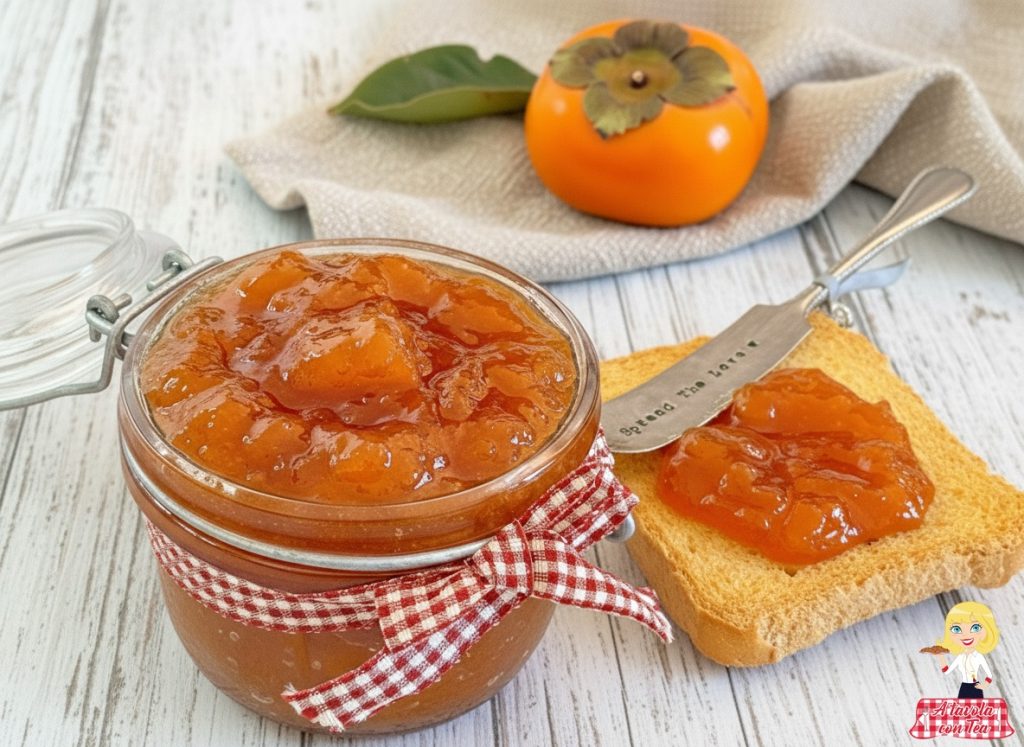
- Difficulty: Easy
- Cost: Cheap
- Rest time: 30 Minutes
- Preparation time: 30 Minutes
- Cooking time: 45 Minutes
- Portions: 6 jars of about 8.8 oz each
- Cuisine: Italian
Ingredients PERSIMMON JAM
- 2.6 lbs persimmons (Weight of whole fruit, to be cleaned)
- 17.6 oz granulated sugar
- 10.6 oz Golden apple (with peel)
- 1 lemon juice (About 50-60 ml)
- 1/2 pod vanilla
Tools
- Pot
- Flame tamer
- Immersion Blender
- Skimmer
- 6 Jars
PERSIMMON JAM Step by Step
Wash the jars and lids thoroughly. Place them in a large pot, placing cloths between them to prevent breaking during boiling.
Fill the pot with water and bring to a boil. Count 30 minutes from when the water boils.
Turn off the heat, remove the jars with clean kitchen tongs, and let them dry upside down on a clean cloth, without touching the inside.Cut the persimmons in half, remove the seeds and the stem. Scoop the ripe pulp with a spoon and collect it in the saucepan.
Wash the Golden apples well (do not peel them, the pectin is concentrated in the peel!) and cut them into cubes. Add them to the persimmons.
Add the sugar, strained lemon juice, and seeds scraped from half a vanilla pod.Mix the ingredients and let them rest for about 30 minutes. This will help the sugar dissolve and the fruit release its juices.
Put the saucepan on the stove (it’s ideal to use a flame tamer to distribute heat evenly and prevent burning the bottom).Cook the preserve for about 45 minutes over medium-low heat. Stir often during cooking and remove the foam that forms on the surface with a skimmer.
When about 5 minutes are left, blend the mixture directly in the pot with an immersion blender to obtain a homogeneous and velvety preserve.
Plate test (cooking test): Put a teaspoon of preserve on a cold plate and tilt it. If it runs slowly and is not too liquid, it is ready!Immediately jar the boiling preserve into sterilized jars.
Seal tightly with the lids and turn the jars upside down on a work surface to create a vacuum.
Let cool completely. You will hear the classic “click” of the lid sealing, guaranteeing proper preservation.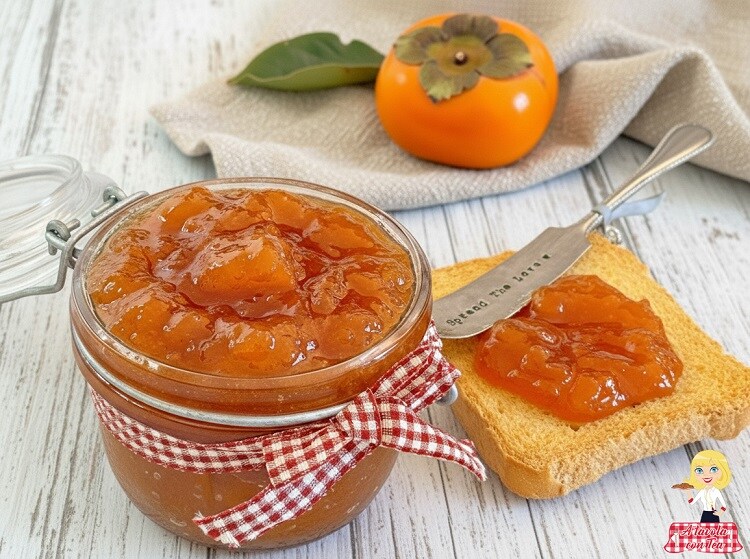
Notes on Ingredients and Substitutions
The Persimmons (Weight and Ripeness): The weight of 2.6 lbs refers to whole fruits. The final pulp will be slightly less. Choose very ripe and soft persimmons, they have the most gelatinous pulp, ideal for preserve.
The Apple (Natural Pectin): The Golden apple is perfect, but you can also use Granny Smith for a more acidic note that balances the sweetness. Do not peel it; it is the main source of pectin for natural thickening.
Sugar: The dose of 17.6 oz is designed for a preserve that is not too cloying, but ensures proper preservation. If you use very sweet persimmons and want a lighter preserve, you can reduce it to 15.8 oz, but the storage time will be shorter.
Vanilla: You can replace vanilla with the zest of half an organic orange (only the orange part) for a citrus scent.
Preservation
Persimmon preserve, if properly jarred and with successful vacuum sealing, can be kept in a cool, dry place (like a pantry) for about 10-12 months.
After opening: Once the jar is open, store it in the refrigerator and consume it within 3 weeks.
Recipe Alternatives and Variations
Persimmon and Ginger Preserve (Spiced): Add 10 g of finely grated fresh ginger along with the lemon, or 1 teaspoon of ginger powder. The ginger will add a spicy touch that balances the sweetness.
“Vegan” Preserve (Sugar-Free): For a version with less sugar, replace 250 g of sugar with 200 ml of maple syrup (added halfway through cooking). In this case, the storage time is reduced.
Persimmon, Rum, and Raisin Preserve (Gourmet): Add 50 g of raisins soaked in 2 tablespoons of Rum (add raisins and Rum 15 minutes before the end of cooking). Perfect for pairing with desserts and aged cheeses.
Perfect Uses and Pairings
Persimmon preserve is extremely versatile thanks to its delicate and sugary flavor:
Classic Breakfast: Great spread on toast, rusks, or waffles.
Desserts: Perfect as a filling for pies and dry biscuits. It pairs magnificently with almond flour doughs.
Cheese Boards: Its sweet flavor is the ideal pairing for strong-tasting cheeses. Try it with aged Pecorino, spicy Gorgonzola, or a light blue cheese like Robiola.
Origins and History of the Recipe
The persimmon (or Diospyros kaki) originates from East Asia and is known in Italy mainly in the southern regions and Emilia-Romagna, where its cultivation is particularly widespread. The preserve was born from the peasant need to preserve abundant autumn fruits. Traditionally, persimmons were consumed fresh or turned into simple preserves. Pairing with the apple (a source of pectin) is a household technique passed down through generations that ensures a preserve with impeccable consistency, evolving simple persimmon pulp into a truly spreadable and long-lasting jam.
The Secret for Preserve Without “Black Filaments”
Do you know those little black filaments that sometimes appear in persimmon preserve? They are tannins and appear if the persimmon is not ripe enough or if the fruit has been damaged.
My pro tip: Make sure the persimmons are very soft to the touch before peeling them. Additionally, the apple pulp and lemon juice, rich in acidity, help to “block” the tannin action, ensuring a more homogeneous and bright color in the final result!
FAQ (Questions & Answers)
1. Should I peel the persimmons?
Answer: It is highly recommended. The persimmon peel is not particularly pleasant in a smooth preserve. Furthermore, if the fruit is not ultra-ripe, the peel may be slightly astringent (tannic). Remove the peel and any hard or dark parts of the pulp.
2. How do I know if the vacuum seal is successful?
Answer: There are two tests: A) After 12-24 hours of cooling, the lid should be concave (pulled inward). B) If you press the center of the lid, it should not make the typical “click-clack” noise. If the vacuum seal is not created, store the jar in the fridge and consume it within a month.
3. Can I use less sugar?
Answer: You can reduce the amount to 15.8 oz for a lighter taste. However, sugar acts as a natural preservative. If you go below this threshold, the preserve will have a much shorter storage life (maximum 1-2 months in the fridge after opening or immediately in the pantry).
