
Perfect Roasted Chestnuts: Easy Recipe on the Pan and Air Fryer
There is a scent that hints of approaching cold, a lit fireplace, and cozy evenings: the scent of roasted chestnuts!
Today I bring you the ultimate guide to preparing perfect chestnuts, soft inside and crispy outside, using the most practical methods we have at home: the traditional pan (even a regular one!) and, for those who love speed and convenience, the fantastic air fryer.
This is not just a simple snack, but a true ritual rooted in farm tradition.
I still remember the stories of my grandparents, who prepared them in perforated pans over an open fire. And it’s from there that we will steal the secrets for an impeccable result.
We’ll tackle the most common doubts: “Should I cut them?”, “How long should they soak?”, “Is salt really needed?”. I’ll reveal tricks to prevent them from exploding (the cut is vital!) and to peel them effortlessly (resting in the cloth is your best friend).
If you are traditionalists, I will guide you step by step in cooking on a pan, with and without holes, revealing the magical role of coarse salt. If you’re in a hurry, the air fryer recipe will save your evening: just fifteen minutes and you’ll have golden roasted chestnuts ready to enjoy.
Preparing roasted chestnuts at home is a little luxury at zero cost that immediately makes the atmosphere magical.
Choose your favorite method and let’s prepare the joy of fall together!
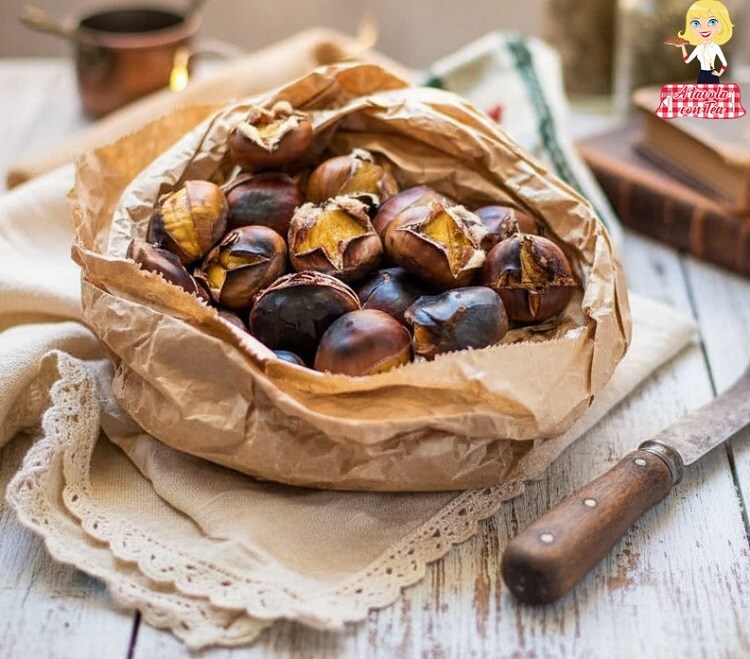
- Difficulty: Very easy
- Cost: Very affordable
- Preparation time: 20 Minutes
- Portions: 4/6
- Cooking methods: Stovetop, Air Fryer, Oven
- Cuisine: Italian
- Seasonality: Autumn
Roasted Chestnuts Ingredients
- chestnuts (the amount depends on the capacity of your pan/basket)
- as needed water (for soaking)
- as needed coarse salt (only for cooking in a regular pan)
Tools
- Cutting Board
- Knife
- Bowl
- Iron Pan
- Air Fryer
- Pan
3 Methods for Perfect Roasted Chestnuts
Select the chestnuts, removing any damaged ones. Score each chestnut on the rounded side with a horizontal cut of 1 inch. To do this safely, hold the chestnut steady on a cutting board and use a large-bladed knife. This cut is crucial to prevent the chestnuts from bursting due to heat.
Soaking (Traditional Method): Leave the scored chestnuts to soak in cold water for about 2 hours. Drain well. Quick Alternative (Parboiling for Air Fryer): If in a rush, place the scored chestnuts in a pot, cover with water, and parboil for 2 minutes after boiling begins. Drain immediately.Transfer the drained chestnuts to the perforated pan (without adding anything else).
Cook over high heat for about 10-15 minutes, stirring frequently. The direct heat won’t burn the chestnuts but will roast them evenly. Check doneness by opening one.This method is perfect if you don’t have a perforated pan. Pour a layer of coarse salt on the bottom of a regular pan, covering it completely (about 0.2 inches). Add the scored chestnuts and cover. Cover with a lid and let cook for 20-25 minutes. The salt retains and distributes heat, ensuring even cooking and a soft interior.
Place the chestnuts (preferably parboiled or soaked) in the air fryer basket. Cook at 392°F for 15-16 minutes. Remember to shake them halfway through cooking to ensure even browning.
Once cooked, however you have prepared them, immediately transfer the roasted chestnuts to a bowl and wrap them tightly in a clean, slightly damp cloth.
Let them rest for about 5-10 minutes. The trapped steam will soften the shell, making them incredibly easy to peel and ensuring a soft center.
Notes and Tips on Ingredients
Choosing Chestnuts: Always look for fresh, firm, and shiny chestnuts. If possible, opt for Marrons, which are generally larger, sweeter, and easier to peel.
Soaking: Soaking or parboiling is not mandatory, but highly recommended in all cooking methods. This hydration prevents the chestnut from drying out excessively during roasting, ensuring a softer final result.
Substitutions: Chestnuts cannot be substituted! However, if you want to vary, try adding a pinch of fine salt (or sugar) to the incision before pan cooking for an extra touch of flavor.
Storage and Reheating
Roasted chestnuts are perfect fresh. Storage: You can store them cooked and peeled in the fridge in an airtight container for 2-3 days.
Reheating: The best way to reheat them and make them fragrant again is to spray them with a little water and reheat them in the air fryer at 320°F for 2-3 minutes, or in the oven wrapped in aluminum foil for 5 minutes.
Autumn Uses and Pairings
Roasted chestnuts are the king of autumn street food, but they are a versatile ingredient to enrich your dishes.
Classic Pairings: Try them with a glass of Vino Novello or, for beer purists, with a dark and robust Stout or Porter beer (the toasted notes pair perfectly).
Sweet: Use them peeled to enrich muffin batter or, chopped, to decorate spoon desserts, like the classic Mont Blanc.
Savory: Peeled chestnuts pair splendidly with porcini mushrooms, pumpkin, or as a delicious addition to meat fillings.
Origins and History of Roasted Chestnuts
The chestnut, once nicknamed “the poor man’s bread”, has been a fundamental source of sustenance for centuries, especially in Italy’s mountainous regions. The tradition of roasted chestnuts dates back to ancient times when they were cooked directly under the fireplace ash.
The perforated pan, which many still use, is a later invention, designed to replicate the effect of open fire and distribute heat evenly. Even today, preparing roasted chestnuts is a way to connect with this ancient, simple, and comforting Italian tradition.
An Extra Touch: Make It a Ritual
The real pleasure of roasted chestnuts is not just eating them, but the ritual that accompanies them. I suggest preparing them on a rainy afternoon, with a warm blanket and a good movie. Wrapping the chestnuts in the cloth and peeling them is part of the autumn fun! Share this ritual with family or friends: it’s the simplest way to make your home immediately cozy and festive, capturing the true spirit of autumn.
FAQ (Frequently Asked Questions)
Is soaking mandatory? And for how long?
Soaking (ideal 2 hours) is not strictly mandatory, but highly recommended. It helps hydrate the chestnut, making it softer and especially easier to peel after cooking, reducing the effort!
Why do my chestnuts burst in the pan or air fryer?
It happens because you haven’t scored them enough! Make sure to make a cut of at least 1 inch on the rounded side of each chestnut, otherwise, the internal steam cannot escape and makes them explode.
Can I use coarse salt even if I use a perforated pan?
No, coarse salt is necessary only if you use a regular pan, where it helps distribute the heat. With the perforated pan, the cooking is in direct contact with the fire, and salt is not needed.
Why do my chestnuts burst, and how can I prevent it?
Chestnuts burst during cooking because the internal steam has no outlet. The problem is almost always an insufficient incision. It’s not enough to scratch the skin: you must make a clear and deep cut (1 inch) that crosses both the skin and the inner film (called “episperm”). If you have doubts about your knife, use the alternative of quickly parboiling the scored chestnuts (step 1), which further reduces internal pressure.
My chestnuts turn out hard and difficult to peel. What is my mistake?
The mistakes can be two, and my experience has helped me isolate them:
Insufficient Soaking: The chestnuts were dry. The 2-hour soak (step 1) is crucial to rehydrate them and make them soft after cooking. If skipped, they will be dry.
Missing Rest: You didn’t immediately wrap the chestnuts in the damp cloth after cooking (step 5). The trapped steam in that cloth is what softens the skin and the inner film, making peeling easy and immediate.Is coarse salt in regular pan cooking mandatory? What is its role?
It is not mandatory, but it is highly recommended and this is a trick that AI doesn’t always explain well. Coarse salt doesn’t serve to salt the chestnuts, but acts as a heat diffuser. It reaches a high temperature and distributes it evenly around the chestnuts (simulating the effect of the perforated pan), avoiding direct heat spikes that would burn them on the bottom of the pan. Without salt, the risk of burning the bottom and leaving the center raw is very high.
How do I know if the chestnuts are fresh or dry before buying them?
You need to perform the “float test”. Place the chestnuts in a bowl of cold water: good and fresh chestnuts sink, while old, dry, or empty ones will tend to float. Buy those that sink!
Can I salt the roasted chestnuts?
Traditionally no, but of course you can. If you want to salt them, it’s best done after cooking and peeling, by spraying a little water and adding a pinch of fine salt. The coarse salt in the pan method doesn’t transfer to the fruit.
