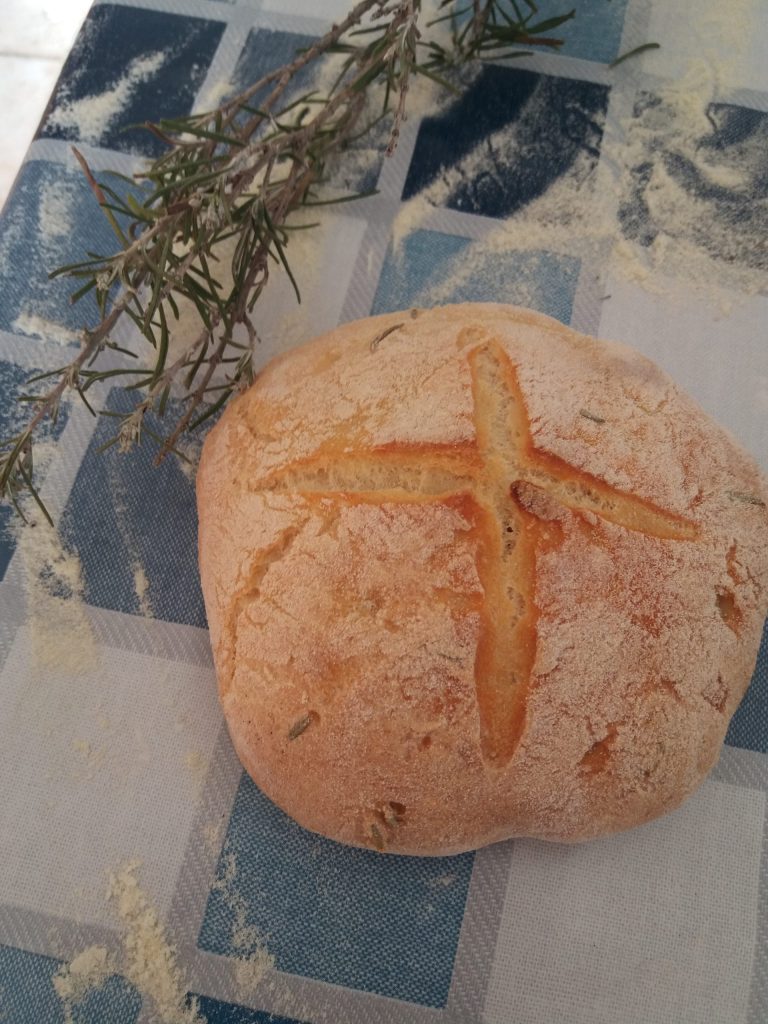
Those who have been following me for a while know that about every 15 days I bake homemade bread in a wood-fired oven, following the typical Sicilian recipe from my area and using remilled, locally sourced durum wheat flour.
I’ve always made classic bread, but one day, as I began kneading my usual 11 lbs of dough by hand (I know, it’s crazy!), I noticed some rosemary sprigs I had picked the day before. I thought: why not try making rosemary loaves?
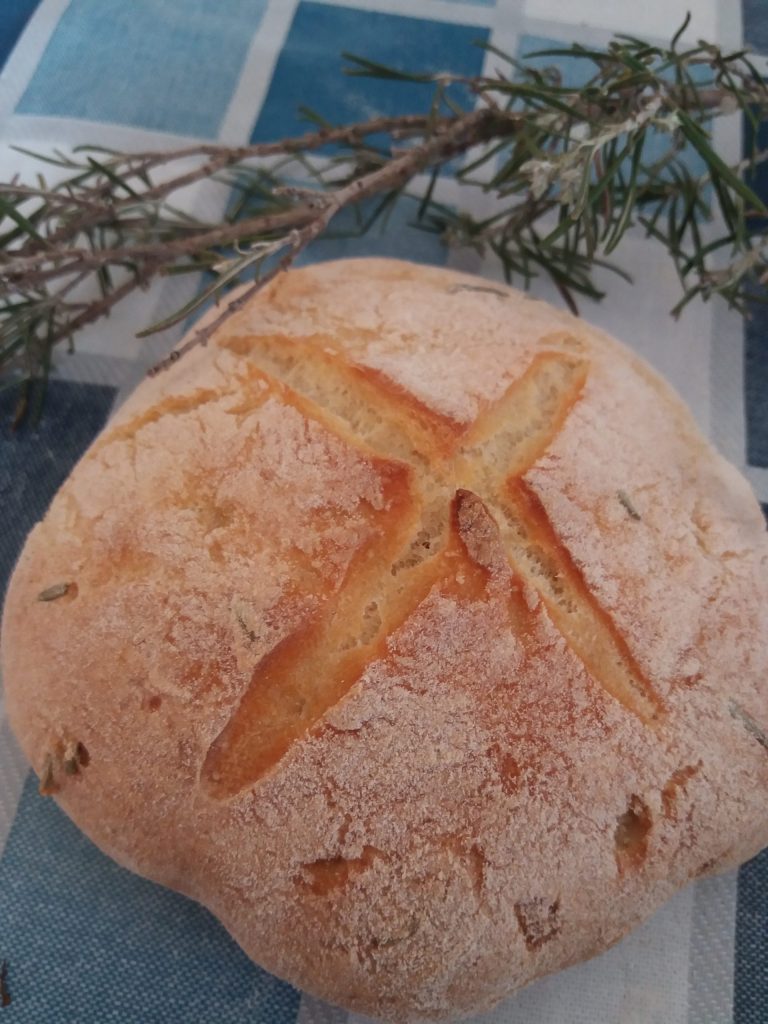
With a few small tweaks to the traditional recipe, the rosemary loaf was born: crunchy, fragrant, and flavorful. We enjoyed it warm, needing nothing else, and we literally devoured it!
- Difficulty: Easy
- Cost: Very cheap
- Rest time: 1 Hour 40 Minutes
- Preparation time: 20 Minutes
- Portions: 2
- Cooking methods: Oven
- Cuisine: Italian
- Seasonality: All seasons
- Energy 961.93 (Kcal)
- Carbohydrates 184.02 (g) of which sugars 4.02 (g)
- Proteins 36.57 (g)
- Fat 15.76 (g) of which saturated 2.55 (g)of which unsaturated 3.47 (g)
- Fibers 1.17 (g)
- Sodium 1,950.50 (mg)
Indicative values for a portion of 375 g processed in an automated way starting from the nutritional information available on the CREA* and FoodData Central** databases. It is not food and / or nutritional advice.
* CREATES Food and Nutrition Research Center: https://www.crea.gov.it/alimenti-e-nutrizione https://www.alimentinutrizione.it ** U.S. Department of Agriculture, Agricultural Research Service. FoodData Central, 2019. https://fdc.nal.usda.gov
Ingredients for the rosemary loaf
- 4 cups remilled durum wheat flour
- 1 cup water
- 0.35 oz fresh brewer's yeast
- 2 tbsps extra virgin olive oil
- 2 tsp honey
- 2 sprigs rosemary
- 2 tsp salt
Preparation of the rosemary loaf
To prepare our rosemary loaf, start by pouring the flour into a large bowl. Make a well in the center and add the crumbled yeast and honey. Begin pouring in half of the lukewarm water, a little at a time, and start kneading with one hand.
Next, add the salt and the rosemary leaves, previously removed from the sprigs. If necessary, chop them slightly to release even more aroma. Continue working the dough, always adding the remaining water little by little. Knead until you obtain a smooth and homogeneous ball.
At this point, add the extra virgin olive oil and continue kneading until fully absorbed.
Cover the bowl with a damp cloth and let rise for about an hour in a warm environment (around 77°F), or inside the turned off oven with the light on.
Once the time has passed, transfer the dough onto a lightly floured board. Divide it into two equal parts (about 9.5 oz each) and shape each portion into a round loaf.
Place the two loaves on a floured baking sheet, leaving at least 2 inches between them. Gently press them with your hands and make a cut on the surface: I chose a cross cut, which I find very beautiful on round shapes, but you can score them as you prefer.
Cover again with a cloth (this time dry) and let rise for another 30-40 minutes.
At this point, bake in a preheated static oven at 392°F for about 25 minutes, or until the loaves are well browned and crispy.
If you have the opportunity to use a wood-fired oven, like I do, bake at 482°F for about 20 minutes.