The prickly pears are a fruit from the South, not much used in northern Italy, but I find them delicious. Juicy, with soft and tasty pulp, they have nothing to envy to any exotic fruit coming from afar. At the greengrocer or supermarket, you can find them already available without thorns, making them very easy to use for your sweet and savory dishes.
If you are lucky enough to pick them directly from the cactus, use the appropriate metal tool, a plastic bottle cut in half, or sturdy work gloves to avoid pricking yourself while removing them from the branches. Rub them inside the sand, a sturdy cloth (disposable), or paper bags, always using gloves to remove the glochids, then place them in a basin with water, gently rotate them on the bottom with the help of a metal utensil and leave them to soak for at least 30 minutes, so the thin thorns on the skin will soften. Here is how to remove thorns from prickly pears under running water.
If, despite all precautions, you get thin thorns lodged in your skin, do NOT use tweezers as it could worsen the situation. Try applying a layer of Vinavil (or wide adhesive tape) on the skin area where you have thorns, let it dry, and when solidified, remove it; the thorns will come off with the glue layer.
Learn here how to grow prickly pears.
When are prickly pears harvested?
Depending on the variety, the SEASONALITY of prickly pears goes from July to December, a delicious autumn fruit.
You might be interested
- Difficulty: Easy
- Cost: Inexpensive
- Preparation time: 5 Minutes
- Portions: 4 crostini appetizer
- Cooking methods: No cooking
- Cuisine: Fusion
- Seasonality: Summer, Autumn
- Energy 38.71 (Kcal)
- Carbohydrates 3.16 (g) of which sugars 0.28 (g)
- Proteins 1.52 (g)
- Fat 2.31 (g) of which saturated 0.08 (g)of which unsaturated 0.45 (g)
- Fibers 0.59 (g)
- Sodium 9.00 (mg)
Indicative values for a portion of 22 g processed in an automated way starting from the nutritional information available on the CREA* and FoodData Central** databases. It is not food and / or nutritional advice.
* CREATES Food and Nutrition Research Center: https://www.crea.gov.it/alimenti-e-nutrizione https://www.alimentinutrizione.it ** U.S. Department of Agriculture, Agricultural Research Service. FoodData Central, 2019. https://fdc.nal.usda.gov
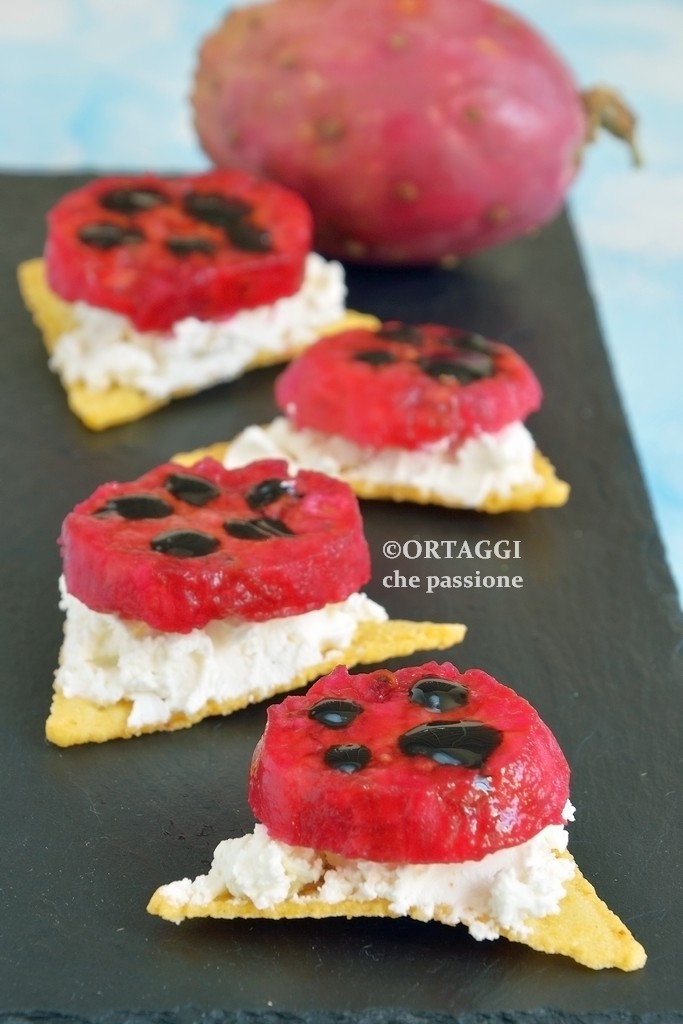
Prickly Pear Appetizer
for vegans use vegan spreadable cheese
- 1 prickly pear (or kiwi)
- 4 tortilla chips (or crostini)
- 2 tablespoons robiola (or other fresh spreadable cheese)
- 2 tablespoons balsamic vinegar (or vinegar glaze)
Prickly Pear Appetizer
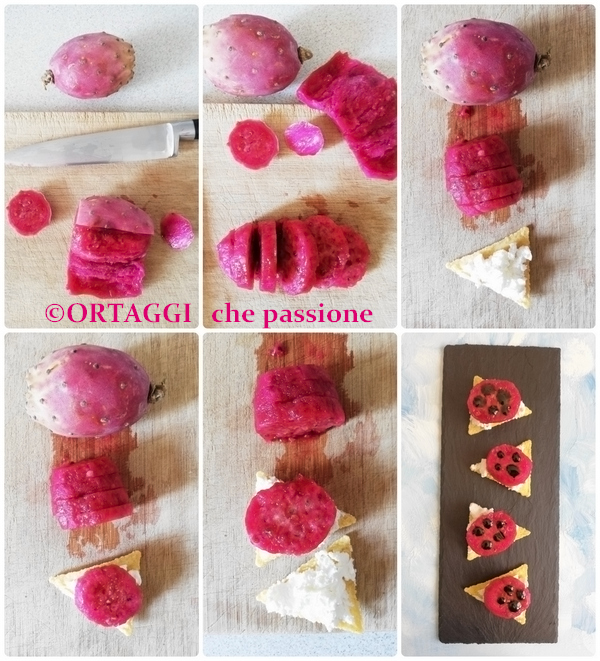
Peel the prickly pear and slice it.
On a chip (rustic or tortilla) spread the creamy cheese, place a slice of fruit on top, and some drops of balsamic vinegar glaze (or apple vinegar).
How to make balsamic vinegar glaze?
In a non-stick small pan place two tablespoons of vinegar and let it evaporate. Once the right consistency is reached, use immediately.
Can you eat the small seeds of prickly pears?
Certainly, you can swallow them safely; they are small and edible. The important thing is not to chew them as they are very hard.
How to eat prickly pears naturally?
Cut in half and enjoy the pulp with a spoon as you would with a kiwi.
Recommend storing them in the refrigerator and enjoying them fresh right after taking them out.
SAVORY recipes
SALAD: peeled and chopped prickly pears, thinly sliced onion and/or fennel, capers and/or olives, pistachio granules or other nuts, pomegranate seeds, lemon or orange juice, oil, and salt.
Prepare a risotto
Add pieces to the mixed salad
SWEET recipes
IN THE PAN: cook in the pan in slices with butter, sugar, cinnamon, and a little ginger, deglaze with grappa or brandy, serve with ice cream.
JUICE: blend peeled and chopped prickly pears; with an extractor, you can also use the skin.
JAM – marmalade
Gelatin, mustard, ice cream, or sorbet, liqueur, candies
Which prickly pears to choose?
Choose those with a beautiful vibrant color and that are beginning to slightly wrinkle.
VARIETIES
– sanguigna, with red-violet skin and ruby red pulp, is the sweetest
– sulfarina, the most common, with yellow-orange fruits and orange pulp
– muscaredda has green fruits with white pulp and a delicate flavor