Have you ever wondered how to clean and store fresh parsley when you have a large amount, whether given by a neighbor with a garden, grown at home in a pot, or bought more than needed, right? Well, today I will suggest how to clean it and store it fresh, dried, or frozen to have it available as if just picked since parsley is the most used aromatic herb in the kitchen. It goes well with chicken, fish, meat, and also on many pasta dishes or to garnish salads.
Let’s find out how to clean and store parsley right after the photo as always!!
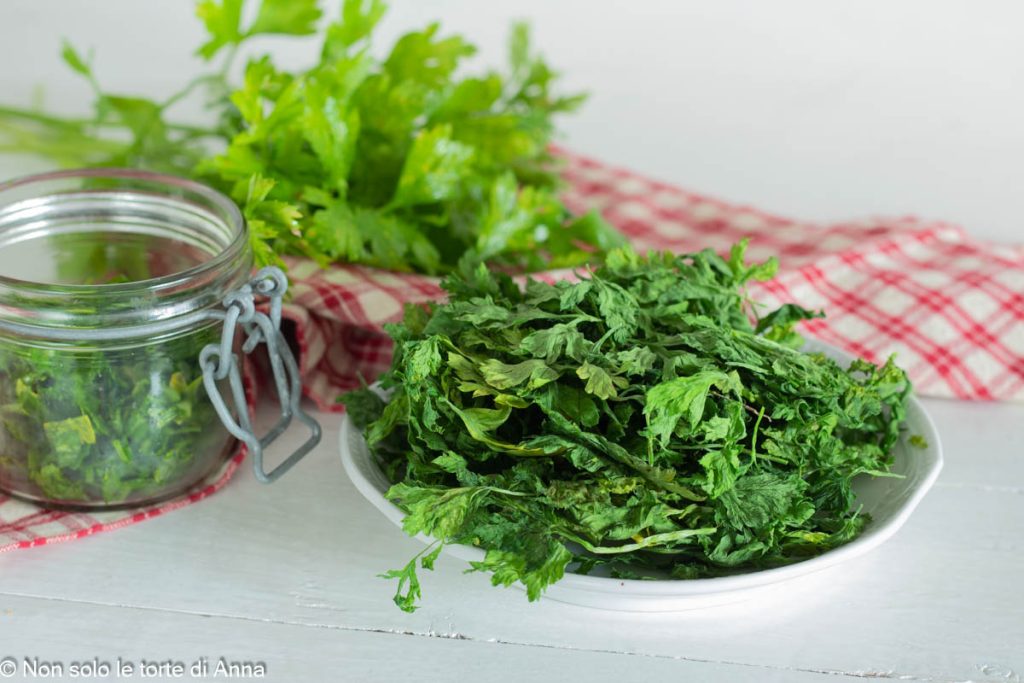
- Difficulty: Very easy
- Cost: Very cheap
- Preparation time: 10 Minutes
- Cooking methods: No cooking
- Cuisine: Italian
- Seasonality: Summer, Autumn
- Energy 36.00 (Kcal)
- Carbohydrates 6.33 (g) of which sugars 0.85 (g)
- Proteins 2.97 (g)
- Fat 0.79 (g) of which saturated 0.13 (g)of which unsaturated 0.42 (g)
- Fibers 3.30 (g)
- Sodium 192.80 (mg)
Indicative values for a portion of 100 g processed in an automated way starting from the nutritional information available on the CREA* and FoodData Central** databases. It is not food and / or nutritional advice.
* CREATES Food and Nutrition Research Center: https://www.crea.gov.it/alimenti-e-nutrizione https://www.alimentinutrizione.it ** U.S. Department of Agriculture, Agricultural Research Service. FoodData Central, 2019. https://fdc.nal.usda.gov
Ingredients How to Clean and Store Parsley
- 14 oz parsley
- 1 pinch baking soda
Tools
- Plastic bag
- Container (with airtight lid)
- Salad spinner
How to Clean and Store Parsley
Choose parsley with intact, bright green leaves and free of spots. Then remove the leaves with a small part of the stem, discarding the rest.
Wash the parsley very well in a bowl with cold water and a pinch of baking soda to remove soil and any bruised parts, rinse thoroughly.
Dry the parsley with a salad spinner, or you can lay it well spread on a clean tea towel, cover with paper towel, and let it sit for 30 minutes.
At this point, you can decide whether to chop the parsley or leave the leaves whole. If you want to dry it in the microwave, it’s better to leave the leaves whole; otherwise, you can chop it.
Parsley can be dried in the microwave by simply spreading the parsley leaves without overlapping them on a paper towel, covering with another sheet, and placing in the microwave.
Set the maximum power, in my case 750 w, and run the microwave in 30-second bursts, checking if it’s still moist; dry for another 30 seconds.
Place the dried parsley (which now breaks when you take it in your hands) in glass jars with airtight lids and store them in the pantry.
To freeze the parsley after washing and drying, you can chop it or leave the leaves whole, place the leaves on a tray and freeze for 1 hour then gather the frozen parsley in a freezer bag or in airtight containers and store in the refrigerator.
Another method I often use to freeze parsley is to fill ice cube trays halfway with chopped parsley, cover with extra virgin olive oil, and put in the freezer for 2 hours.
At this point, you can remove the parsley cubes and place them in a freezer bag. They will keep for 12 months.
You can air-dry parsley with the stems. After washing and drying, tie a small bunch of parsley with string, put it in a paper bag, and hang it in a dry place with good air circulation, either indoors or on the balcony. It’s important to check after a couple of days that no mold has formed among the leaves.
Dried parsley or any other dried herb is much stronger in flavor and aroma than the fresh herb, so use a smaller amount.
Frozen parsley can be used like fresh parsley by adding it at the beginning or end of cooking without needing to thaw, retaining its bright green color and flavor.
Parsley and oil cubes can be added to dishes while still frozen.
How to Clean and Store Parsley Other Ideas
If you are used to using parsley with chopped garlic cloves, you can add the chopped garlic before freezing the parsley either in freezer bags without oil or in ice cube trays.
Other Recipes
If you want to see other types of recipes, you can go back to HOME.