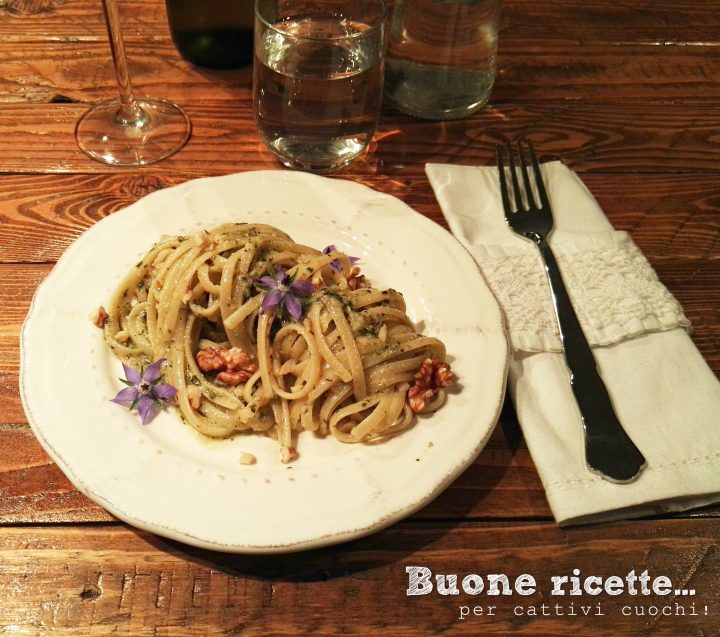
The borage pesto is an original and little-known recipe that takes advantage of the unique flavor of borage leaves to create a unique dish. The borage is accompanied by other ingredients to create a dense, creamy, and flavorful pesto that will not make you regret the classic Genoese pesto.
If you like original pesto recipes, don’t forget to read
- Difficulty: Easy
- Cost: Cheap
- Rest time: 2 Minutes
- Preparation time: 5 Minutes
- Portions: 2
- Cooking methods: Stovetop
- Cuisine: Italian
- Seasonality: Spring, Summer, and Fall
- Energy 331.89 (Kcal)
- Carbohydrates 30.04 (g) of which sugars 0.85 (g)
- Proteins 10.44 (g)
- Fat 19.26 (g) of which saturated 3.45 (g)of which unsaturated 1.43 (g)
- Fibers 1.99 (g)
- Sodium 696.85 (mg)
Indicative values for a portion of 5 g processed in an automated way starting from the nutritional information available on the CREA* and FoodData Central** databases. It is not food and / or nutritional advice.
* CREATES Food and Nutrition Research Center: https://www.crea.gov.it/alimenti-e-nutrizione https://www.alimentinutrizione.it ** U.S. Department of Agriculture, Agricultural Research Service. FoodData Central, 2019. https://fdc.nal.usda.gov
Ingredients for 2 people
- 6.35 oz pasta (long type like linguine, spaghettoni, bavette, etc)
- 5 leaves borage (fresh and fleshy)
- 5 walnuts
- 1 clove garlic
- 0.71 oz Parmigiano Reggiano DOP
- to taste extra virgin olive oil
- to taste salt
Tools
- 1 Pot
- 1 Food processor
- 1 Knife
- 1 Tongs kitchen
- 1 Colander
Procedure
The borage is a wild plant that can be easily cultivated at home, similar to stinging nettle. The leaves are fleshy with white fuzz, and the flowers are bright purple, excellent for decorating and flavoring dishes.
Borage should not be eaten raw but blanched in plenty of boiling water, it’s ready when it has softened, taking 3-4 minutes.
The borage cooking water is perfect for cooking pasta, releasing its fragrance and aroma during cooking. Don’t throw it away but use it for the pasta.
Prepare the pesto by putting the borage leaves, oil, salt, and walnut kernels in a blender or immersion blender. Blend at maximum speed for a few seconds to reduce to a thick, velvety cream.
Complete the pesto by adding the Parmigiano Reggiano, taste it and you’ll notice a fresh but much more aromatic pesto than traditional ones.
Now that the pesto is ready, cook the pasta in plenty of salted water.
When the pasta is cooked, drain it and mix with the borage pesto away from the heat, if necessary add a drizzle of oil.
Your pasta with borage pesto is ready!
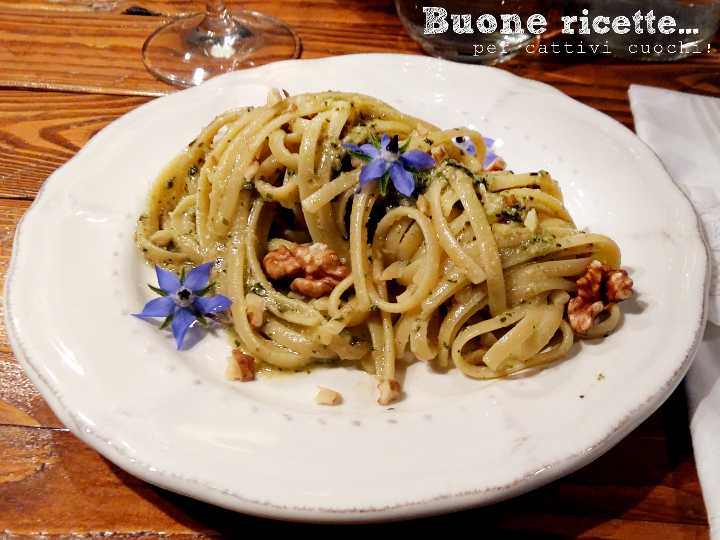
Plating tips:
Use borage flowers and walnut kernels to decorate the dish; they have a beautiful blue color and are almost salty edible, arrange the pasta in a nest and a few flowers to complete.
How to pair borage pesto:
I recommend a Ligurian white wine, preferably with a certain alcoholic structure and semi-aromaticity, to support the strong character of the dishes, such as a Vermentino Colli di Luni.