Here is the detailed recipe for Neapolitan pastiera with all the steps, tips, and secrets to prepare it perfectly.
Making the classic pastiera is a ritual, an art passed down from generation to generation. It is an iconic Easter dessert, a perfect blend of the creaminess of ricotta, the scent of orange blossoms, and the unique taste of cooked wheat.
Like all ancient and traditional desserts, making a pastiera requires patience and attention to detail, but the result will more than compensate for every effort.
Neapolitan pastiera is much more than just a dessert. Its origins are lost in the mists of time, intertwining history, legend, and popular devotion.
Some scholars trace the origins of pastiera to pagan rituals linked to spring and fertility. Wheat, a symbol of rebirth, and eggs, a symbol of new life, were sacred ingredients offered to the gods to ensure a good harvest.
It is hypothesized that an ancestor of pastiera was a sort of rustic cake made with wheat and ricotta, prepared during spring festivals as early as Roman times.
One of the most fascinating legends tells that pastiera was created by the siren Partenope, mythical founder of Naples.
The inhabitants of the gulf, enchanted by her sweet song, offered her seven precious gifts, symbols of their land: flour (wealth), ricotta (abundance), eggs (fertility), wheat cooked in milk (fusion between the animal and plant kingdoms), orange blossoms (scent of spring), spices (homage from all peoples) and sugar (sweetness of her song).
Partenope, grateful, immersed these gifts in the sea, and the waves, mixing them with the magic of their movement, gave birth to the first pastiera, a sweet as gentle as her song.
The most accredited and historically plausible version links the birth of pastiera (as we know it today) to the nuns of the San Gregorio Armeno convent, in the heart of Naples’ historic center.
This convent was renowned for the culinary skills of its nuns. It is said that, at Easter, the nuns wanted to create a dessert that would unite the symbols of the Resurrection (eggs, ricotta, wheat) with the scents of spring (orange blossoms from their garden).
The nuns perfected the ancient wheat and ricotta cake, enriching it with sugar, eggs, and aromas, creating a masterpiece of taste and scent. The result was a cake with a unique and unmistakable flavor, which soon became the symbolic dessert of Neapolitan Easter.
Over the centuries, the classic pastiera recipe has undergone small variations, but it has maintained its essence.
Every Neapolitan family jealously guards its own version, passed down from generation to generation.
The main differences are found in the ingredients’ quantities, the addition or not of candied fruits (citron and orange in particular), the flavoring of the ricotta (with vanilla, cinnamon, or lemon zest), and the filling’s consistency.
Some prefer a smoother ricotta cream, others a more granular consistency due to the presence of wheat.
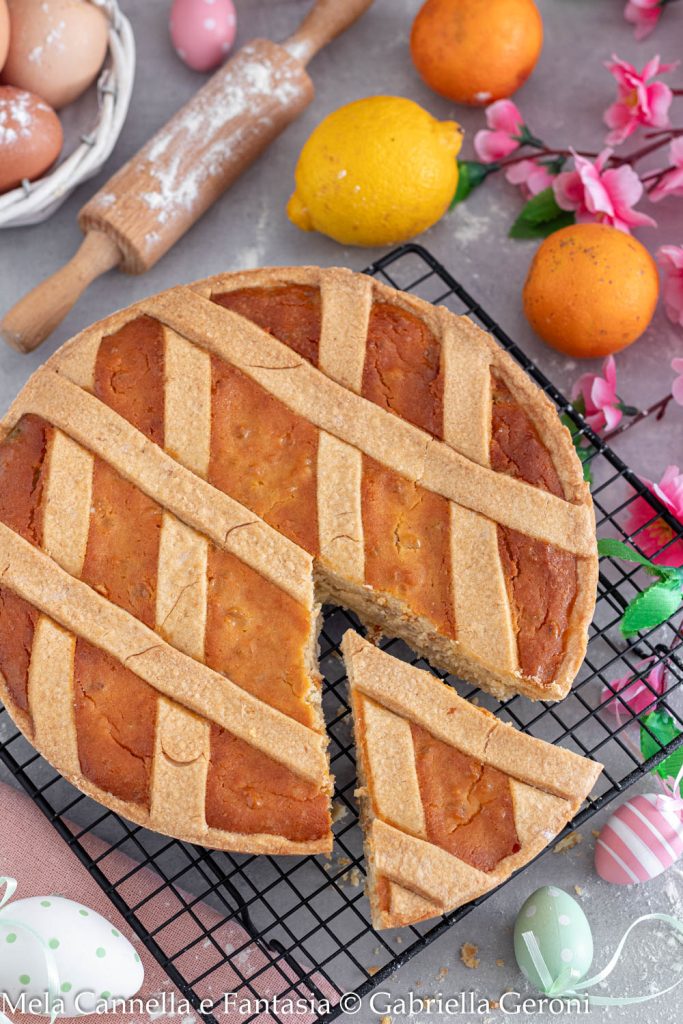
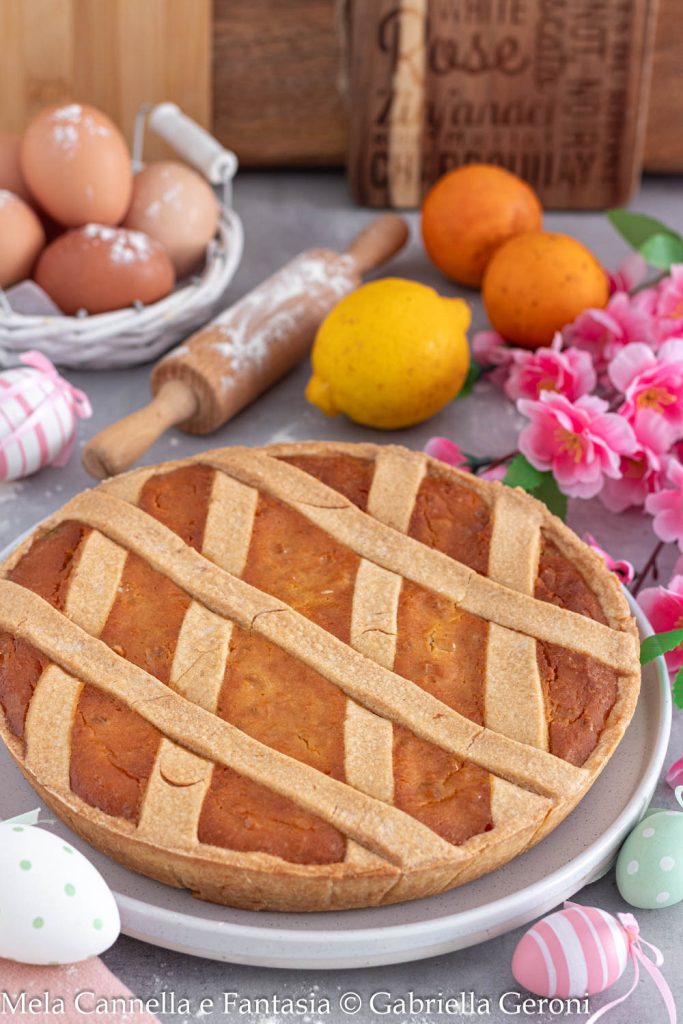
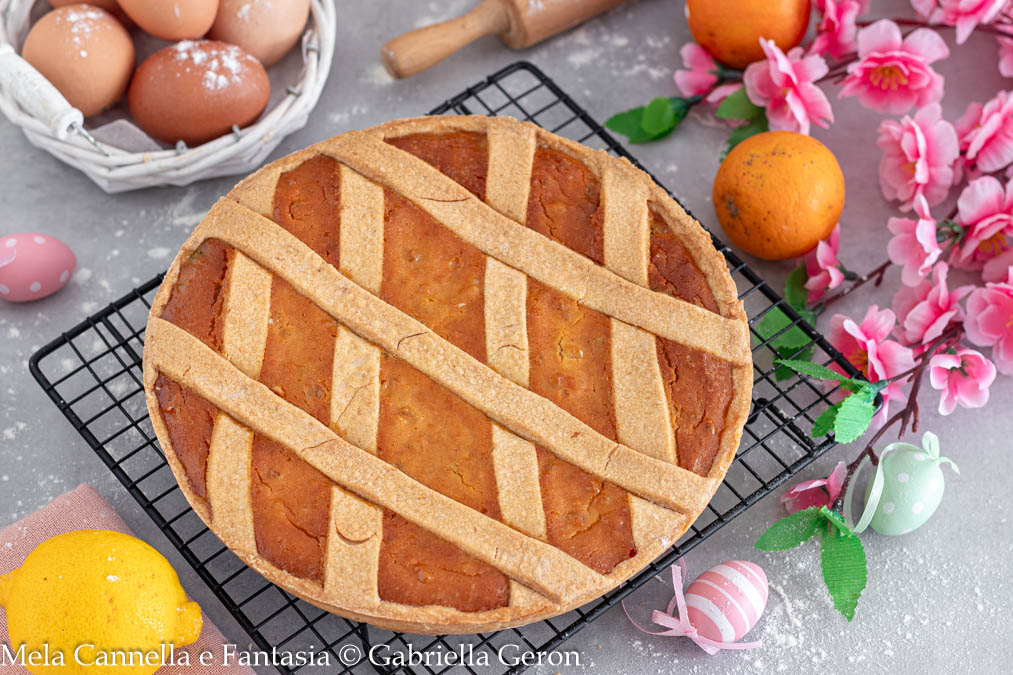
Another detail not to be underestimated when it comes to pastiera is that tradition requires seven strips of shortcrust pastry to be placed on the surface. This number is not random, but is imbued with symbolic and religious meanings.
• Holy Week: The number seven immediately recalls Holy Week, the culminating period of Christian liturgy leading up to Easter. The strips would therefore represent the days leading to Christ’s Resurrection.
• The Seven Sacraments: Some interpret the seven strips as a reference to the seven sacraments of the Catholic Church.
Besides the symbolic meaning, the strips also have a practical function: they help contain the filling during cooking and create an elegant and recognizable decorative pattern.
I believe, as often happens when I tell you about an ancient dish that represents a pillar of Italian gastronomy, that I have spoken too much!
We are just at the moment to roll up our sleeves, put on a nice apron (or zinale as my Abruzzese grandmother would say!) and go to the kitchen to prepare the original Neapolitan pastiera!
But first, I’ll leave you with some other Easter recipes that might interest you:
- Difficulty: Medium
- Cost: Expensive
- Rest time: 2 Days
- Preparation time: 2 Days
- Portions: two pastiere, one 9.5 inches and one 8.7 inches, or one 13-13.4 inches
- Cooking methods: Stove, Electric Oven
- Cuisine: Italian
- Seasonality: Spring, Easter
Ingredients
- 4 cups cups all-purpose flour
- 3 eggs (medium whole)
- 7 oz oz lard (or 7 oz butter or 3.5 oz lard + 3.5 oz butter)
- 1 cup cups sugar
- 1 pinch salt
- orange zest
- lemon zest
- 17.6 oz oz wheat for pastiera (already precooked)
- 1 cup cups milk (preferably whole)
- 1.8 oz oz butter
- orange zest
- lemon zest
- 17.6 oz oz sheep ricotta (or cow ricotta, DRY)
- 1.6 cups cups granulated sugar
- lemon zest
- orange zest
- 4 eggs (medium whole)
- 2 yolks
- 1.8 oz oz candied fruits
- orange blossom aroma (half ampoule + half ampoule orange blossom)
- cinnamon powder (only if you like)
Tools
- Saucepan
- Bowls
- Spatula
- Sieve
- Whisk
- Pan
- Workbench
- Rolling Pin
- Grater
- Pasta Cutter
- Food Wrap
- Parchment Paper
- Scale
- Wooden Spoon
Steps
As I mentioned above, there are hundreds of versions of this famous cake because every family has its own recommended doses, tips, and secrets of this ancient preparation.
Those who follow me know that I am Abruzzese, so I cannot say that pastiera belongs to my cultural gastronomic heritage.
However, I love this dessert, which I prepare thanks to the recipe that a dear Neapolitan pastry chef friend gave me and that I now share with you.
Let’s start by saying that the true shortcrust pastry for pastiera is made using sugna, or pork lard. Some use half sugna and half butter, while others prefer to use only butter; at the end of the article, I’ll explain the difference.
Today, respecting the original recipe, we will use only lard, but you can choose the solution you prefer.
In a bowl, place the sugar, the zest of an orange and a lemon, organic, well-washed, and dry.
Rub the sugar and citrus zest with your hands to release all the aromas.
At this point, add the lard, not cold from the fridge (or the butter or half lard and half butter), and mix quickly until you obtain a cream.
Pour in the slightly beaten eggs with a fork and mix.
Incorporate the flour (remember no yeast) and a pinch of salt and mix until you get a very soft dough. Cover with plastic wrap and let rest in the fridge for about 12 hours.
For practicality, I suggest dividing the dough into two parts, a larger one (about 2/3) will be used to line the pan, and the other (1/3) to make the 7 strips.
Take two food bags, insert the dough inside and flatten it with your hands until you get a fairly thin sheet.
This method will allow, once removed from the fridge, to work the shortcrust pastry more easily.
Let’s start with the cooked wheat for pastiera: take a saucepan and put the cooked wheat inside.
Pour in the milk, add a pinch of salt, the butter, orange zest, and lemon zest, and bring to a boil.
As soon as the mixture starts to simmer, count 15 minutes of cooking over low heat, stirring occasionally to prevent it from sticking to the bottom.
The milk should be almost completely absorbed by the wheat, which will be beautifully creamy. Add the orange blossom aroma ampoule and stir. Let cool completely.
Now let’s move on to the preparation of the ricotta:
Drain the ricotta: place the ricotta in a fine-mesh sieve and let it drain in the refrigerator for at least a couple of hours, or ideally for the entire night.
Then sift it until you obtain a cream. Too wet ricotta would compromise the filling’s consistency.
Work the ricotta with the sugar: place it in a large bowl and work it with the granulated sugar using a whisk (manual or electric) until you obtain a smooth and homogeneous cream. Make sure the sugar is completely dissolved.
Add the eggs and yolks: Add the whole eggs and yolks to the ricotta and sugar cream, mixing well.
Flavor the filling: Add the grated orange and lemon zest, the orange blossom water (or other orange blossom aroma), and, if desired, a pinch of cinnamon. Mix gently to combine all the aromas.
Add the cooled wheat: Add the cooked and cooled wheat to the ricotta and eggs mixture. Mix gently with a spatula to distribute it evenly.
If you prefer a less lumpy texture, blend the wheat with an immersion blender to make it smoother.
Cover everything with plastic wrap and let it rest in the fridge overnight.
Roll out the shortcrust pastry: Take the larger dough out of the fridge for lining the cake pan and leave the other for the strips in the fridge so it doesn’t warm up.
Line the cake pan: Roll out the pastry on a lightly floured surface until you get a thickness of about 1/8 inch.
Roll the dough onto the rolling pin and gently unroll it onto the previously greased and floured cake pan (or lined with parchment paper).
With these doses, you can get two pastiere using a 8.7-inch pan and a 9.5-inch one. Or if you prefer a larger one of 13-13.4 inches. I recommend strictly using the pan, a typical mold for Neapolitan pastiera.
Make sure the dough adheres well to the bottom and sides, ensuring the latter are at least 1.2-1.6 inches high. Trim the excess dough with a knife.
Pour the filling: Gently pour the filling into the shortcrust pastry base, distributing it evenly.
Prepare the strips: Roll out the remaining shortcrust pastry and cut strips about 0.6-0.8 inches wide with a fluted wheel or a knife.
Decorate the pastiera: Arrange the strips on the surface of the filling, crisscrossing them to form a lattice of lozenges. Make sure the ends of the strips adhere well to the edges of the shortcrust pastry.
Bake in the oven: Preheat the static oven to 320°F for at least 20 minutes. Bake the pastiera on the lowest rack and cook for an hour and a half. After the time has elapsed, move the cake pan to the middle rack and bake at the same temperature for another 30 minutes.
The pastiera will be ready when the surface is golden and the filling has set. If the surface darkens too quickly, you can cover the cake pan with a sheet of aluminum foil.
Cooling: Once cooked, remove the pastiera from the oven and let it cool completely at room temperature.
This is a crucial step to allow the filling to settle and the flavors to blend.
Not surprisingly, the pastiera should be prepared 2 days before being served and stored in the refrigerator.
Feel free to decorate it with powdered sugar and finally cut and enjoy a slice of this poetry!
I hope this detailed explanation helps you prepare Neapolitan pastiera too!
If you like, let me know in the comments if you’ll try it or if you prepare it differently!
Come back soon to see the upcoming recipes! Until next time
Article protected by copyright © – Gabriella Geroni © All rights reserved
Storage of Pastiera
The pastiera is a dessert that lends itself well to storage, maintaining its fragrance and flavor for several days if stored correctly:
Room Temperature: The cooked pastiera can be stored at room temperature (in a cool, dry place, away from heat and humidity) for 3-4 days. It is advisable to cover it with a glass dome or wrap it gently with plastic wrap to prevent it from drying out or absorbing odors.
Refrigerator: for longer storage, the cooked pastiera can be kept in the refrigerator for about a week. Again, it is important to protect it with plastic wrap or place it in an airtight container. Before serving, it is advisable to let it sit at room temperature for at least half an hour to restore its optimal consistency and release its aromas.
Freezing Pastiera
Yes, the pastiera can be frozen, either raw or cooked, and here are all the details below. However, here are some precautions to follow:
Seal well: air is the enemy of freezing, so make sure the pastiera is well sealed to prevent freezer burn and loss of flavor.
Label: always indicate the date of freezing to keep track of storage times.
Slow defrosting: it must be gradual and done in the refrigerator, to best preserve the consistency and flavor of the pastiera. Avoid defrosting at room temperature too quickly or in the microwave, as this could alter its texture.
Secrets and Tips for the Filling:
Sheep ricotta: Traditionally, sheep ricotta is used, which gives a more intense and characteristic flavor. If you can’t find it, you can also use high-quality cow ricotta, but make sure it is dry.
Drain the ricotta: This step is essential to avoid a liquid filling. Cooking the wheat: Cooking the wheat with milk makes it softer and creamier.
Quality aromas: Use high-quality aromas for an intense and authentic scent.
FAQ (Questions and Answers)
Can I freeze the pastiera?
Yes, the pastiera can be frozen, either raw or cooked, with some precautions.
• Freezing Raw: prepare the shortcrust pastry base in the mold and pour in the cooled filling. Arrange the seven strips of shortcrust pastry on the surface and cool completely for at least a couple of hours, in the fridge if it’s too hot at home. Then wrap the mold carefully with multiple layers of plastic wrap and then with a sheet of aluminum.
Freeze the pastiera for up to 2-3 months. To defrost the raw pastiera, transfer it from the freezer to the fridge and let it defrost slowly for at least 12-24 hours. Once defrosted, bake the pastiera following the traditional recipe.
• Freezing Cooked: let the cooked pastiera cool completely at room temperature for several hours. Choose whether to freeze it whole or portion it (for example, cut it in half or directly into slices). Wrap the entire pastiera or individual slices carefully with multiple layers of plastic wrap and then with a sheet of aluminum or store them in airtight containers suitable for freezing. The cooked pastiera keeps in the freezer for up to 1-2 months.
To defrost the cooked pastiera, transfer it from the freezer to the refrigerator and let it defrost slowly for several hours. Alternatively, you can defrost individual slices at room temperature for about an hour.
If you wish to serve it warm, you can slightly reheat the defrosted pastiera in the oven at a low temperature (about 300°F) for a few minutes.How is the wheat cooked for the pastiera?
The wheat for the pastiera, generally sold already precooked in a jar, requires further preparation to make it creamy and fragrant. From the time it starts boiling, cook for about 15 minutes, or until the milk is almost completely absorbed and the wheat has a creamy consistency. Then, it is essential to cool it completely before adding it to the ricotta filling.
If I wanted to use raw wheat, how do I do it?
The original recipe requires the use of raw wheat. Today it is hard to find, which is why precooked wheat in a jar is used, which significantly shortens preparation times.
If you want to use raw wheat, the dose is half compared to cooked wheat. First, soak it in a bowl for 3 days. Change the water at least twice a day. After the indicated time, the wheat should be drained, rinsed, and cooked in water for about 1.5 hours without stirring. Once cooked, drain it, and the wheat will be ready to be used as described above.What ricotta to use for the pastiera?
Neapolitan tradition requires the use of sheep ricotta. This ricotta has a more intense flavor and a drier consistency, ideal for the pastiera filling. However, if you can’t find it, you can use a high-quality cow ricotta, provided it is well-drained to remove excess whey. Avoid overly watery or industrial ricottas, which could compromise the consistency of the dessert.
How to drain the ricotta for the pastiera?
An excessive amount of moisture in the ricotta can make the pastiera filling too liquid. Here’s how to drain it effectively:
Sieve method: the simplest method is to place the ricotta in a fine-mesh sieve, lined with a clean cotton cloth or sterile gauze. Place the sieve over a bowl to collect the whey. Let the ricotta drain in the refrigerator for at least a couple of hours, better yet for the entire night. Then sift it until it becomes a cream.
Pressure: if you’re short on time, you can wrap the ricotta in the cloth and gently squeeze it over the sieve to promote whey removal. Be careful not to squeeze it too much, as it could become too dry.How to substitute lard in the pastiera crust?
The oldest and “orthodox” recipe for the shortcrust pastry for Neapolitan pastiera uses lard instead of butter. Lard gives the pastry a unique flakiness and a slightly different, more rustic and intense flavor.
However, over time, many modern and family variants use butter, or even a mix of butter and lard. Butter gives the pastry a more delicate flavor and a slightly different, but still pleasant, texture.
If you want to follow the most authentic and traditional recipe, lard is the ingredient to use.
Pastry made with lard tends to be flakier than pastry made with just butter.
Also, lard has a more pronounced flavor than butter, which is slightly reflected in the final taste of the pastry.
The only drawback is that lard may be less available than butter in some areas. In this case, you can use butter.How long to bake Neapolitan pastiera?
Baking times are important for the success of this Neapolitan dessert and vary depending on the oven and the size of the cake pan. Generally, it takes between an hour and a half to two hours.
At what temperature to bake the pastiera?
The oven temperature is another key element. The pastiera should be baked in a static oven preheated to a temperature of 320°F. Slow cooking at a not too high temperature allows the filling to cook evenly without swelling excessively and then deflating abruptly, avoiding cracks. If after the time indicated by the recipe you find that the filling is still soft, lower the temperature to 280/300°F and continue cooking until the filling, when touched with your fingers, is firm.
How to make pastiera without cooked wheat?
Cooked wheat is a traditional and distinctive ingredient of Neapolitan pastiera, giving the dessert a particular texture. However, if you can’t find it or want to try a variant, you can replace it with:
Rice: Boil about 200 g of arborio rice with milk and butter for about 30 minutes, until the milk is almost completely absorbed and the rice has become creamy. Cool completely before adding it to the ricotta and ingredients as described above.
Pearl barley: Similar to rice, you can use precooked pearl barley, cooking it with milk and aromas.
Obviously, pastiera made without cooked wheat will not be the traditional version and will have a different flavor and texture.Why does the pastiera swell and then deflate?
A common phenomenon during baking that causes concern. The pastiera swells in the oven because the filling contains water that turns into steam during cooking.
When the steam expands, it lifts the surface of the pastiera, causing it to swell. This swelling reduces when the pastiera cools, but in this case, unsightly cracks can form. Some use a sheet of parchment paper under the pastiera to prevent direct contact with the bottom of the oven, while others put the pastiera in the fridge for an hour before baking. However, to reduce this phenomenon and prevent the crust from breaking, the trick is to do a slow bake at low temperatures.How to flavor the Neapolitan pastiera?
Flavoring is a key element of pastiera. Traditional aromas include:
Orange blossom: Orange blossom aroma is indispensable and can be added via ampoules, orange blossom water, or essence.
Lemon and orange zest: obviously untreated, they add freshness and fragrance.
Cinnamon: A pinch of cinnamon is optional but adds a warm and spicy note.
Vanilla: Some recipes include the addition of vanilla extract.
It’s important not to overdo the aromas to avoid overpowering the delicate flavor of the ricotta and wheat.The base of the pastiera is raw, what can I do?
If once you’ve completely cooled the pastiera and removed it from the mold you notice that the crust underneath is undercooked, to avoid throwing everything away, you can try this.
Put it back in the mold, wrap it completely with foil to prevent it from darkening excessively on the surface, and put it back in the oven, on the lowest rack.
Bake for at least 15 minutes at 300°F static oven, and check until you reach optimal cooking.What if the pastiera filling is too liquid?
This is a problem that can happen.
If the pastiera filling is too liquid before baking, you can try to:
Add a level tablespoon of cornstarch or sifted flour to help absorb the excess liquids. Mix well to avoid lumps.
Cook the filling slightly: If the wheat has not been cooked long enough with the milk, you can cook the filling over low heat for a few minutes, stirring continuously, to slightly thicken the liquids. Let cool completely before pouring it into the shortcrust pastry base.
However, it’s important not to alter the original recipe too much, so add thickeners with moderation.Why does the pastiera turn out too moist once baked?
A pastiera that’s too moist after baking can be due to several factors:
Ricotta not sufficiently drained: If the ricotta contained too much whey, this will release during baking, making the filling moist.
Wheat too moist: If the wheat has not been cooked enough with the milk or has not dried well after cooking, it can release moisture into the filling.
Insufficient baking: If the pastiera has not been baked for the necessary time, the filling may not have set completely and remain moist.
Insufficient cooling: It’s essential to cool the pastiera completely at room temperature and then in the refrigerator. During cooling, the filling settles, and excess moisture can slightly evaporate. Cutting the pastiera while still warm can make it seem moister.Can I add more or fewer strips of pastry?
There is no “technical” reason why there must be seven strips of pastry and not more or fewer. It is a custom rooted in Neapolitan Easter tradition and symbolism. Therefore, since making seven costs absolutely nothing but makes the pastiera perfect as tradition wants, make sure to put seven 😉