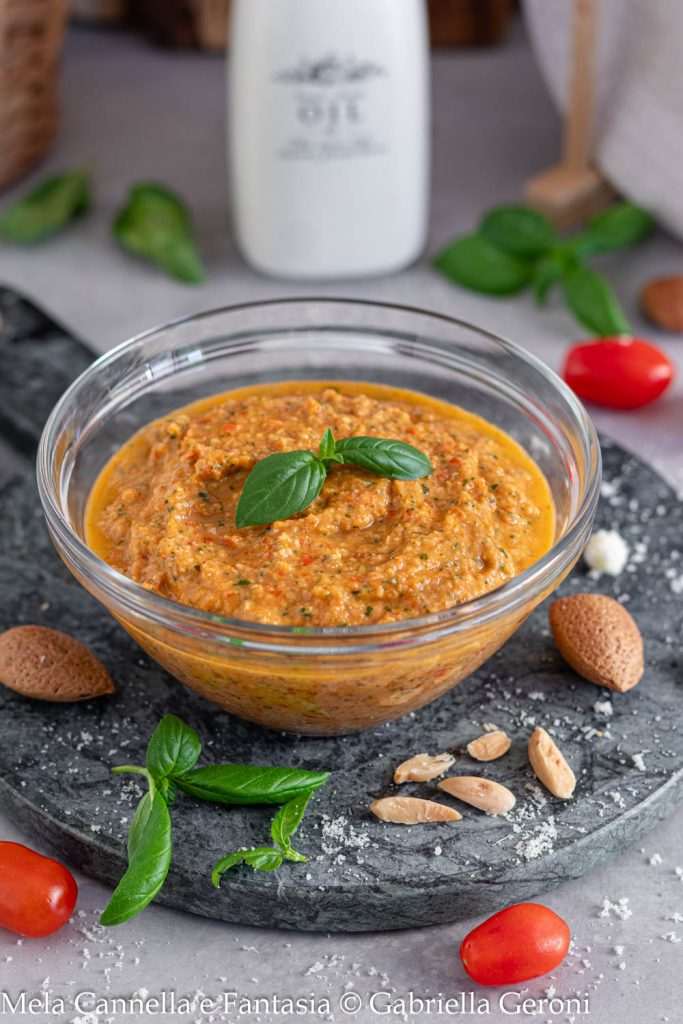
Today, let’s prepare Trapanese Pesto with cherry tomatoes, almonds, and pecorino together. It is a fresh condiment, fragrant, typical of the Sicilian tradition, reminiscent of summer, the south, and ancient influences.
The Sicilian pesto, or better known as Trapanese pesto, is much more than just a Mediterranean variant of the more famous Genoese pesto.
It’s an explosion of simple and genuine flavors that tells a story of travels, exchanges, and cultural influences.
But how do you make Sicilian pesto?
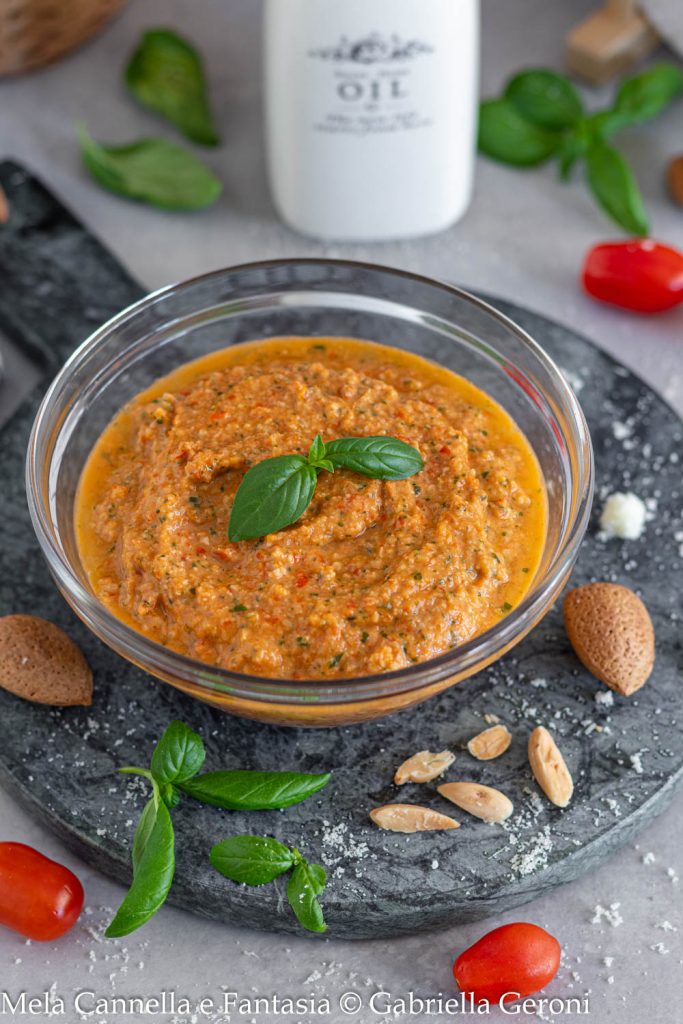
Sicilian pesto is a sauce made with cherry tomatoes, almonds, basil, pecorino, and extra virgin olive oil. It is easily prepared by pounding or blending the raw ingredients and is perfect for dressing pasta, especially busiate, or as an accompaniment to summer appetizers.
This recipe originates from the area of Trapani, a seaport and crossroads for merchants and sailors. It seems that Genoese sailors, docking at the Sicilian port during their trade routes, brought with them the idea of classic Ligurian pesto.
The Trapanese, with the creativity that distinguishes Sicilian cuisine, reinterpreted the Genoese recipe with local products.
Almonds instead of pine nuts, adding ripe cherry tomatoes instead of pure basil, and aged pecorino with a bold flavor.
Thus, a red pesto was born, fragrant, intense but also delicate, perfect for summer, light, no-cook dishes.
The beauty of Sicilian pesto is that it is prepared in just a few minutes, without turning on the stove, with seasonal and raw ingredients.
Like other regional variants – such as zucchini pesto, asparagus pesto with almonds, or arugula pesto – Trapanese pesto also tells a territory, a season, and a way of experiencing the table made of simplicity and conviviality.
Over time, many variants have emerged: some use salted ricotta instead of pecorino, others add a clove of garlic, some blend everything finely, while others prefer a more rustic, mortar-pounded texture.
It is the ideal sauce for a quick first course or as a base for crostini and bruschetta. Perfect to serve at a summer buffet, perhaps along with other pasta or rice salads, fresh and colorful salads, or for a delicious aperitif.
If you’re looking for ideas for a complete summer menu, check out my 15 summer appetizers or the collection of summer first courses. You’ll find plenty of fresh, quick proposals perfect for accompanying this Sicilian pesto.
As always, I talk too much! Those who follow me know that I love to tell the story behind a dish… sharing its history and the emotions it conveys.
Finally, let’s see how to make Sicilian pesto! Be sure to read until the end; you’ll find lots of useful tips for executing this recipe and a small gift for you 🩷🥰
Before that, here are some more delightful recipes to try! 🥣👩🍳👇
- Cost: Medium
- Preparation time: 10 Minutes
- Portions: 4 people
- Cooking methods: No cooking
- Cuisine: Italian
- Seasonality: All seasons, Spring, Summer
Ingredients
- 10.5 oz cherry tomatoes (or ripe datterini)
- 1.75 oz blanched almonds
- 1.75 oz pecorino (aged)
- 1 bunch basil (about 20 large leaves)
- 1 clove garlic (the traditional recipe calls for one clove of garlic per person, but if you don't like it, you can use less!)
- extra virgin olive oil
- salt
Tools
- Blender
- Cutting Board
- Knife
- Grater
- Bowl
If you’d like to have a nice mortar for making pesto by hand, here are some models of different sizes:
Granite Pestle and Mortar Set Ø 16 cm
Granite Mortar and Pestle, HxD 9×20 cm, Light Gray, 9 x 20 x 20 cm
Large Granite Mortar and Pestle – Wooden Surface Protection – 400ml Capacity
Gourmeo Mortar and Pestle Set, 18 cm, Snow White Marble
A small piece of advice that I didn’t follow when I bought mine! Don’t get one that’s too small, or else you’ll take forever to make a sufficient quantity of pesto!
Steps
💬 Share your version!
🍅 Have you ever made Sicilian pesto? 👩🍳🥣
✨ Let me know in the comments how you make it or if you have a family variant: I love discovering new twists on traditional recipes!🥰
If you want to make Sicilian pesto as tradition dictates, you will need to arm yourself with a mortar, pestle, and elbow grease!
I confess in all honesty that I even tried to make it the traditional way! But when I realized my arm was completely asleep, I grabbed my trusty blender and in no time, the pesto was ready!
So, I hope my Sicilian friends won’t be offended, my intentions were good!
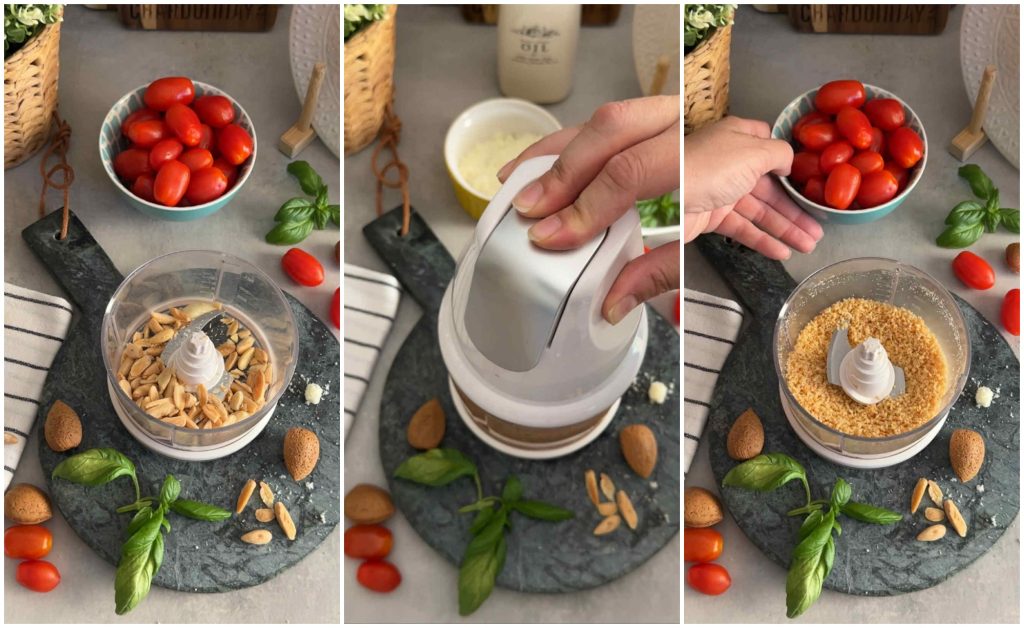
Place a clove of garlic (per head if you want it to be traditional!), a pinch of salt, and the blanched almonds into the appropriate container (blender or mortar). Blend for a few seconds (or pound).
Wash the cherry tomatoes and cut them in half. If you prefer a more digestible pesto, remove the seeds.
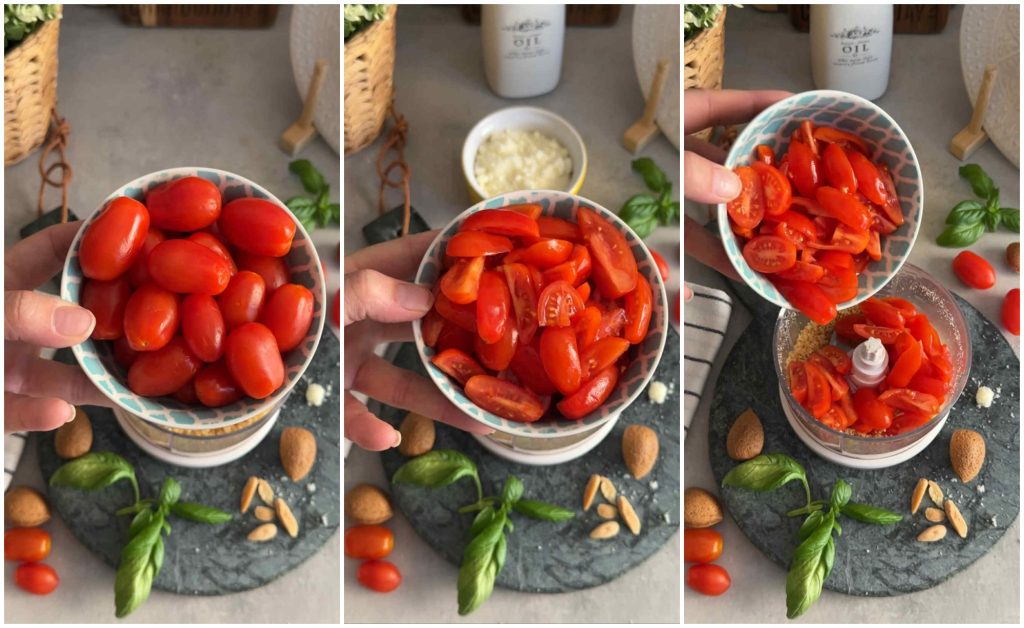
Place the cherry tomatoes in the blender or mortar (if it’s large, put them all in at once; otherwise, you’ll have to do it a bit at a time) and blend.
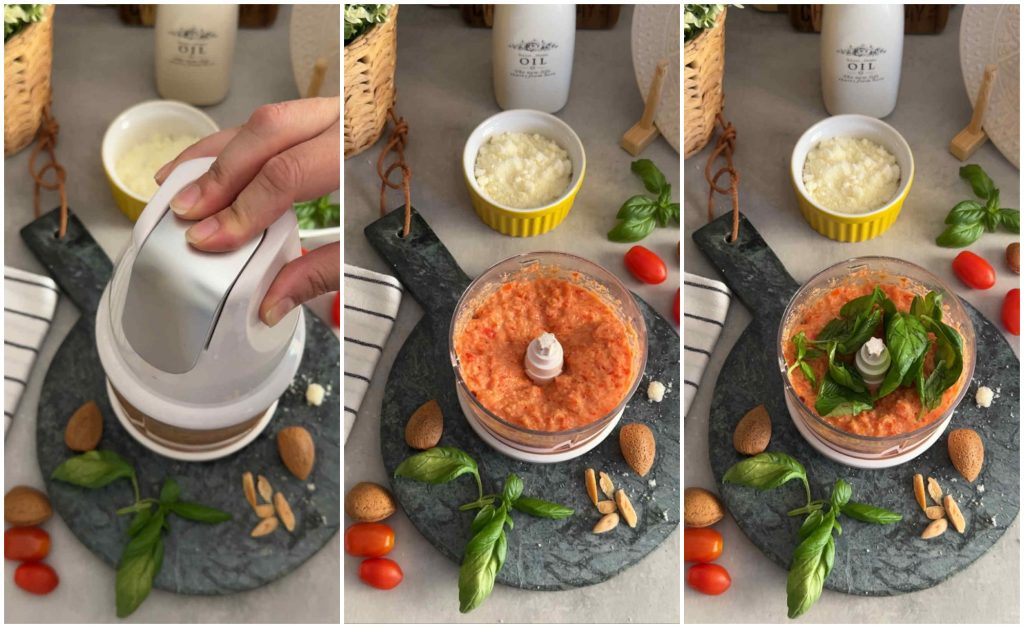
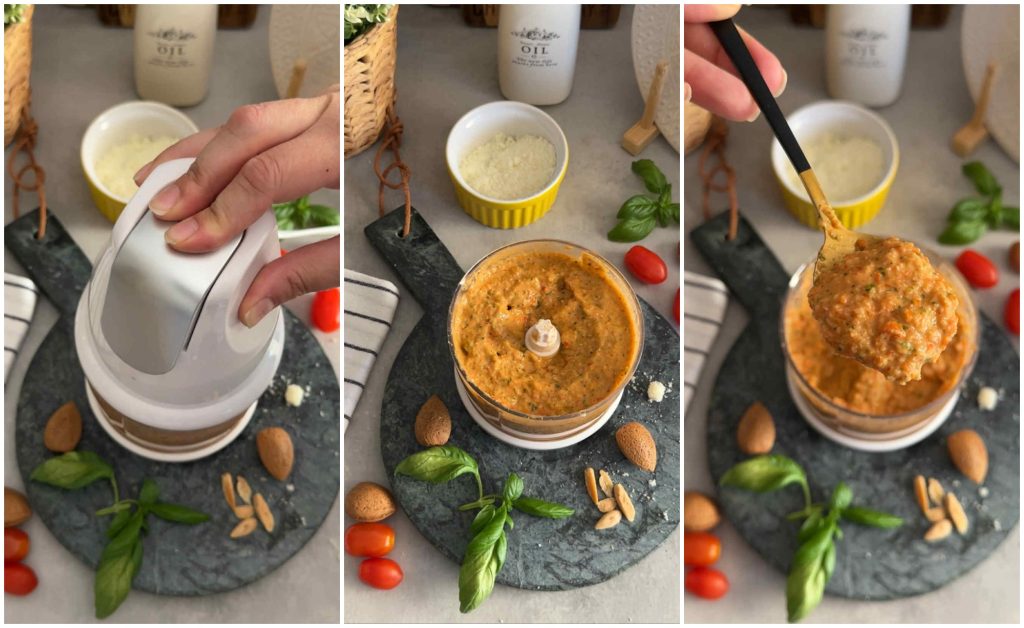
At this point, add the basil and EVO oil and blend again. Finally, add the grated pecorino and pulse the blender for a few seconds.
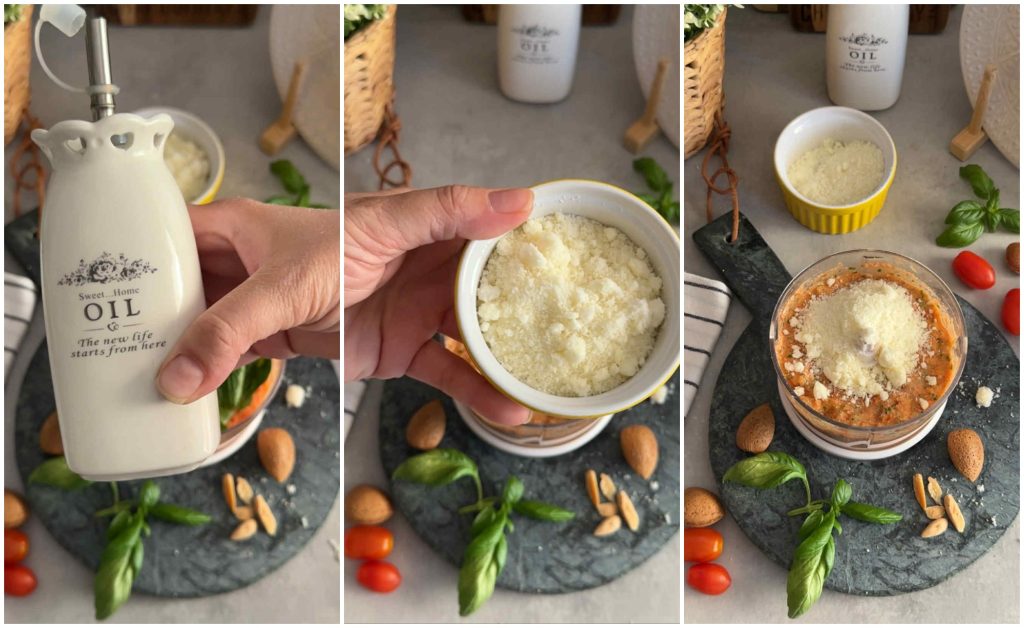
Taste the sauce and adjust the salt or add more oil if necessary.
Sicilian pesto is immediately ready to dress a nice plate of al dente pasta, but it can also be stored in the fridge for 2-3 days, covered with a layer of oil.
💌 If you liked this recipe, share it with those who love to cook or save it for your next summer lunch ☀️
Every share is a small but great help to grow this blog! 💛
Article protected by copyright © – Gabriella Geroni © All Rights Reserved
FAQ (Questions and Answers)
What is the difference between Sicilian pesto and Genoese pesto?
Sicilian pesto (or Trapanese) differs from Genoese pesto mainly in its ingredients. While the Ligurian version is made with basil, pine nuts, garlic, parmesan, and extra virgin olive oil, the Sicilian version replaces pine nuts with almonds and adds fresh cherry tomatoes and often pecorino. The result is a sweeter, aromatic, and red-colored pesto.
Can Sicilian pesto be stored? For how long?
Yes, it can be stored in the refrigerator for 2–3 days in a glass jar, covered with a thin layer of oil on the surface. It can also be frozen in small portions, for example, in ice cube trays, for up to 1–2 months.
Can I make Sicilian pesto with sun-dried tomatoes?
Yes! Sun-dried tomatoes give the pesto a more intense flavor and a denser consistency. It’s a perfect variant if you want a bold taste or a condiment that keeps longer.
Which almonds should be used for Sicilian pesto? Blanched or with skin?
It’s better to use blanched almonds because they are more delicate and don’t alter the color of the pesto. If you want a more intense flavor, you can lightly toast them before blending.
Which pasta pairs well with Sicilian pesto?
Traditionally, this condiment perfectly pairs with busiate trapanesi, a fresh pasta typical of the area, but it also goes well with spaghetti, fusilli, trofie, or linguine.
A tip? Don’t drain the pasta too much: save a ladleful of pasta cooking water to mix well with the pesto and achieve a creamy and fragrant result.Should Trapanese pesto be cooked or used raw?
It should be used raw. It is not cooked because it is a fresh pesto: just add it to the hot pasta right after draining, with some cooking water to mix well.
Which pecorino should be used for Sicilian pesto?
🧀 Sicilian Pecorino DOP
The most traditional cheese historically used in the Trapanese recipe. It has an intense, savory, and slightly spicy taste. Perfect if you want a pesto with a strong character and authentically Sicilian.
🧀 Pecorino Romano DOP
Easier to find, even in supermarkets. It has a pronounced salinity, so it should be dosed carefully. Excellent if you want a strong and appetizing flavor.
🧀 Aged Tuscan Pecorino
It has a more delicate and round taste compared to the others. Ideal if you prefer a less salty pesto or want to pair it with salted ricotta.Can Sicilian pesto be made without garlic?
Garlic is an ingredient foreseen by the traditional recipe. However, if you can’t eat it, you can omit it or use just a small piece for a more delicate note.
Is Sicilian pesto vegetarian?
The red Trapanese pesto can be consumed by vegetarians if prepared with pecorino or ricotta that do not contain animal rennet (you’ll have to check the label to verify).
Or you can use a vegetarian cheese to adapt the recipe to your dietary needs.Can I use ricotta instead of pecorino in Trapanese pesto?
Absolutely yes! It is a very common variant. You can use fresh ricotta for a creamier and more delicate version, or salted ricotta if you want to maintain a more robust but less pungent taste than pecorino.
Is red pesto suitable for lactose intolerants?
Traditionally, Sicilian pesto contains pecorino or salted ricotta, both cheeses that may contain lactose. However, many aged cheeses are naturally lactose-free. With a careful choice of ingredients, you can prepare a 100% lactose-free Sicilian pesto without sacrificing taste!
What cheeses to use?
Aged pecorino for 8 months or more
Parmigiano Reggiano aged 24/30 months
Grana Padano aged 12+ months
👉 All three are naturally lactose-free, thanks to the long aging process that almost completely eliminates milk sugars.
How to be sure?
Check the label for the wording “Naturally lactose-free”
Or: “<0.01g of lactose per 100g”
Many producers today indicate this, especially in DOP consortia (e.g., Grana Padano, Parmigiano Reggiano, Pecorino Romano).
Do you want a 100% plant-based version?
You can replace the cheese with nutritional yeast flakes or use a vegan grated cheese.Is Sicilian pesto gluten-free?
Trapanese pesto is naturally gluten-free, as all the ingredients (cherry tomatoes, almonds, basil, extra virgin olive oil, garlic, pecorino) are naturally gluten-free.
However, attention should be paid to the pasta with which it is paired: for a 100% gluten-free dish, use certified gluten-free pasta.