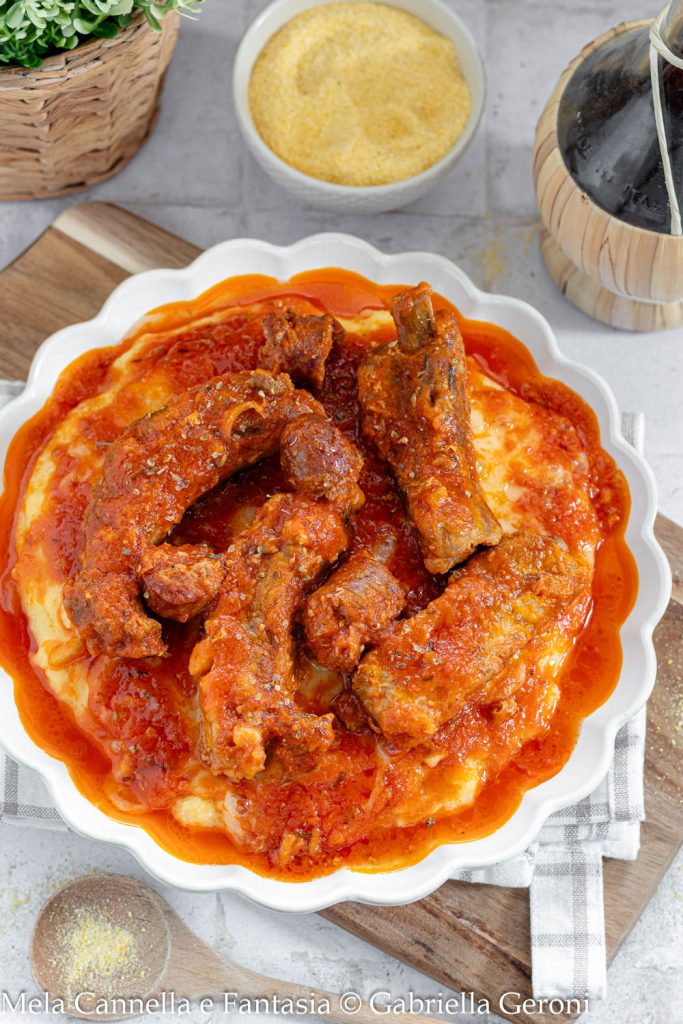
Since the cold is still quite present today, let’s prepare together the Polenta with Sauce, Sausage and Pork Ribs.
The polenta with pork sauce is a symbolic dish of the traditional Italian cuisine, particularly in the northern regions but not only. A rich and tasty comfort food, perfect for cold winter days.
It was in the Middle Ages that this poor dish became a staple food for rural populations.
Over the centuries, polenta has been enriched with different toppings, giving rise to countless regional variations.
Also known as “pulenta” or “poenta“, it represents the staple food of the poor cuisine in various northern areas such as Lombardy, Veneto, Liguria, and Trentino, Valle d’Aosta, Piedmont, Tuscany, and Emilia-Romagna.
However, it is also a typical traditional dish in the mountain areas of Umbria and Marche, Abruzzo, Lazio, and Molise.
The cereal predominantly used for polenta is corn, which gives it that characteristic yellow color. It is also found darker when prepared with flour mixtures containing buckwheat. An example is the polenta taragna, typical of the Valtellinese cuisine.
So how is polenta prepared? In a large pot traditionally made of copper, called a paiolo, water is brought almost to a boil. The flour, usually coarse and predominantly corn, is sprinkled into the hot and slightly salted water. Everything is continuously stirred with a wooden ladle (in the past with a stick) for about an hour (even an hour and a half).
Polenta can have different consistencies depending on the amount of water and flour used. More precisely “soft“, “firm“, “loose“.
But how much water is needed to make polenta?
For a polenta with medium softness, the classic recipe requires: 1 liter of water, 250 grams of flour, 10 grams of salt.
For a denser and compact polenta, increase the flour to about 300 grams.
To get a looser polenta, the flour should decrease to approximately 200 grams. Depending on the three variants, the salt quantity should also be adjusted.
Polenta with sausages and ribs is particularly widespread in Lombardy, Veneto, Abruzzo, and Emilia-Romagna. This dish meets the bold flavors of pork and becomes a complete and filling meal.
In Abruzzo, polenta is traditionally consumed with two types of toppings: the first is, indeed, a tomato sauce, pork ribs, and sausages.
Also called ribs, cutlets, small ribs, tips, pork ribs are a poor cut but very tasty, obtained from the animal’s rib. Combined with sausages, they make this dish really rich and succulent.
The second topping is white, with sausages and guanciale or pancetta. Both versions can include a generous addition of grated pecorino.
In the inland areas of Abruzzo, such as in Teramo, polenta is also oven-baked and seasoned white with sausages or minced meat, various cheeses, mushrooms, broccoli rabe, etc.
Here is my version of oven-baked polenta with mushrooms and mozzarella.
But now, after so much talk, I hope you feel like trying to make this rich and delicious Abruzzese polenta with sauce, sausages, and pork ribs together.
But first, I leave you with some other delicious recipes:
- Difficulty: Very Easy
- Cost: Medium
- Preparation time: 15 Minutes
- Portions: 2 people
- Cooking methods: Stovetop, Slow Cooking, Simmer
- Cuisine: Italian
- Seasonality: Fall, Winter
Ingredients
- 14 oz pork ribs
- 2 sausages (fresh pork)
- 24.5 oz tomato puree
- 1 carrot
- to taste celery
- 1 onion
- 1 drizzle olive oil
- 2 leaves bay leaf
- salt
- black peppercorns (only if desired)
- 9 oz coarse cornmeal
- 4 cups l water
Tools
- Pan
- Casserole
- Polenta Pot
- Ladle
- Cutting Board
Steps
Before starting, it’s important to make this essential premise. As our grandmothers used to do, polenta should be cooked using the right pot, the copper paiolo.
Additionally, to achieve good polenta, you need to have a lot of patience! It should be stirred very often and for about an hour, so if you’re in a hurry, choose another recipe!
Since time is not always on our side, fortunately there are electric paioli. For those who want to buy one, there are many models on Amazon.
If you prefer using a copper paiolo without an electric motor, this one is definitely an excellent product.
Finally, there are also more economical solutions like this one in aluminum from Pentole Agnelli or, if you prefer a non-stick pot, I certainly recommend this one.
Let’s start with preparing the polenta. Dice the celery, carrot, and onion into very small pieces and set aside.
In a large pan, preferably non-stick to avoid using oil, place the ribs and sausages and let them brown for about 10 minutes.
After the time has passed, you will notice that a lot of fat has accumulated at the bottom of the pan. Don’t worry, we won’t use it!
This step is not mandatory but I personally prefer to “defat” the pork to get a less heavy sauce.
While ribs and sausages are browning in the pan, let the chopped vegetables soften in a large casserole with a splash of olive oil.
When the vegetables are wilted, we can transfer the browned meat but most importantly drained from the oil inside.
Add a couple of bay leaves and cover with the tomato puree. Just a pinch of salt to avoid making everything too tasty.
Cover with a lid and let the sauce cook on low heat for about two hours.
To try to keep up with both preparations, remember the time well.
When there is about an hour left for the sauce to cook, we start preparing the polenta.
Take a high-sided casserole but especially with a thick bottom to prevent the polenta from sticking.
Pour 1 liter of water inside. This is the dose indicated on the package for 250 grams of coarse yellow cornmeal.
Regarding the salt, it is better not to overdo it in quantity since the sauce will be rich and tasty.
If necessary, we can always adjust the salt along the way 😉
Stir with a ladle very often, reaching the bottom of the casserole to prevent the polenta from sticking.
It will take approximately 50 minutes. Always check the instructions on the package.
Meanwhile, as the polenta cooks, always keep an eye on the sauce 😉
When the polenta has reached the right consistency and is coming away from the sides of the casserole, turn off the gas.
Place the still warm polenta on a nice wooden cutting board and top with the sausage and rib sauce.
Those who prefer can serve the polenta on individual plates and decorate the surface with plenty of sauce and pork.
Serve the polenta with a sprinkle of grated Parmesan or pecorino. And if you like, a bit of chili pepper.
If you prefer, you can also season only a part of the polenta and leave some aside for later.
In this case, I recommend spreading it on a wide, shallow baking tray and greasing the bottom with a little olive oil.
I usually make a little more to bake it the next day in the oven.
When you want, you can enjoy it and season it as you like. It should obviously be stored in the fridge.
I hope you enjoyed this recipe! Visit me again soon!
Article protected by copyright © – Gabriella Geroni © All Rights Reserved
Useful Tips
The flour should be thrown into the pot when the water is hot but not boiling. This helps prevent lumps from forming.
Another tip to prevent those annoying lumps is to add a drizzle of olive oil to the water.
When stirring, you should reach the bottom with the ladle and scrape well to move the polenta evenly.
It’s always helpful to have a small pot of slightly salted water on the stove so, if necessary, it can be added little by little.
FAQ (Questions and Answers)
What is the best flour for polenta?
Surely the ideal one for long-cooking polenta is the classic coarse cornmeal, which has a coarse grain and is more rustic. At most, we can use Fioretto, which, unlike the coarse one, has a finer grain. It’s more suitable for making oven-baked polenta, but also for making cookies, bread, and even, as I do, for breading vegetables and fish.
How is polenta stored?
Unseasoned polenta can be stored in the refrigerator for 2-3 days or frozen for about 3 months. The important thing is to put it in an airtight container.
The cooked sauce can be stored in the fridge for about 3 days or in the freezer for three months.
The important thing is that the meat used to make the sauce has not been previously frozen and thawed. In that case, the sauce should not be frozen.How do you reheat already cooked polenta?
We can put it in a container suitable for the oven or air fryer and, once seasoned as we like best, grill it for about 10 minutes.
Or we can grill it in a pan and then season it with sautéed mushrooms and a drizzle of oil, or with cheeses of your choice that will melt in seconds due to the heat.
To make it even more delicious, we can even fry it. In this case, however, it must not be seasoned, just cooked and cut into small pieces (strips, diamonds, triangles, squares, etc.).What wine pairs best with polenta?
A full-bodied and structured red wine, like a Bonarda or a Barbera, pairs perfectly with the richness of this dish.
When is polenta considered cooked?
Polenta is cooked when it starts to come away from the sides of the pan.
How can I pair polenta differently?
For a vegetarian version, I recommend seasoning the polenta with cheeses. For example, gorgonzola is a great choice, or Asiago, Crescenza, Fontina, etc.
For a vegan version, definitely use sautéed mushrooms with oil, garlic, and chili pepper or with a nice lentil ragù.
Besides sausages and pork ribs, polenta is excellent served with cotechino, or with a nice beef stew. Even stew pairs beautifully with polenta, as does braised turkey shank. For fish lovers, there’s also the version with creamy codfish or Vicentine style.Can polenta be eaten by those with celiac disease?
Certainly, the cornmeal used to make polenta is gluten-free, so it can be consumed by people with gluten intolerance.
For added safety, always check the product’s packaging to verify the presence of possible traces of allergens or intolerants.