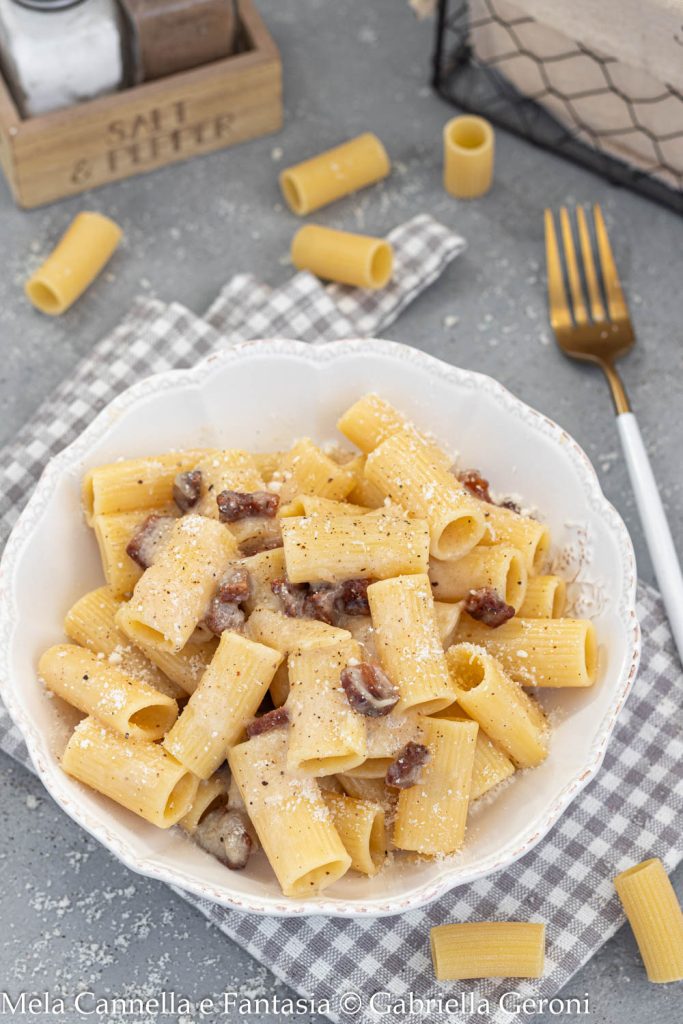
Today we’re making one of my favorite dishes, pasta alla Gricia. If I had to rank my favorite first courses, I’d be in a lot of difficulty!
Among these, perhaps not by chance, are three typical dishes of Roman tradition! Carbonara, Gricia, and Cacio e Pepe (I didn’t write them in order of importance because I can’t choose!).
Whoever is about to taste a dish of Gricia for the first time absolutely needs to know its history to savor it better!
I should mention that I’m not Roman but from Abruzzo, not too far from this culinary culture made of simple and authentic flavors.
Pasta alla Gricia, also called white Amatriciana, is a typical first course of Lazio cuisine. The main ingredients, NOT replaceable, in this recipe are Pecorino Romano, black pepper, and cured pork jowl.
There are two schools of thought regarding the origins of this ancient dish. Some say it originated near Gresciano, a locality near Amatrice. Perhaps also because initially, Amatriciana was made without using tomatoes (introduced around the 1800s). And maybe for this reason, Gricia is also called white Amatriciana.
Others believe it was created thanks to the “gricio“, a local vendor of typical products from the area like bread, pasta, pepper, lard, Pecorino, meat.
The peculiarity of this dish is that by removing the cured pork jowl, you get Cacio e Pepe, another typical Roman dish that I love. While if you add tomato sauce to Gricia, you get Amatriciana, a typical first course from Amatrice, which I talked about a few articles ago. If you add an egg to Gricia (or Griscia), you get Carbonara.
So let’s say that Roman cuisine, with a few simple ingredients, managed to create three exceptional dishes, each more famous and loved than the last.
Have you ever tried these typical dishes? And which one do you like the most?!
Let’s now see how to prepare the famous pasta alla Gricia!
Other typical Italian recipes you shouldn’t miss!
- Cost: Medium
- Preparation time: 5 Minutes
- Portions: 2 people
- Cooking methods: Boiling, Stove
- Cuisine: Italian
- Seasonality: All seasons
Ingredients
- 7 oz pasta (long or short)
- 3.5 oz cured pork jowl (preferably already peppered)
- 3.5 oz Pecorino Romano
- to taste black peppercorns
- to taste salt
Tools
- Casserole
- Frying Pan
- Skimmer
- Ladle
- Colander
- Absorbent Paper
- Spatula
Steps
First, put the water to boil in a large casserole.
Now let’s deal with the cured pork jowl. I used a piece of cured, already peppered pork jowl from the butcher.
If you prefer, you can take a single thick slice and then cut it.
The important thing is that the piece of pork jowl you use has both lean and fatty parts.
Cut the pork jowl into strips (or cubes) of equal size and put them in a large frying pan.
Place on the heat, set to medium flame, and fry the pork jowl without adding oil, as it will be released from the meat during cooking.
Stir occasionally and let cook until it becomes nice and crispy.
In the meantime, the water should have reached a warm enough temperature. Let’s prepare the Pecorino cream.
In a bowl, combine the Pecorino Romano and a bit of black pepper (if the cured pork jowl was already peppered, don’t overdo it; you can always add more later!).
Add a tiny amount of cooking water and mix quickly with a whisk. You should obtain a thick and NOT liquid sauce.
If you added too much water, don’t worry! You can fix it by adding a bit more Pecorino 😉
Once the pork jowl is nicely golden, DRAIN it with a skimmer. Set the frying pan aside with all its oil.
Wrap the pork jowl in a couple of kitchen paper towels. This way, the excess oil will be absorbed, and it will remain dry.
When the water comes to a boil, salt it, drop in the pasta, and cook it for about 5 minutes.
Then drain it into the frying pan with the oil released by the pork jowl.
Add a ladle of cooking water and continue cooking until the pasta is ready.
This phase is crucial. The pasta is risotto-style cooked in the pan where it releases its starch, creating that marvelous mouth-watering cream!
The risotto-style cooking must be done well, adding little water at a time to avoid turning the Gricia into a soup!
As the water is absorbed by the pasta, add more, always little by little.
When the pasta is cooked, turn off the heat and move the pan away.
Last step before serving (the most delightful!).
Pour the previously prepared Pecorino cream into the pan and mix quickly with a spatula.
ONLY if necessary, add a few more drops of cooking water and mix.
Finally, add the crispy pork jowl and mix. A little more pepper, only if you like, and off to the table like a rocket!
Gricia should be consumed immediately, otherwise it loses its creaminess!
I hope I’ve whetted the appetite of those who have never tried this fantastic dish!
Pasta alla Gricia is an experience you absolutely must have! Enjoy your meal, everyone!
Article protected by copyright © – Gabriella Geroni © All Rights Reserved
Contains advertising content
FAQ (Questions and Answers)
Can I substitute pancetta for cured pork jowl?!
I struggled to assume this question since the use of cured pork jowl is essential for making Gricia! It is not the same as pancetta, so it can NOT be substituted if you want to make this recipe traditionally! However, as I always say, everyone cooks as they wish at home! Certainly, there won’t be any starred chefs spying on you while you cook, so if you only have pancetta in the fridge and feel like trying this dish, why not! Just know that it can’t be called Gricia without cured pork jowl!
What type of pasta is best for Gricia?
You can use both short and long pasta. The most popular are rigatoni or the classic spaghetti. However, it’s so delicious that if you feel like preparing it and you only have penne in the pantry, I don’t think anyone will be offended! 😉
What’s the difference between Cacio e Pepe and Gricia?
Let’s say Gricia is a richer version of Cacio e Pepe because, compared to it, it includes the addition of cured pork jowl (remember, NOT PANCETTA!).
What kind of wine can I drink with Gricia?
Since I’m from Abruzzo (but not a wine expert!), I can recommend what I often pair with dishes like this. A Pecorino from Abruzzo, a fresh and spicy white wine.