
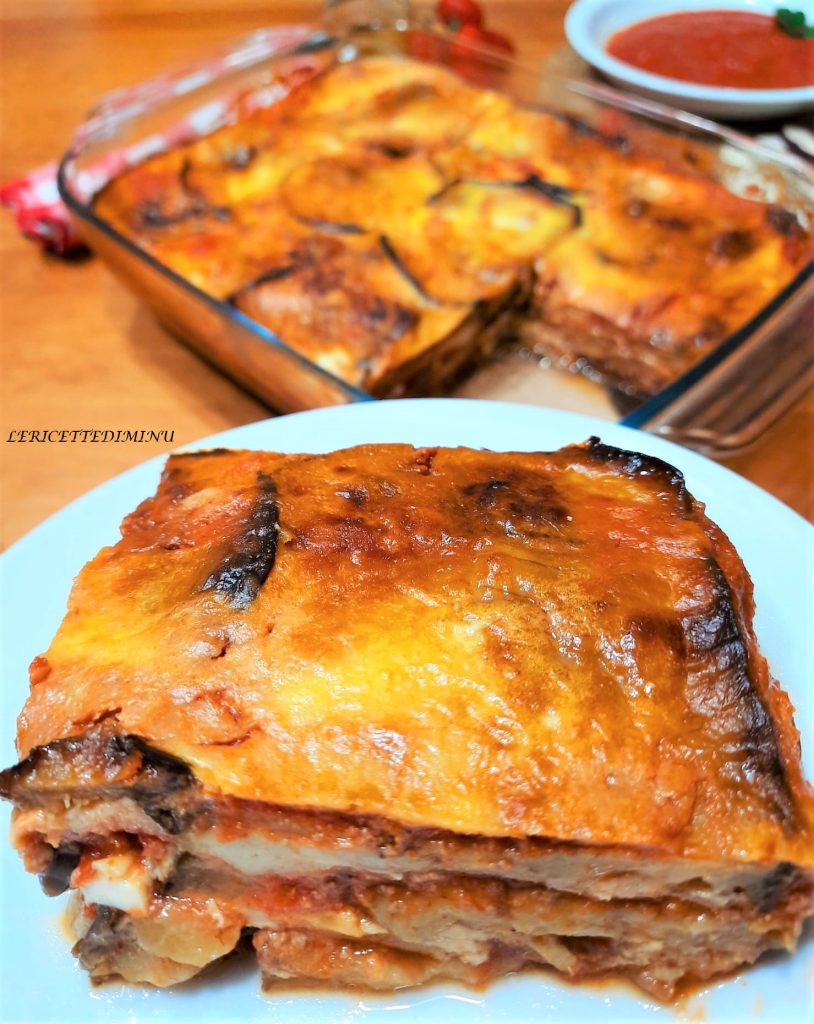
The Sicilian eggplant parmigiana recipe, Catania version, that I propose is the one that has always been prepared at my house.
This is how my mother prepared it and in the same way, following all her advice carefully, I prepare it today.
Being from the province of Catania, my recipe is linked to my territory, but as we know, every family has its own version of every dish.
My recipe allows you to obtain a parmigiana rich in flavor and gives you some small tricks to have slices that hold their shape well.
In short, a real delicacy that, when served, will not fall apart inevitably, try it and I am sure you will like it!
If you like my recipes you can follow me on my FACEBOOK page and on INSTAGRAM
Thank you ❤️😘❤️
- Difficulty: Medium
- Cost: Economical
- Preparation time: 1 Hour
- Portions: 10
- Cooking methods: Oven
- Cuisine: Italian
- Seasonality: Summer, Fall
- Energy 1,141.86 (Kcal)
- Carbohydrates 7.33 (g) of which sugars 1.01 (g)
- Proteins 14.58 (g)
- Fat 119.53 (g) of which saturated 25.19 (g)of which unsaturated 84.67 (g)
- Fibers 1.06 (g)
- Sodium 642.76 (mg)
Indicative values for a portion of 230 g processed in an automated way starting from the nutritional information available on the CREA* and FoodData Central** databases. It is not food and / or nutritional advice.
* CREATES Food and Nutrition Research Center: https://www.crea.gov.it/alimenti-e-nutrizione https://www.alimentinutrizione.it ** U.S. Department of Agriculture, Agricultural Research Service. FoodData Central, 2019. https://fdc.nal.usda.gov
Ingredients
- 4 eggplants
- 750 ml tomato passata
- 4 eggs (boiled)
- 100 g Grana Padano PDO (grated)
- 3 eggs
- 180 g cheese (like fresh caciocavallo or galbanino plus two cheese slices)
- 150 g mortadella (thin slices or cooked ham)
- to taste basil (fresh)
- 4 tablespoons extra virgin olive oil
- to taste peanut oil (for frying)
- to taste salt
Tools
- Large colander
- Frying pan
- Oven tray 12 x 9.5 in
- Egg slicer
Preparation
To prepare the Sicilian eggplant parmigiana, start by cutting the eggplants into slices that are not too thin (you can use a graduated mandoline), soak them in a container with well-salted water, adding a weight on top to keep them all submerged.
Leave them like this for about an hour.
Meanwhile, prepare the sauce by putting the passata in a pan or pot, with a glass of water and a large crushed or sliced clove of garlic, which we will then remove.
Bring to a boil, salt and let it reduce at a low flame, covering with a lid but leaving a side vent. Stir occasionally.
When it starts to smell cooked, adjust the salt and, if needed, add half a tablespoon of sugar or more, to eliminate the sour taste from the sauce.
It will be ready after about 25 / 30 minutes of cooking and should not be too dry or too liquid, as it would season poorly in both cases.
Add two or three tablespoons of extra virgin olive oil and fresh basil raw.
Cook the eggs for 8 minutes from boiling, then put them in a container with cold water.
When well chilled, peel them and cut them with an egg slicer.
At this point, return to the eggplants. Heat a large non-stick pan with plenty of peanut oil, pat the eggplants well with a clean kitchen towel and when immersing the handle of a wooden spoon in the oil, many small bubbles form around it, the oil will have reached the right temperature.
Fry a few slices at a time to avoid lowering the oil temperature too much.
After frying them, transfer them to a colander to drain excess oil, but without applying any pressure on the surface.
Personally, I believe that placing freshly fried eggplants on absorbent paper impoverishes them too much for this type of preparation.
In a bowl, beat the three eggs with a pinch of salt and one and a half tablespoons of grated Grana.
Cut the cheese into not too large pieces, remove the hard skin that runs around the slice of mortadella.
Spread a baking dish with sauce, create a layer of eggplants without leaving empty spaces.
Anyone who wants could remove the skin from the eggplants, but I leave it.
Distribute a layer of sauce on the slices to taste, without exaggerating. Then place the sliced boiled eggs and the mortadella in pieces.
Add the cheese pieces.
In Sicily, a traditional ingredient is caciocavallo, but I often use galbanino instead, to which I add 1 slice of cheese in each of the two inner layers of the parmigiana.
Sprinkle with grated Grana and then distribute the beaten egg here and there, using a spoon.
Add it moderately to avoid the omelet effect.
The addition of beaten egg, along with the cheeses, will bind the various layers together and help the parmigiana maintain its shape once sliced.
Repeat the process once more and finish with eggplants sprinkled with sauce and a uniform layer of beaten eggs.
In a preheated oven at 392 degrees Fahrenheit, static function, middle rack for about 30 / 35 minutes.
Lower the temperature to 356 degrees Fahrenheit after the first 10 minutes.
After about 15/20 minutes, you will see many small bubbles forming across the surface of the parmigiana.
It’s from this phase, having reached boiling temperature, that the beaten eggs will begin to cook and the cheeses will melt.
If the surface tends to brown too much, cover with parchment paper in contact, topped with an aluminum foil.
The Sicilian eggplant parmigiana is thus ready.
It will be much better served the next day and if enjoyed at room temperature or chilled.
As it cools, it will hold its shape even better.
Storage
In the fridge, well closed, it keeps well for about 3 days. I do not recommend freezing.
In the fridge, well closed, it keeps well for about 3 days. I do not recommend freezing.
Here is a selection of great products useful in the kitchen. Many of these I myself have bought and tested. The list will be constantly updated.
To view the recommended products click here.
To view the recommended products click here.
