
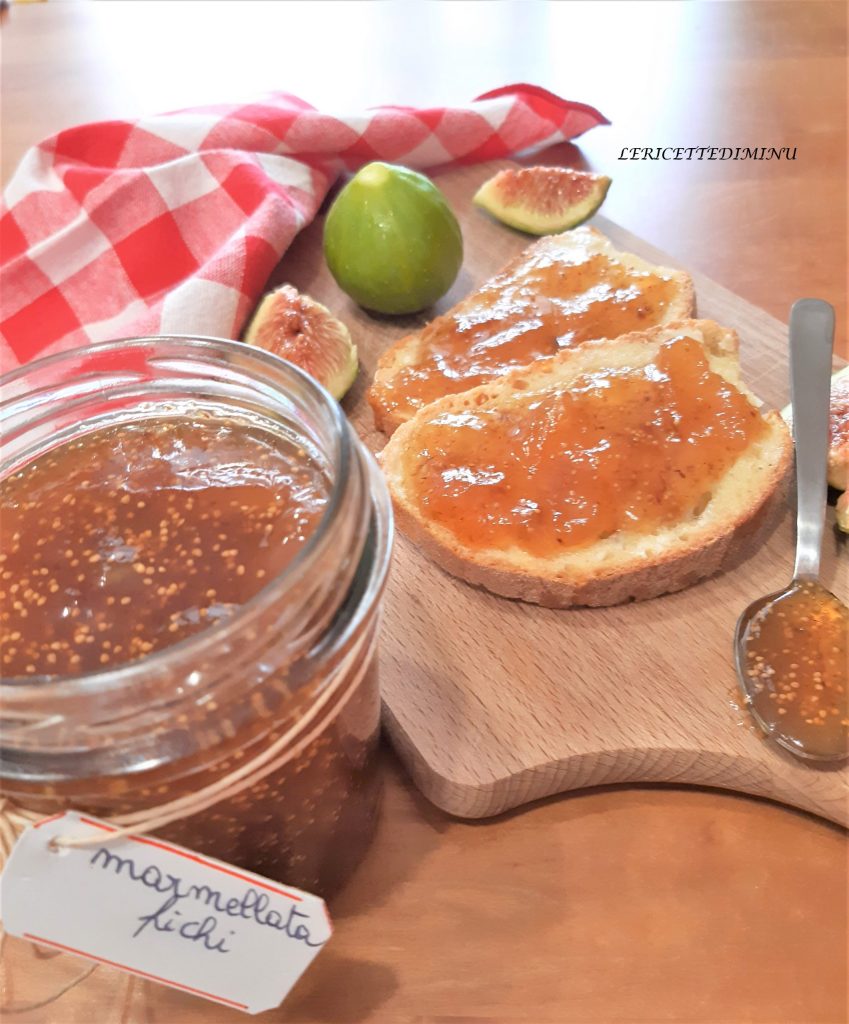
Fig jam has a delicate and naturally sweet taste, great for breakfast spread on toasted and buttered bread or perhaps inside a luscious pie.
It can be made with white figs or black figs; some, like me, love it chunky, or others prefer to pass it through a food mill for a smooth and uniform version.
Thanks to the inherent sweetness of these fruits, it is possible to reduce the added sugar, thus obtaining a more genuine jam.
The fig jam recipe I propose is the one I used to help my mother prepare as a child and now make for my family, a simple and tested recipe that smells of summer and tradition.
Excellent pairing with cheeses, among which I prefer those of medium maturation or blue cheeses.
- Difficulty: Medium
- Cost: Very cheap
- Preparation time: 10 Minutes
- Cooking methods: Stovetop
- Cuisine: Italian
- Energy 326.69 (Kcal)
- Carbohydrates 86.28 (g) of which sugars 81.96 (g)
- Proteins 1.11 (g)
- Fat 0.44 (g) of which saturated 0.09 (g)of which unsaturated 0.31 (g)
- Fibers 4.28 (g)
- Sodium 2.07 (mg)
Indicative values for a portion of 100 g processed in an automated way starting from the nutritional information available on the CREA* and FoodData Central** databases. It is not food and / or nutritional advice.
* CREATES Food and Nutrition Research Center: https://www.crea.gov.it/alimenti-e-nutrizione https://www.alimentinutrizione.it ** U.S. Department of Agriculture, Agricultural Research Service. FoodData Central, 2019. https://fdc.nal.usda.gov
Ingredients
- 3.5 lbs figs
- 3 cups sugar
- 4 tbsp lemon juice
Tools
- 3 Jars with twist-off lids (two 500 g, one 250 g)
- 1 Pot wide with a thick bottom
- 1 Pot tall
Preparation
Let’s start the fig jam recipe by sterilizing the jars and the lids we will need.
After washing them well, place the jars in a tall pot on a clean kitchen towel.
Place one also to separate the jars from each other to cushion any bumps.

Cover them completely with water and once it reaches a boil, keep it on the fire for 20 minutes, lowering the flame.Then add the lids and continue sterilizing for another 10 minutes.
Turn off and as gently as possible, slide away most of the water and then remove the jars and lids.
Let them dry on a clean kitchen towel.
Now let’s take care of the figs. Wash them without soaking in water and trim by removing the stem and peel only half of them (as it’s a natural thickener and therefore useful for thickening).
Weigh the figs net of waste.
Cut each into 4 wedges and if you want small pieces, cut each wedge again in half.
Place the figs in a wide pot with a thick bottom.
Add the filtered lemon juice and over high heat without a lid, cook until they reach a consistency that is neither too liquid nor too dense.
In short, we should reach the consistency we would like to be the final consistency of our jam.
It will take about half an hour, during which you need to stir often to ensure the fruit does not stick to the bottom and to monitor when you are approaching the right consistency.
Skim off the acidity that rises to the surface with a slotted spoon.
If it sticks, transfer everything to another pot to prevent bad odors from forming in the jam.
After this time, remove from the heat momentarily (if you want it smooth, pass it through a food mill) and add the sugar.
Stir with a wooden spoon.
Put it back on the heat and once it starts boiling again, cook over moderate heat for another 20 minutes, stirring very often.
Turn off the heat.
If we want to pasteurize, let the jam cool slightly, then pour it into the previously sterilized jars along with the lids, now dry.
Fill leaving an inch or more free below the edge of the jar.
Wipe the edges well with a slightly damp paper towel and dry with another paper.
If you have the jam funnel, using it will prevent dirtying the jar’s edge.
Remember, for your jams use new lids, as previously used ones may have deformations, possibly not visible, that would prevent the vacuum seal from forming.
Close the jars, place them in a large pot, placing cloths at the bottom of the pot and between the jars so that, when they wobble during boiling, they do not break by hitting each other.
Fill with warm water until the jars are completely covered, cover with a lid and bring to a boil.
When it starts boiling, lower the flame, move the lid aside and keep on the fire for 20 minutes.
If the water level drops, leaving the jars slightly uncovered, add more boiling water to maintain the boil.
Let cool completely in the pot before removing the jars.
Always check that a vacuum seal has formed; if it has, the lid’s center will be sucked inward.
By pasteurizing the jars in this way, your jam will keep for 8-10 months.
If you plan to consume it within a short time (2-3 months), you can jar the boiling jam and ideally the jars and lids should still be warm from sterilization.
Close the jar immediately with a twist-off lid and turn it upside down, leaving it that way until it is cold.
Check that a vacuum seal has formed by pressing in the center of the jar; you should not hear the classic click-clack sound and the lid should be sucked inward. If not, change the jar and lid and boil for 20 minutes to pasteurize.
Here are our preserves ready according to the fig jam recipe I proposed.
If you wish, you can decorate your jam jars with checkered fabrics fastened with rustic cords and to identify them well, add labels with the type of jam contained in them.
Storage
Keep in a dark and cool place in the pantry. If pasteurized, they keep for 8-10 months; if we have created a vacuum by turning the jar upside down, consume within 2-3 months. Once opened, store in the fridge and consume within about a week.
Keep in a dark and cool place in the pantry. If pasteurized, they keep for 8-10 months; if we have created a vacuum by turning the jar upside down, consume within 2-3 months. Once opened, store in the fridge and consume within about a week.
Here is a selection of products that are definitely useful for making desserts. Many of these I have purchased and tested myself. To view the recommended products click here.
Here is a selection of products that are definitely useful for making desserts. Many of these I have purchased and tested myself. To view the recommended products click here.
