
Easter is just around the corner, and the Light and Tasty Team decided to dedicate this week’s recipe to eggs, a perfectly themed ingredient for these days. 🙂 When choosing a suitable recipe to propose for the column that could also be an Easter recipe, my first spontaneous thought went to the pasqualina pie—it couldn’t have been otherwise, right? 😉 Since I had already dared to write a version of the pasqualina pie (not the original one, just to be clear) some time ago… my backup spontaneous idea could only be: ahhh, then I’ll make mini single-portion pasqualine!
Actually, I’ll tell you… given my fondness for single portions and finger food in general, I really wonder now: why haven’t I tried these mini pasqualine before? 😄
〰 〰 〰
More recipes for Easter and Easter Monday? Here they are! 👇
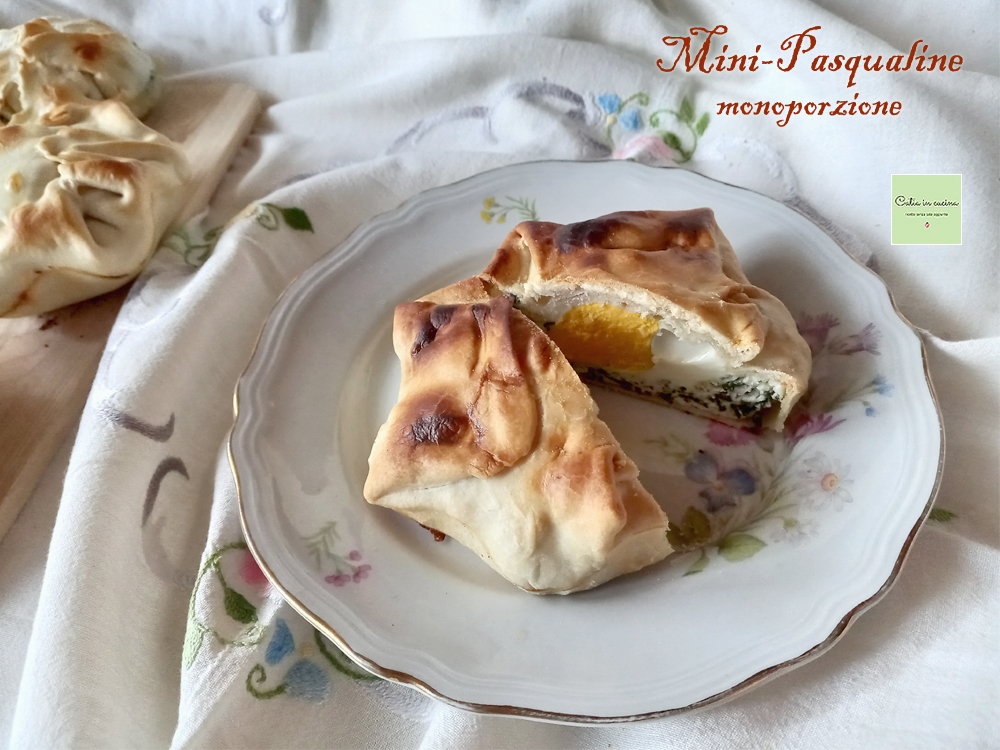
- Difficulty: Medium
- Cost: Affordable
- Preparation time: 40 Minutes
- Portions: 4
- Cooking methods: Oven
- Cuisine: Italian
- Seasonality: Easter
Ingredients
- 1 block pasta matta (with extra virgin olive oil)
- 6 oz agretti (also called lischi, lischeri or monk's beard)
- 1/2 cup ricotta
- 1 clove garlic (small)
- 1 tsp extra virgin olive oil
- lemon zest (grated)
- nutmeg
- marjoram
- pepper
Tools
- Molds with fluted edges
Steps
I have quite a few step-by-step photos to show you; I’m sure that following the pictures will make the process simple and intuitive. 🙂
Let’s start with the pasta matta preparation.
For these mini pasqualine I used the pasta matta with extra virgin olive oil. If you prefer the version made with seed oil, that works fine too. (I invite you to read both recipes to choose the one that suits you).
After preparing the dough, place the block in the refrigerator for about half an hour.
Meanwhile, prepare the filling.
Instead of the classic spinach or chard, I used agretti (we call them “lischeri” here) (The reason for this substitution is that the family members who are “anti-veg” eat agretti without complaining, so… 😉).
First, remove the stems from the agretti, wash them well, then cook them directly in a pan with about a very thin layer of water and a lid on for 10–15 minutes.
☝ It’s true, 180 grams isn’t a huge amount, so if you want you can increase the quantity to obtain a more intensely green filling. Adjust according to any “anti-green” protests at home. 🙆♀️
When the agretti are cooked, sauté them in the pan with one minced clove of garlic and one teaspoon of olive oil for a few minutes to season them and to dry off excess moisture.
Chop them, mix them with the ricotta, season with a good grating of nutmeg, a sprinkle of pepper and the grated zest of half a lemon.
Take the pasta matta out of the fridge and divide it into 4 portions.
(In the photo there are only 3 pieces because initially I wanted to make only 3 mini pasqualine, then the dough yielded more and I got 4).
Use each portion to make one mini pasqualina.
Divide each portion into 3 or 4 smaller pieces, roll them thinly, then layer them on top of each other and roll again. You should obtain a thin dough.
👉 After rolling with the pin, it’s useful to thin it out with your hands: just pick the dough up and, thanks to its own weight, it will stretch and thin out.
With the filling ready and the dough rolled, move on to the assembly:
Place the rolled dough into the mold.
Divide the filling into 4 parts and spoon a couple of tablespoons onto the dough, spreading it to fit the bottom of the mold and creating a bit of a rim so there’s a cavity to hold the egg.
If you like, sprinkle pepper and nutmeg over the egg and add another little grating of lemon zest.
Cover the egg by gently folding the dough over to enclose the filling.
Brush the surface with milk (or oil).
After making the first two mini pasqualine shown in the earlier photos, I realized I might have folded in a bit too much dough, so I decided to close the other two differently, to make the dough covering thinner.
I’ll also show you photos of this second option, which covers the filling a bit less (so some filling might escape slightly) but on the plus side bakes better (because there are no folded dough corners that can be a bit harder to cook through at the folds).
☝ If you use round molds instead of the fluted ones I have, you can simply cut the dough into a round shape rather than a star, and sealing the edge will definitely be easier. 😃
Bake in the oven for about half an hour. Start the oven at 392°F and then, halfway through baking, lower it to 356°F. If needed, and depending on your oven or the type of mold used, move the molds to the lower part of the oven.
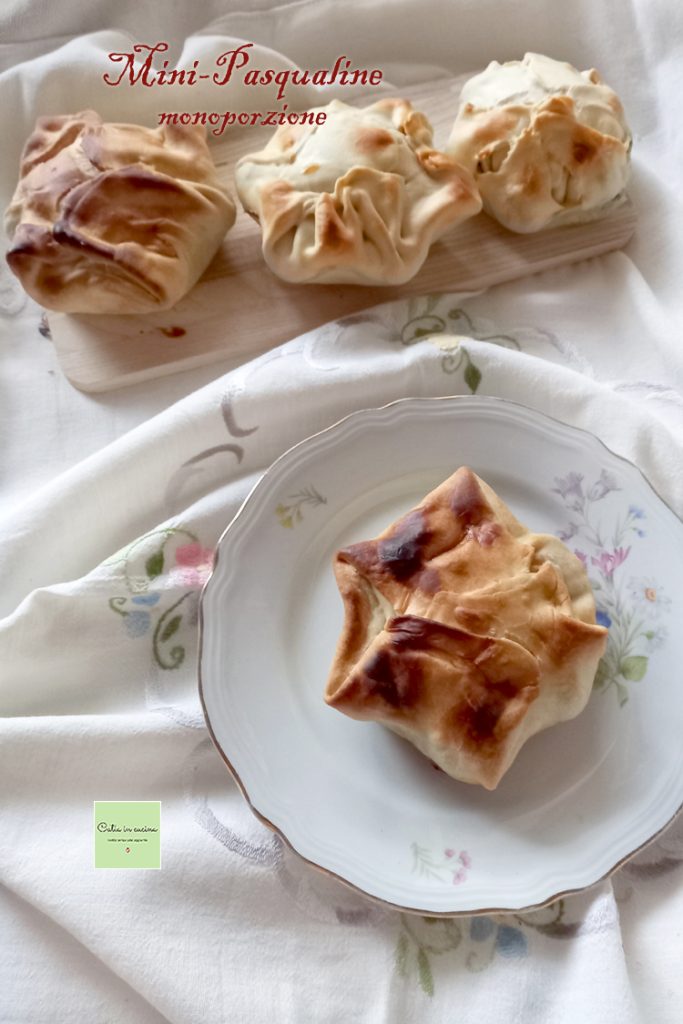
They are excellent hot, warm or even cold.
In this single-portion version I see these mini pasqualine fitting nicely among Easter appetizers. What do you think?
Also consider that they can be a great vegetarian main course. If you have vegetarian guests, they will appreciate them. 😊
And they can also go into the picnic basket on Easter Monday. Where else? 😀
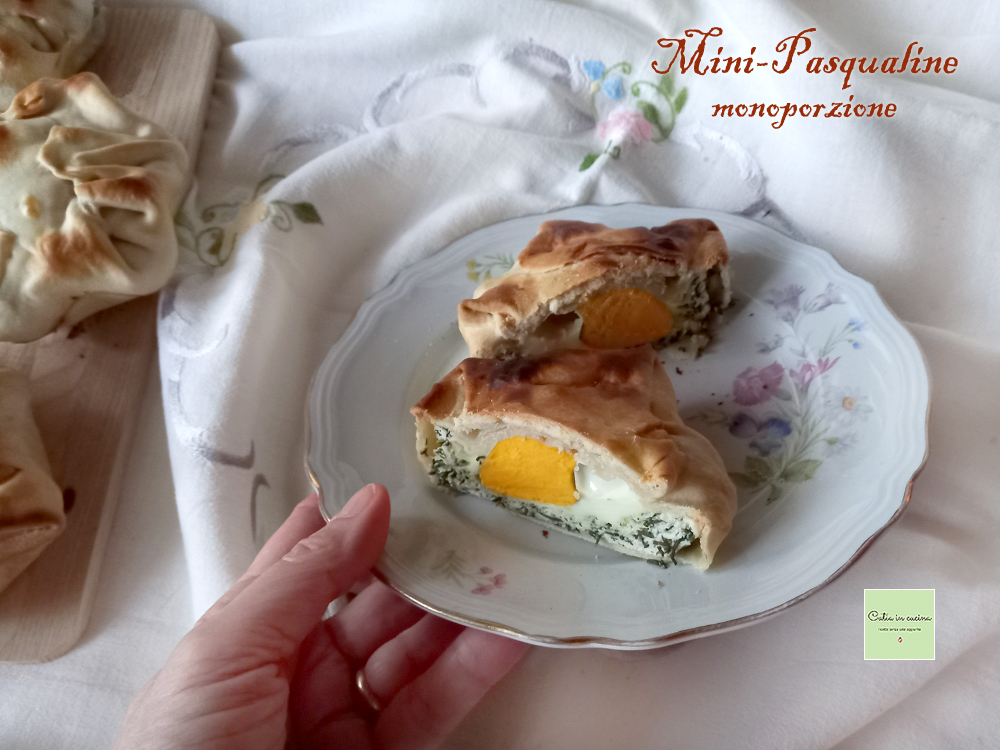
One last tip:
If you have leftover pasta matta… roll it very thin and make crackers! 😉 Hey, take a look HERE to see how many crunchy treats you can get from the scraps of pasta matta!
Salt-free tips
 Suggestions to season this recipe without added salt: 1. don’t forget to add the grated lemon zest, and 2. if desired, add 1 teaspoon of Parmesan to the filling of each single portion. 🙂
Remember that I cook without adding salt 😉 If you want to learn more read this article and join my group!
Remember that I cook without adding salt 😉 If you want to learn more read this article and join my group!
If you are interested in reducing or eliminating salt, always remember:
▫ Reduce salt gradually; the palate must get used to the change slowly.
▫ Use spices. Chili, pepper, curry, nutmeg, cinnamon, cloves, cumin…
▫ Use aromatic herbs. Basil, parsley, oregano, thyme, sage, marjoram, rosemary, mint…
▫ Use seeds and nuts. Sesame, pine nuts, almonds, walnuts…
▫ Use pungent vegetables or fruit. Garlic, onion, lemon, orange…
▫ Use my salt-free vegetable granulate
▫ Prefer fresh foods.
▫ Avoid boiling in water; prefer cooking methods that preserve flavors (griddle, foil, steam, microwave)
▫ Avoid bringing the salt shaker to the table!
▫ Occasionally allow yourself a treat. It’s good for morale and helps you persevere.
If you do not want, or cannot, give up salt:
▫ You can still try my recipes and salt them according to your usual habits.
Follow me!
On my WhatsApp channel and on Instagram, on my Facebook page, on Pinterest and in my two groups: Il gruppo di Catia, in cucina e oltre and Proprio quello che stavo cercando! and if you feel like it… subscribe to my Newsletter.
On my WhatsApp channel and on Instagram, on my Facebook page, on Pinterest and in my two groups: Il gruppo di Catia, in cucina e oltre and Proprio quello che stavo cercando! and if you feel like it… subscribe to my Newsletter.
And now let’s see how my colleagues from the Team Light and Tasty cooked eggs: 🙂
Carla Emilia: Frittata with anchovies and zucchini
Daniela: Baked eggs with spinach and tomatoes
Elena: Uova alla foggiana
Milena: Scrambled eggs with agretti
Serena: Eggs and avocado
Carla Emilia: Frittata with anchovies and zucchini
Daniela: Baked eggs with spinach and tomatoes
Elena: Uova alla foggiana
Milena: Scrambled eggs with agretti
Serena: Eggs and avocado
