
Today I have a basic ‘technical’ recipe. 🙂 I’m writing a new recipe that will be published on Monday (that is, in a couple of days, it’s almost ready,) which… small spoiler… will include this pasta matta with extra virgin olive oil among the ingredients.
As always, when I prepare a recipe that requires a basic dough, I like to write the specific base recipe separately, because it’s useful for everyone and because then I can add it to the collection. The basic recipes collection is one of my favorites; I consult it often myself (given my notoriously poor memory for ingredient weights!), and it’s one of the collections you consult most often as well.
You might wonder whether it’s really necessary to write a new pasta matta recipe. After all, the oil-based pasta matta (with seed oil) is already on the blog, and someone might argue that you only need to change the type of oil, right? Sort of. Yes, that’s true, but not entirely. A few extra explanations about this extra virgin olive oil version are worth writing.
I’ve tried it several times with different flours and with two different types of olive oil, and the main clarification I want to make is that for this use (that is, to make pasta matta) I prefer to use a delicate extra virgin olive oil. I had mentioned this also in the seed oil version: at the time I had tried a more robust extra virgin oil I had at home, a trial that didn’t fully convince me, which led me to prefer seed oil then. Now that I’ve bought a supply of a milder oil, I’m satisfied with how the pasta matta turns out with this olive oil, although I still sometimes make it with seed oil depending on the recipe I need to prepare.
Of course, these are personal preferences, but in cooking there are so many variables and even the individual products used matter.
The main difference I’ve noticed between seed oil and the extra virgin olive oil in the final result of the pasta matta is that with seed oil it turns out more crumbly and crispier, while olive oil (especially robust mill oil) makes the dough a bit softer and it holds together better after baking.
These are details I’m sharing with you, and I invite you to comment to tell me your impressions and, if you like, to tell me about your versions. I’m happy to try other variations of this beloved pasta matta! 😍 Yes, pasta matta has become for me… much more than a simple recurring recipe I really like; I could say that ‘pasta matta is the new parsley’ of my kitchen! 😅
Indeed, pasta matta with extra virgin olive oil, or with seed oil, smooth or with added seeds (links below) has become the base pastry for all my quiches and savory pies, for sweet tarts and cookies, and even for crackers.
The crackers, yes. I must confess that the sourdough cracker recipes I repeated many times in my early years of sourdough baking I almost no longer make, because I’m now captivated by this new passion for pasta matta crackers. I have a dedicated photo folder for them, and I wouldn’t rule out a specific dedicated recipe in the future (it will happen, it will!). 😃
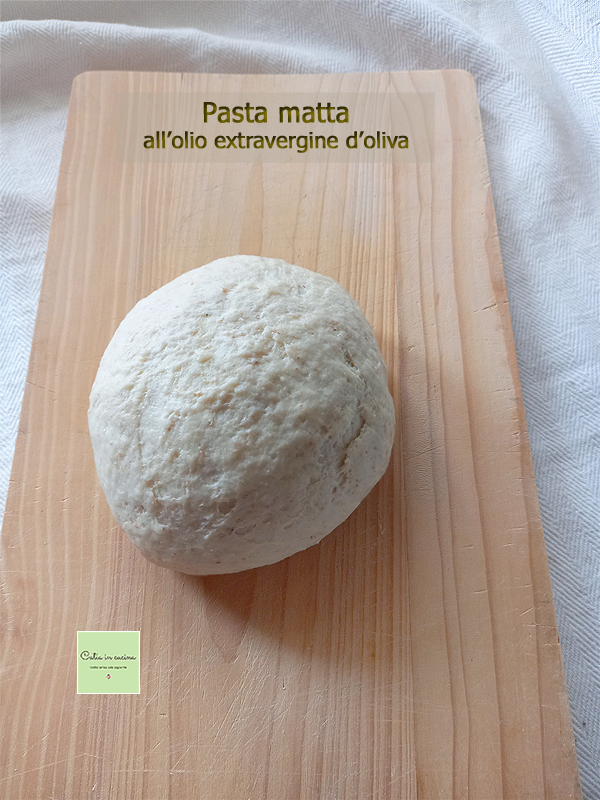
- Difficulty: Easy
- Cost: Economical
- Rest time: 30 Minutes
- Preparation time: 5 Minutes
- Portions: 1 dough ball
- Cooking methods: Other
- Cuisine: Italian
- Seasonality: All seasons
Ingredients
In this recipe you’ll find photos of two different doughs made with two different flours: with type 0 flour (which I used for the next recipe), and with type 1 flour (which I used for a spinach flatbread, a recipe I plan to write). But I’ve also tried it with type 2 and whole wheat flours — in short, it works well with all flours!
- 2 1/8 cups flour (type 1 or 0)
- 3 tbsp extra virgin olive oil
- 1/2 cup water
- 1 teaspoon vinegar
Tools
- Bowl
- Kitchen scale
Steps to prepare pasta matta with extra virgin olive oil
Pour the flour into a bowl.
Add the oil, the water and the teaspoon of vinegar.
☝ As always, I recommend not adding all the water at once but adding it little by little. The total amount may differ from what I indicated in the ingredients because it always depends on the flour used. The amount of water needed can vary due to different absorption of the flours
👉Also, note that in the version with type 1 flour I used 35 g (about 2 1/2 tbsp) of oil. It turned out perfectly fine. In that case one extra teaspoon of water was needed to incorporate the crumbs and the flour left on the bottom of the bowl (so about 115 g, roughly 1/2 cup plus 1 tsp).
Work the dough by hand until you obtain an elastic dough.
Put the dough ball in the fridge for about 30 minutes.
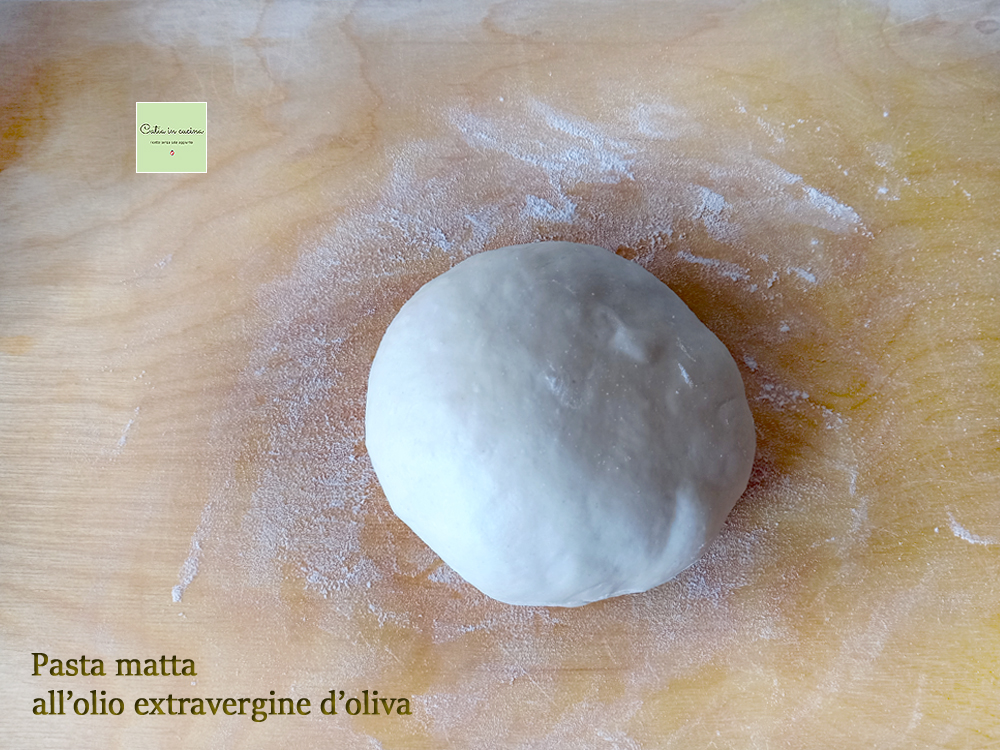
Here is the dough ball of the version with type 0 flour (other photos of this version will be in the procedure of the next recipe):
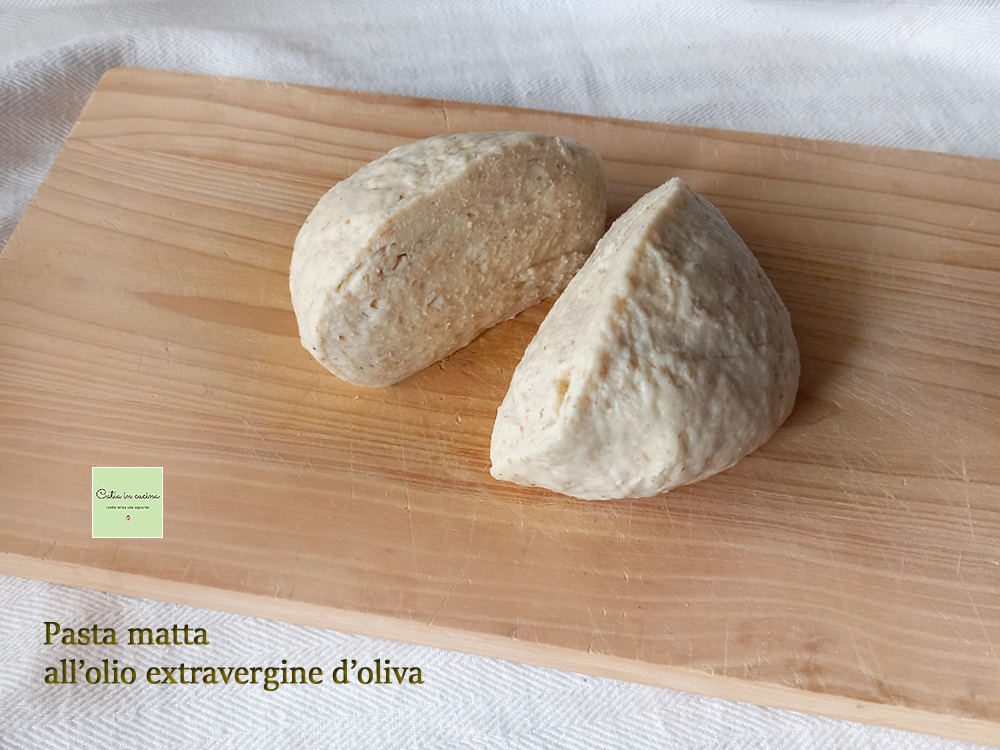
And here is the version with type 1 flour:
I suggest using pasta matta with extra virgin olive oil to make mini pasqualine or to make torta pasqualina, or to make one of these tarts or quiches:
Radicchio and red onion quiche
Quiche with potatoes, spinach, ricotta and provolone
See you on Monday!

Tips for salt-free cooking
 As already mentioned in the seed oil pasta matta recipe, you do not need to add salt. The absence of salt promotes the dough’s elasticity. Moreover, considering that pasta matta is usually rolled very thin for pies with abundant and flavorful fillings, the lack of salt is not noticed (not even by those who do not follow a low-sodium diet 😉).
If you are interested in reducing or eliminating salt, always remember to:
▫ Reduce salt gradually so the palate can adapt slowly and not notice the progressive reduction.
▫ Use spices: chili, pepper, curry, nutmeg, cinnamon, cloves, cumin…
▫ Use aromatic herbs: basil, parsley, oregano, thyme, sage, marjoram, rosemary, mint…
▫ Use seeds: sesame, pine nuts, almonds, walnuts…
▫ Use pungent vegetables or fruit: garlic, onion, lemon, orange…
▫ Use my salt-free vegetable granules and gomasio.
▫ Prefer fresh foods.
▫ Avoid boiling in water; prefer cooking methods that do not disperse flavors (griddle, baking in foil, steaming, microwave).
▫ Avoid bringing the salt shaker to the table!
▫ Allow yourself an occasional indulgence. It’s good for morale and helps you persevere.
If you do not want, or cannot, give up salt:
▫ You can still try my recipes, seasoning to your usual taste.
Follow me!
On my WhatsApp channel and on Instagram, on my Facebook page, on Pinterest and in my two groups: Il gruppo di Catia, in cucina e oltre and Proprio quello che stavo cercando! — and if you like… subscribe to my Newsletter.
