
I think some foods are more important than others, and some are essential. The Easter Loaf from Romagna is one of the essentials for me.
The Easter Loaf is a delicious sweet bread, one of those things that taste like goodness, childhood, grandmothers, and holidays. And that cannot be missing, no matter what, on Easter morning.
For Easter we — in our family — do not have fixed dishes for lunch as we do at Christmas: sometimes we have lasagna, sometimes we repeat the cappelletti in broth exactly like at Christmas, other times my mother makes ravioli — in short we always stay within tradition but with variations.
What truly characterizes Easter for us, though, is breakfast.
Breakfast on Easter has, since forever, to be based on the loaf, blessed hard-boiled eggs and a tart, preferably with apricot jam, or even better with “biuda”, to which later the colomba was added.
Breakfast must be taken, strictly, at a well-set table: a bite of the loaf and a bite of the hard-boiled egg. And until a few years ago — not that long ago — we used to say the Creed in the meantime, according to a custom my father never fails to remind us of every year. Very attached to traditions as he is, he values that custom a lot and who knows how many still remember it — I think few now, perhaps none.
My very first Easter loaf made with my own hands was last year. For that first and difficult lockdown Easter, with the difficulty of going grocery shopping (what a terrible time!), our family was risking an Easter without the loaf and that was absolutely unacceptable.
Deciding to make it at home for me was almost a historic undertaking, because, after the era of Aunt Marcella — who in the old days used to supply us with baked goods made by her (oh, what a pity I didn’t ask her then to pass on her recipes!) — we had never felt the need to bake it at home. We always bought the loaf from the bakery that made it well and with the taste of the past. That was fine with us.
So, not having a trusted recipe and not knowing who to ask, but helped by the lockdown which forced us to rely on the web for everything, I searched online as much as possible locally and I found this recipe, which I considered valid and then personalized a little.
The result was perfect: flavor, aroma, texture — everything came out identical to the Romagnola Easter Loaf that my taste buds recognize as typical of my Rimini area of Romagna.
I’m happy about this discovery, also because, in the end, it is not a complicated recipe at all.
I made it in two variants: with lard as tradition dictates, and with butter instead of lard. The real reason for testing butter was that when I realized I had run out of lard it was midnight, but the result was more than valid — it turned out excellently in both versions.
It’s fair to also offer a vegetarian version, because, if for us Romagnoli having lard in the fridge is more than normal (for the piada!), perhaps not everyone is used to or has the tradition of using lard as we do — we even put it in the bundt cake and use it for frying. It’s part of us.
I also warn you that I baked it in two different shapes: a round loaf, more typically Romagnola, and a taller, narrower shape, a form influenced — since the Montefeltro is around the corner for us and we don’t see its borders — by the Marche region’s high cheese “crescia”, usually baked in a high-edged pan.
Well, I’m ready! Let’s start kneading! 🤩
〰 〰 〰
More of my Easter recipes 👇
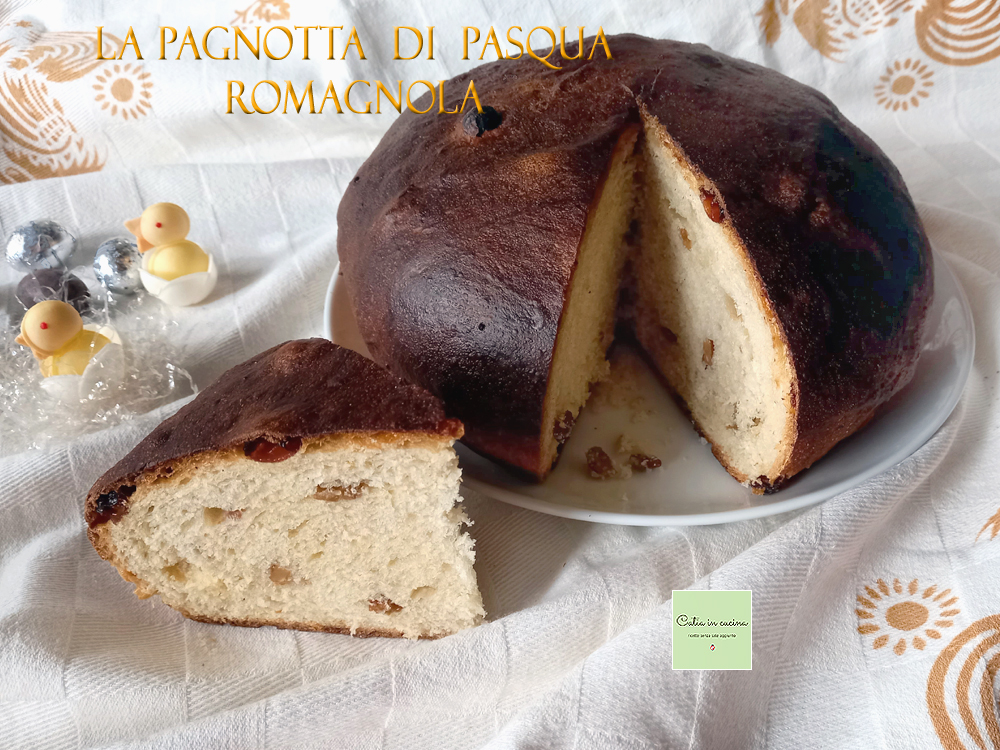
- Difficulty: Medium
- Cost: Economical
- Rest time: 19 Hours
- Preparation time: 20 Minutes
- Cooking time: 30 Minutes
- Portions: 10 slices
- Cooking methods: Oven
- Cuisine: Italian regional
- Region: Emilia-Romagna
- Seasonality: Easter
Ingredients for one Romagnola Easter Loaf
- 1/3 cup liquid sourdough starter (licoli)
- 1 2/3 cups type 0 flour (all-purpose flour)
- 3.5 fl oz water
- the risen pre-dough
- 3/4 + 1 tbsp cup type 0 flour
- 3/4 + 1 tbsp cup Manitoba flour (strong bread flour)
- 1/2 cup sugar
- 3 tbsp lard (or butter)
- 1 egg (large)
- 1 3/4 tbsp anise liqueur (I used Sambuca)
- 1/3 cup raisins
- 6 walnuts
- as needed milk (for brushing)
Tools
- Stand mixer Russel Hobbs
- Pan high-sided
- Cooling rack cake cooling grid
Preparation
Mix 200 g of flour with 100 g of water and 70 g of starter (by hand or with the stand mixer).
Let it rise for 7-8 hours in a bowl, or directly in the stand mixer’s bowl, covered with plastic wrap.

At least half an hour before kneading, soak the raisins in water to plump them up, and let the lard (or butter) soften at room temperature.
Notes: when I used lard I softened it with a spoonful of warm milk; when I used butter I used it soft but not warm, left out of the fridge for a while.
When the pre-ferment is ready (doubled), add it to all the other loaf ingredients.
I mixed everything with the stand mixer, but you can also do it on the work surface if you plan to knead by hand. The dough is soft and a little sticky but manageable by hand.

Knead until you obtain a uniform, well-developed dough, then let it rest for about an hour, after which add the raisins and chopped walnuts.
On another occasion I added walnuts and raisins from the start and didn’t notice significant differences in the final result.
Knead again until the dough shows a soft but visible development.

Leave the dough to rise in the bowl covered with plastic wrap until doubled (it took 9 hours for the lard version and 8 hours for the butter version). Prefer a warm, sheltered place, for example inside the turned-off oven with the light on.

When the dough has doubled, proceed to the final proofing. As I mentioned in the introduction, here are the two shaping options:
– shape the dough as a round loaf and let it proof in a banneton (a test I still need to try) or “free” as I did this time,
– or let it proof in a high-sided pan.
In the first case, if you want a round loaf:
Round the dough (that is, shape it into a ball, tucking the seams underneath) and place it on a baking sheet (I used a tart pan) lined with parchment paper. Moisten the surface by brushing with milk.
Put the dough in the turned-off oven with the light on (or cover it with an inverted bowl) and let it rise until doubled (about 3 hours; in my case it took 2½ hours).

In the second case, if you want a taller shape and bake in a pan:
Place the dough (always rounded) on the bottom of a high-sided pan — I used a glass soufflé dish and lined the bottom with a piece of parchment — and let it rise until doubled (in this case it took 3¼ hours), still inside the turned-off oven preferably with the light on.
If you cannot keep a constant proofing temperature (for sourdough breads the ideal is around 82°F) and you rely on room temperature, it’s natural that the proofing time will vary.

Before baking, brush the surface with milk.
Bake in the oven at 356°F.
After the first 10 minutes lower the temperature to 320°F. Bake for 30-35 minutes, watching the browning of the surface. If necessary, you can switch off the top heating element for part of the baking time.
The crust should be well browned, a deep color. In any case I recommend checking during the last minutes of baking, since a few minutes of inattention can lead to excessive surface “tanning”.

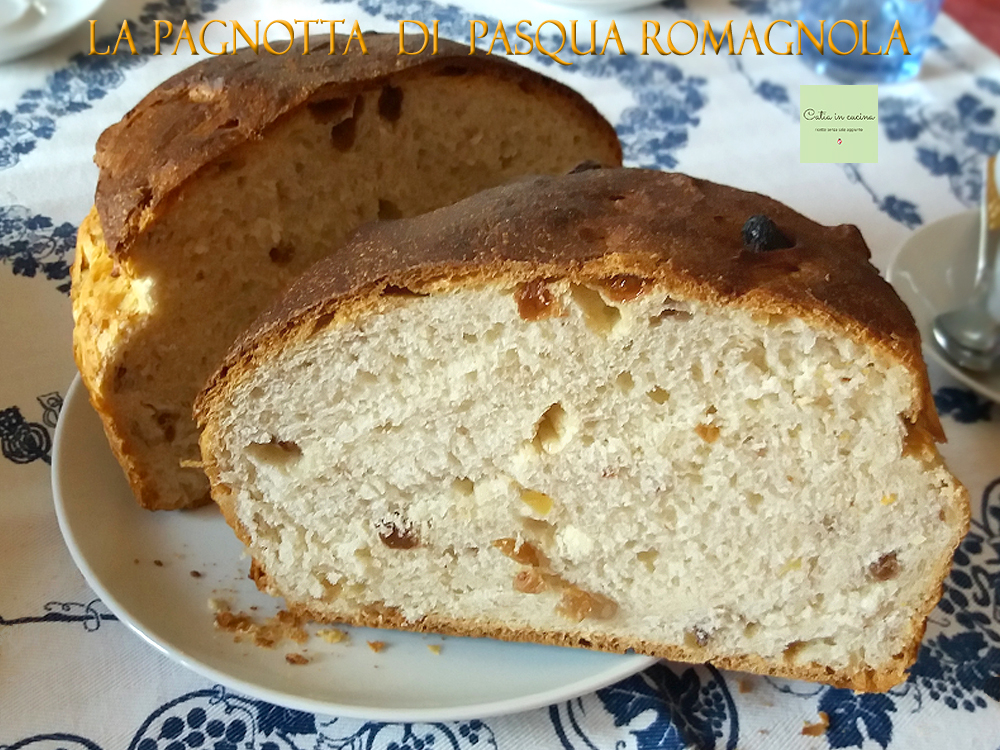
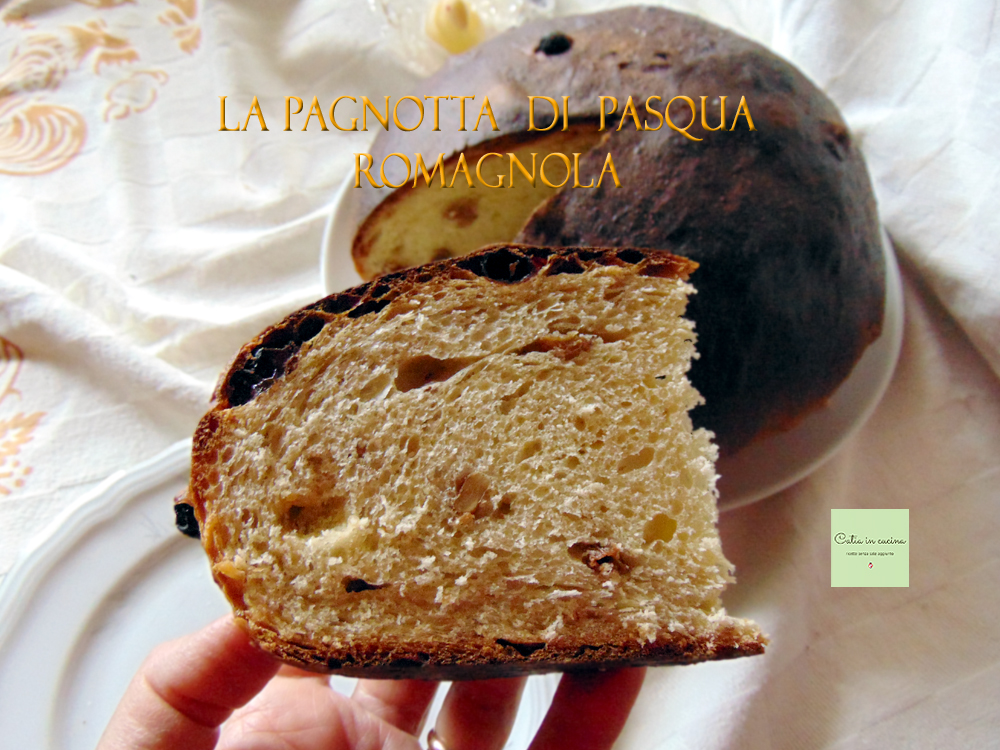
Here is the interior of my two versions:
In the following photo the lard version, baked in the glass pan, photographed on our Easter breakfast table from a year ago (our lockdown Easter we will never forget):
And this is the butter version (very similar to the lard version in taste, texture, and appearance). This is the loaf we ate last Sunday, Palm Sunday:
Now I have to decide which of the two to make again for Easter!
Ahhhh nooo! What’s the problem, I will make both anyway!! 😀
Happy Easter to everyone and enjoy your Easter breakfast!
Send me photos of your Romagnola Easter Loaf!
Follow me!
You can also find me on my Facebook page, on my new WhatsApp channel and on Instagram. If you’d like to chat you can join my group -> Il gruppo di Catia, in cucina e oltre or my second group –> Exactly what I was looking for! You can also visit my Pinterest boards and subscribe to my Newsletter.
I’m waiting for you!!
FAQ (Questions & Answers)
What are the origins of the Romagnola Easter Loaf?
It is said that the Romagnola Loaf was born in Sarsina, an ancient town in the Cesena hills. In reality the loaf is widespread throughout Romagna, albeit with slight differences (walnuts yes or no, anise aroma yes or no) due to the local traditions of each area, province, town or single families. The loaf is a simple, peasant sweet bread made with basic ingredients, sometimes simply “with what was available” (a quote from my father). Traditionally the loaf was (and is) prepared to be served at the table on Easter morning together with the blessed hard-boiled egg. In some parts of Romagna it is also served with salami and red wine, a tradition that does not exist here in my area south of Rimini: our Easter breakfast has always been the loaf eaten with the hard-boiled egg (a bite of egg and a bite of loaf) and, in addition, a slice of crostata with biuda (like this tart by grandmother Francesca).
