
Dear friends, good to see you again. 🙂 Today I leave you with some notes on the basic cooking of barley, in the three types: pearled, hulled and whole.
The idea came to me while preparing the next Light and Tasty recipe (the Filled shortcrust baskets with barley and tofu), which led me to research a bit about barley, and in particular how to cook the hulled barley I bought specifically for the recipe.
Yes, I admit it, I had to research 🙂 because barley is a grain I cook a little too rarely!, although I like it very much.
So I thought of sharing with you what I learned from reading various articles, and in particular two: the information on cooking hulled barley from my faithful and indispensable book Il Cucchiaio Verde, and then this article by my friend Daniela of the blog Timo e Lenticchie, which I found the most detailed and best written.
Some basic information about barley kernels:
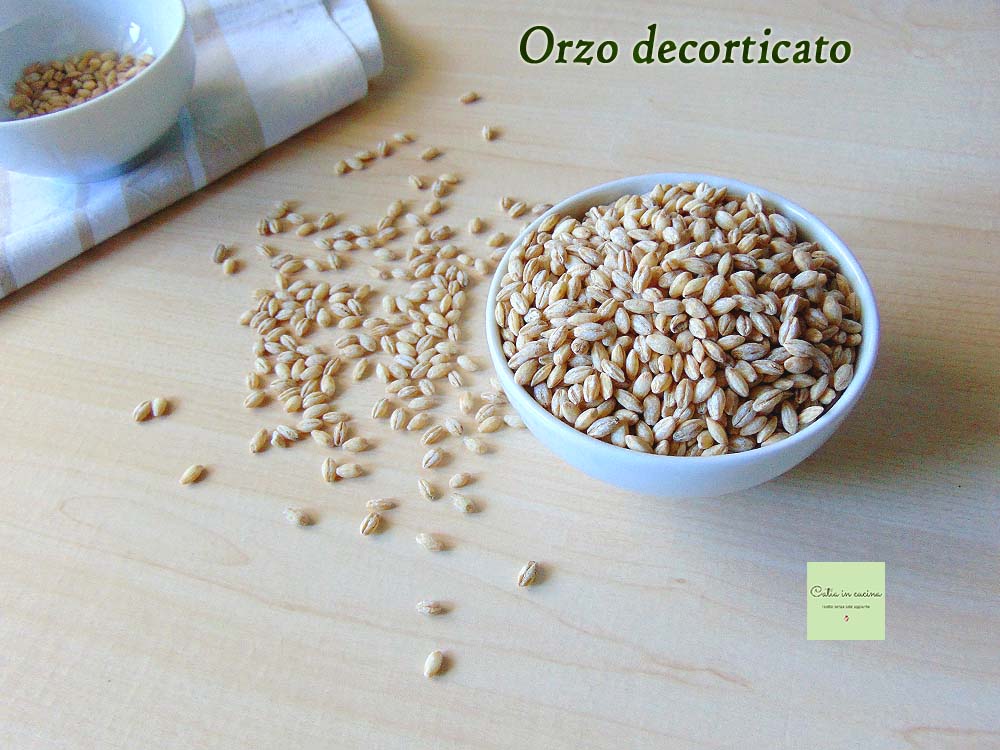
Depending on the refining process, barley is classified as whole, hulled and pearled, plus “orzo mondo” (world barley), which in the publications I read these days is sometimes indicated as whole and sometimes as hulled (that is, “mondato”). This puzzled me a bit – is it whole or is it hulled? – until Daniela clarified the doubt. In fact, in this page she confirmed the suspicion I already had from my own recollections: orzo mondo is an ancient variety of barley that had fallen out of use and which has been reintroduced and cultivated for several years mainly in the Marche region (but also in Umbria), from which only the glume, i.e. the external husk of the kernel, is removed.
In fact – a small personal digression – every time I go grocery shopping in Pesaro, or when we go on holiday to the Marche inland that we love so much, I never fail to buy anise-flavored barley coffee whose package clearly states that it is orzo mondo from Marche cultivation.
Apart from this digression about orzo mondo, which is not available in all regions, returning to the standard classification of barley… which type of barley do you usually buy? You may already know that you can choose between:
– Whole barley: it undergoes no processing and is whole-kernel; as with all whole grains it retains all nutritional characteristics, requires a long soak (24 hours) and prolonged cooking (about 90 minutes).
– Hulled barley: the outer part of the kernel (bran and germ) is removed; it requires an overnight soak (8-12 hours) and cooks in 40-50 minutes, the time may vary depending on the soaking duration.
– Pearled barley: the most refined, it undergoes pearling (removal of the outer covering of the kernels), which avoids the need for soaking and shortens cooking time (30-40 minutes); for obvious reasons this variety is the poorest nutritionally and lacks fiber.
Because whole barley is not always available in supermarkets and is not always convenient to cook due to the long cooking time, and because pearled is the most refined, the most recommended barley for a diet as nutritionally attentive as possible is hulled barley, which retains good nutritional values as only the outermost part of the kernel is removed. In short, it is a good compromise between the three types. The most widespread and used is, however, pearled. Also by me, until now. 🙂 But now that I tried hulled barley I understood it’s worth using it; after all you only have to do the ‘effort’ of soaking it, otherwise there’s not that much difference in cooking terms, while there is a lot in nutritional terms.
Here is how to proceed for the basic cooking of the three types of barley.
I inform you that I have only so far provided photos for the ‘basic cooking hulled barley’ section, but when I cook the other two varieties I will update this page.
Happy reading!
〰 〰 〰
- Difficulty: Easy
- Cost: Inexpensive
- Rest time: 15 Hours
- Preparation time: 5 Minutes
- Cooking methods: Stovetop
- Cuisine: Italian
- Seasonality: All seasons
- Energy 55.54 (Kcal)
- Carbohydrates 12.79 (g) of which sugars 0.13 (g)
- Proteins 1.02 (g)
- Fat 0.20 (g) of which saturated 0.04 (g)of which unsaturated 0.12 (g)
- Fibers 1.73 (g)
- Sodium 89.77 (mg)
Indicative values for a portion of 100 g processed in an automated way starting from the nutritional information available on the CREA* and FoodData Central** databases. It is not food and / or nutritional advice.
* CREATES Food and Nutrition Research Center: https://www.crea.gov.it/alimenti-e-nutrizione https://www.alimentinutrizione.it ** U.S. Department of Agriculture, Agricultural Research Service. FoodData Central, 2019. https://fdc.nal.usda.gov
Ingredients
- 1 cup barley (in kernels, after soaking)
- 2 cups water
Tools
- Bowl
- Colander
- Saucepan
Basic cooking of barley kernels: how to proceed
Wash the barley very well to remove impurities then place it in a bowl to soak in cold water.
After 24 hours of soaking, drain the barley, rinse it and put it in a large pot with water in a 1:3 ratio (one part barley to three parts water).
Cook over the lowest heat for about 90 minutes, until the water is completely absorbed.
Rinse hulled barley under running water, or in a bowl changing the water 3-4 times, until all impurities are gone.
Soak the barley in cold water for about 12 hours (overnight). The soak can be extended depending on the recipe in which it will be used (I soaked it for 15 hours).
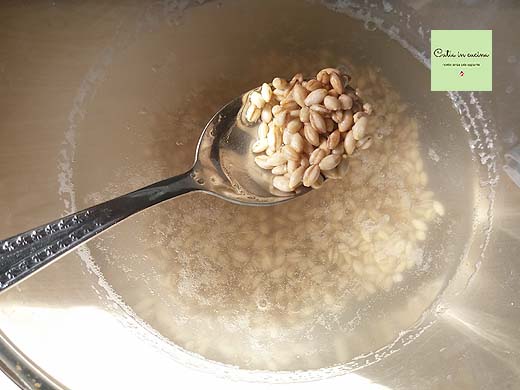
Drain the barley from the soaking water and rinse it.
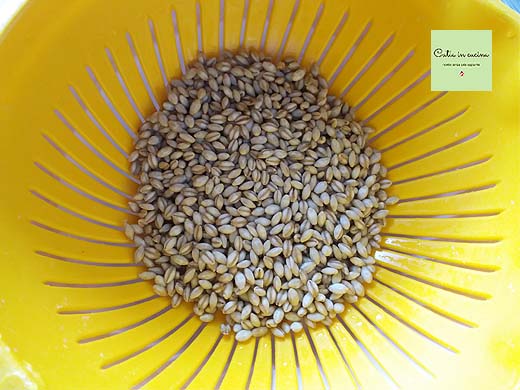
Hulled barley after soaking:
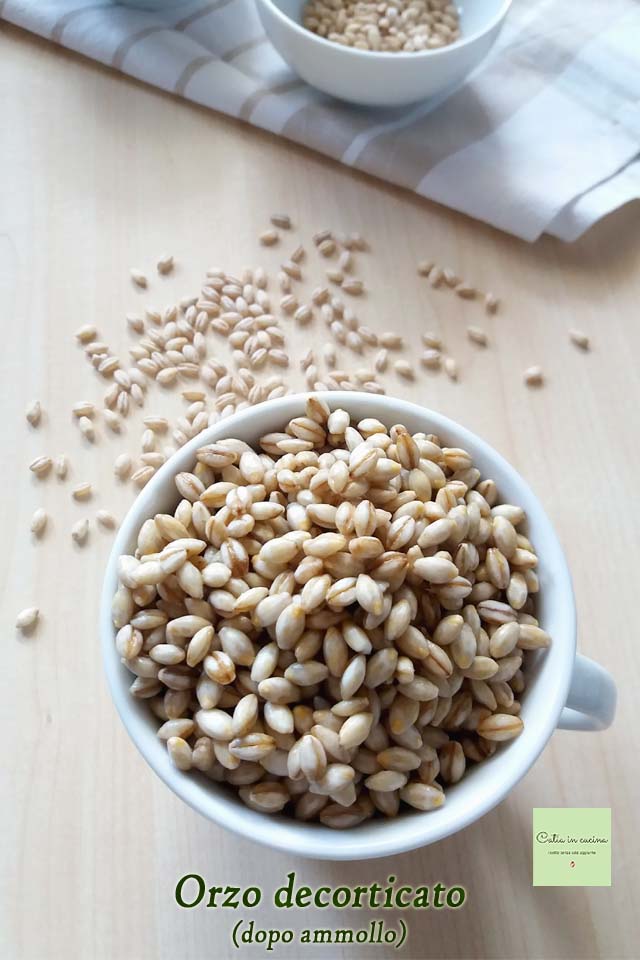
Place it in a pot with water in a 1:2 ratio, that is one part barley (one cup) and two parts water (two cups).
I also tried the 1:3 ratio which I personally recommend only if the barley needs to be cooked for more than 40 minutes, for example if it will be used in a filling or patties. To obtain a normal, separate-kernel cooking, from my tests I recommend the 1:2 ratio. For precision: measure one cup of barley (after soaking) and then two cups of water using the same cup.
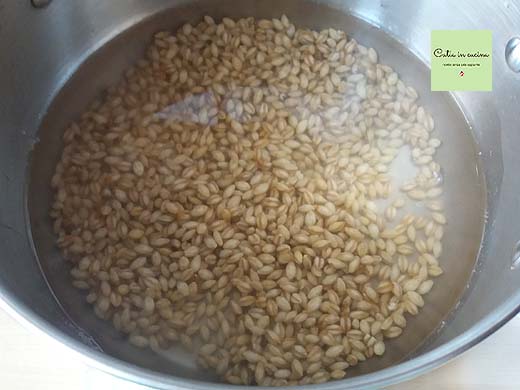
Bring to a boil over high heat then lower the heat to the minimum (I also change to the smallest burner) and cook with the lid closed for 40 minutes.
If the soak was less than 12 hours the cooking time may be longer.
If the ratio between barley and water is correct, and if a lid was used (closed or semi-closed), the barley will be cooked when the water has been fully absorbed.
When finished cooking, let rest with the lid closed for 5-10 minutes.
It is not necessary to stir the barley during cooking, but my advice is to check it from time to time, especially the lid: I found that every 10-15 minutes it is good to open it, or keep it half-closed, to avoid the escape of even a small amount of water due to the foam produced during cooking (this happened to me even though the flame was at minimum and the pot had high sides, I will investigate further to improve this aspect).
If the hulled barley is to be used in a soup, a larger amount of water can be used. If it is intended for a cream or a filling, the cooking time can be extended to soften it as required by the recipe.
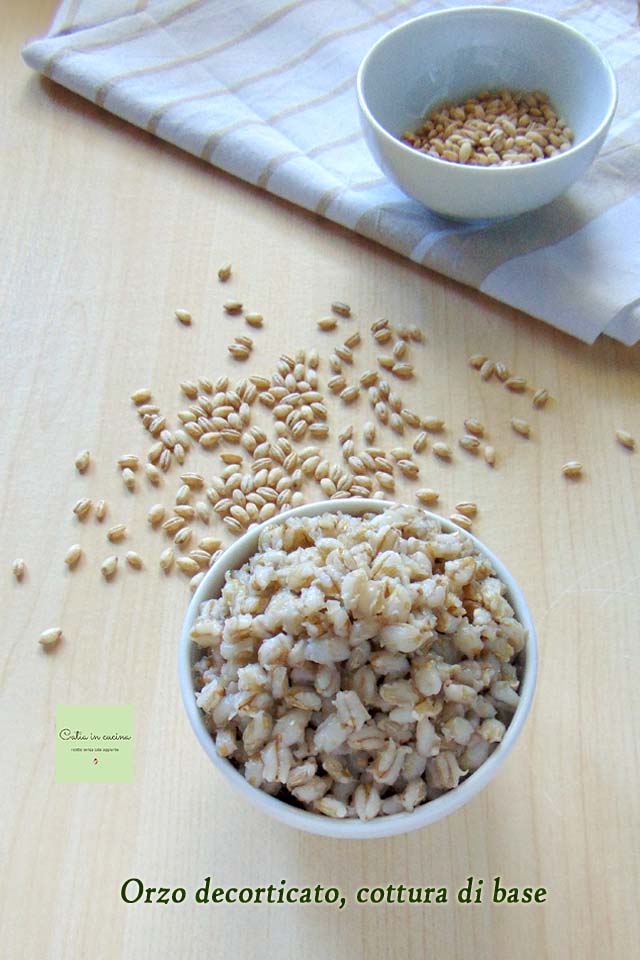
Here is how my hulled barley looks cooked for 40 minutes:
Pearled barley can be cooked without soaking.
Even without soaking, it should always be washed well to remove impurities.
Pearled barley can be cooked by absorption using the same method described above for hulled barley.
Pearled barley is also widely used in soups, as are the other two varieties.
But it is also very suitable for dry recipes: consider the so-called ‘orzotto’, that is cooking similar to risotto, with toasting and adding a little broth at a time.
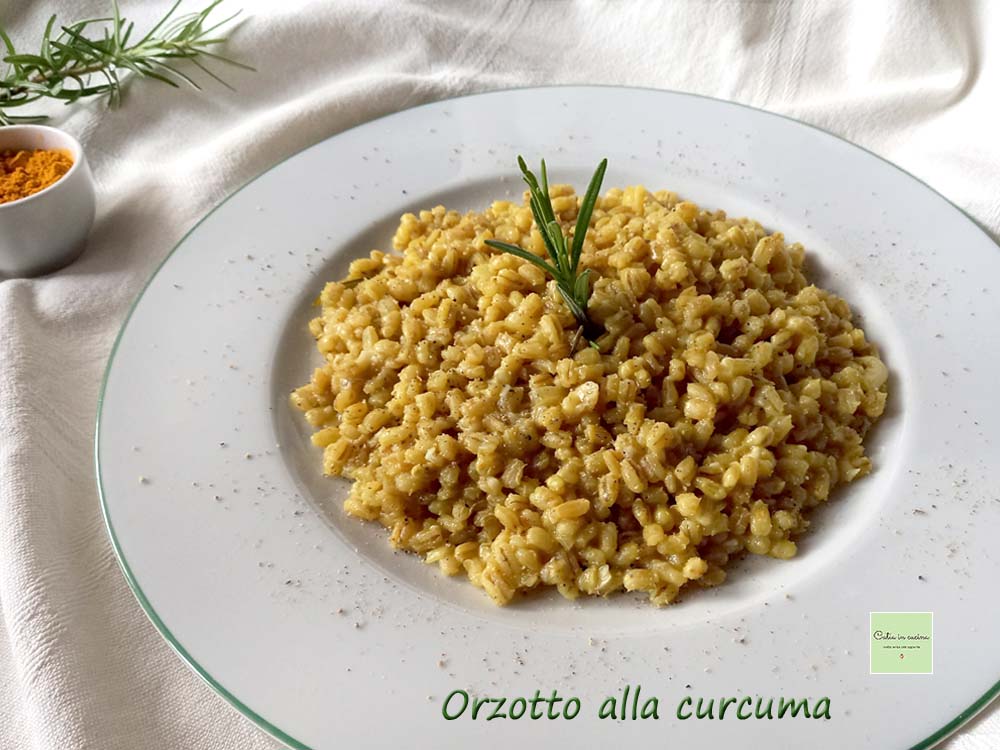
If you’ve never cooked orzotto, try it with turmeric! We liked it a lot!
Barley is very filling, so it is suggested in low-calorie diets; a minimal amount is enough to get a good bowl of soup. Also – like spelt and oats and like pseudocereals (quinoa, amaranth and buckwheat) – barley is a low glycemic index cereal.
Cooking barley is… inspiring 🙂 because it lends itself to use in many different recipes, not only in soups or orzotti which I had cooked so far, as in these two recipes I link here, in case you haven’t seen them yet:
– Brown rice and pearled barley salad
And in these days of experiments I discovered that barley can be used in many alternative recipes, such as fillings or in patties and burgers.
But… Ehhh… If you’re thinking what I’m thinking… No no, the next recipe will be neither a patty nor a burger! 😀 I fully intend to make a…
…ah but by now you already know! A sweet! 😀
Salt-free tips
 Since I cook without salt (you already know that, right?), I did not include it in this tutorial.
If you are not low-sodium like me, but you are cooking barley for a sweet recipe, salt is of course not necessary; if you intend to use barley in a soup or other savory recipe, I invite you to follow my salt-free tips listed below. And why not try a low-sodium approach, it’s good for your health! 😀
If you use salt and are not ready (not yet) to reduce it… according to the book Il Cucchiaio Verde regarding barley cooking, salt should be added when boiling begins. But just a pinch, eh! 🙂
If you’re interested in reducing or eliminating salt, always remember to:
▫ Reduce salt gradually; the palate must adapt little by little and should not notice the progressive reduction.
▫ Use spices. Chili, pepper, curry, nutmeg, cinnamon, cloves, cumin…
▫ Use aromatic herbs. Basil, parsley, oregano, thyme, sage, marjoram, rosemary, mint…
▫ Use seeds. Sesame, pine nuts, almonds, walnuts…
▫ Use pungent vegetables or fruits. Garlic, onion, lemon, orange…
▫ Use my salt-free vegetable granulate and gomasio.
▫ Prefer fresh foods.
▫ Avoid boiling in water; prefer cooking methods that do not disperse flavors (griddle, parcel, steam, microwave).
▫ Avoid bringing the salt shaker to the table!
▫ Allow yourself an occasional indulgence. It is good for the mood and helps perseverance.
If you don’t want, or cannot, give up salt:
▫ You can still try my savory recipes seasoning according to your habits.
Follow me!
On my WhatsApp channel and on Instagram, on the Facebook page, on my Pinterest boards, in my two groups: Il gruppo di Catia, in cucina e oltre and Proprio quello che stavo cercando! and if you feel like it… subscribe to my Newsletter
