
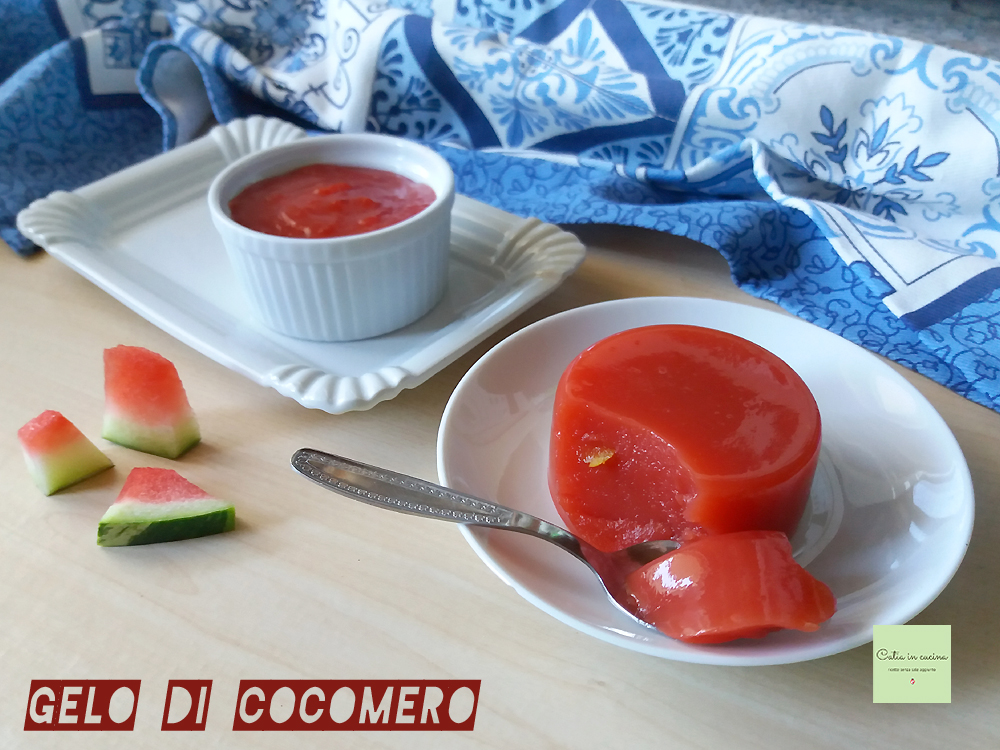
Let me introduce my watermelon jelly.
I called it this way, but I know this dessert is typically called watermelon jelly or melon jelly, or mellone. Relatively few recipes I’ve seen online are titled watermelon jelly, which is why I decided not to use the more common title, in order to honor the original recipe by avoiding usurping its more typical title. Because this watermelon jelly of mine, made by me, with my hands and my innate and unstoppable urge to cook freely, is not the true original recipe. (But I do have a ‘more original’ recipe to pass on to you, and you will find it written among the ingredients).
By chance, I happened to have this unique opportunity to transform a few kilos of watermelon into recipes. In the course of a single day and starting with an innocent ‘test’ marmalade, I ended up with four recipes in my hands, unveiled in a near-endless domino effect of marmalade-jelly-marmalade-jelly-marmalade-jelly…
In short, it’s one of those cases where – to quote a fellow blogger with whom I have many affinities (Zeudi from the blog Cucinoconpoco), (Zeudi, how much we understand each other!) – one of those cases, I was saying, where I read a recipe, try it, and then improvise, or as I say: do it however it comes.
Only this time I couldn’t stop anymore and I entered a loop… gosh, I didn’t know that cooking watermelon releases an i n f i n i t e amount of juice!! 😂
If you’re interested in the ‘test’ marmalade, I ask you to be a little patient and wait a few days, because of the three versions I made (all three ‘test’), I haven’t yet decided which one to publish, since one was liked by me, the other by my husband, the third… well, we’ll talk about it again… 😀 (update: you will find everything told in the marmalade recipes HERE and HERE).
In return, I’ll give you two recipes for the watermelon jelly: mine, the one I improvised, and Evelin’s. Evelin was so kind to give me her watermelon jelly recipe in a conversation on fb (in the post about the photo of the half watermelon weighing 11 kg, in which many of you gave me lots of ideas, and I thank you all from the bottom of my heart 😊).
I swear that initially, I wanted to reproduce Evelin’s recipe diligently, but then… not by my will but because of events… that is… because of the marmalade… in the end, my watermelon jelly turned out like this (as I tell you in the procedure).
☀️ Then, I’ll also leave you the links to the jelly I made with the peels: 👇
And I’ll add two other equally fresh jelly ideas, lemon and orange: 👇
- Difficulty: Easy
- Cost: Economical
- Rest time: 2 Hours
- Preparation time: 5 Minutes
- Portions: 2
- Cooking methods: Stovetop
- Cuisine: Italian
- Seasonality: Summer
Ingredients
- 8.8 oz Watermelon juice (obtained from cooking the marmalade, see link in steps.)
- 0.7 oz Cornstarch (maizena)
- Lemon (juice and zest)
- 8.8 oz Watermelon juice (obtained by blending and filtering the pulp)
- 0.7 oz Cornstarch (maizena)
- 0.7 oz Sugar
- to taste Cinnamon
- to taste Chocolate chips
- to taste Chopped pistachios
Tools
- Saucepan
- Strainer
Steps
You’ll discover that apart from the aromatic differences (my recipe is lemon-flavored and Evelin’s is cinnamon-flavored), the differences between the two recipes are not striking; the procedure in both cases is: juice+cornstarch+cooking+cooling.
The substantial difference lies in the juice: the original jelly recipes (all the ones I’ve seen) involve using blended watermelon pulp or passed through a food mill (raw) and then filtered, while my recipe is in a sense an anti-waste recipe, born from the awareness that since watermelon is a particularly watery fruit… either you remove all the water that the marmalade produces, or you make the jelly the classic way. Then I wonder: but in that case… what happens to the pulp after filtering?…
…eh I told you… it’s a loop!! 😀
If I had started with the jelly, I would certainly have used the raw juice as in Evelin’s recipe, after which I would have decided to make the marmalade with the pulp I had left, since I would never have thrown it away.
But since it happened that the idea of the marmalade occurred to me first, and I found myself mid-process with these two choices, either boil the marmalade for hours until the juice is gone, or remove the juice from the marmalade, I chose the latter. In short, thinking: “I’ll make the jelly with this juice” was an automatic thing. I’d dare to say there was no choice, given my anti-waste nature.
And now that you’ve read all this preamble (did you really??), you also have the answer to what you surely wondered about when reading the ingredients: why is sugar missing from Catia’s version? Answer: It’s there, the marmalade was sweetened (so its juice was sweetened!).
Conclusion: if making watermelon marmalade (made with pulp and without peels) is not in your plans, or if after reading up to here you’ve decided not to follow my example and venture into marmalade only after making the jelly, or if you simply don’t like cinnamon and prefer to use lemon, then make a mix of the two recipes and consider that the ratio between watermelon juice and sugar is: 250 g of juice + 20 g of sugar (except for different degrees of ripeness and sweetness of the watermelon that you will have to evaluate yourself).
And here is – finally! you will say – the procedure!
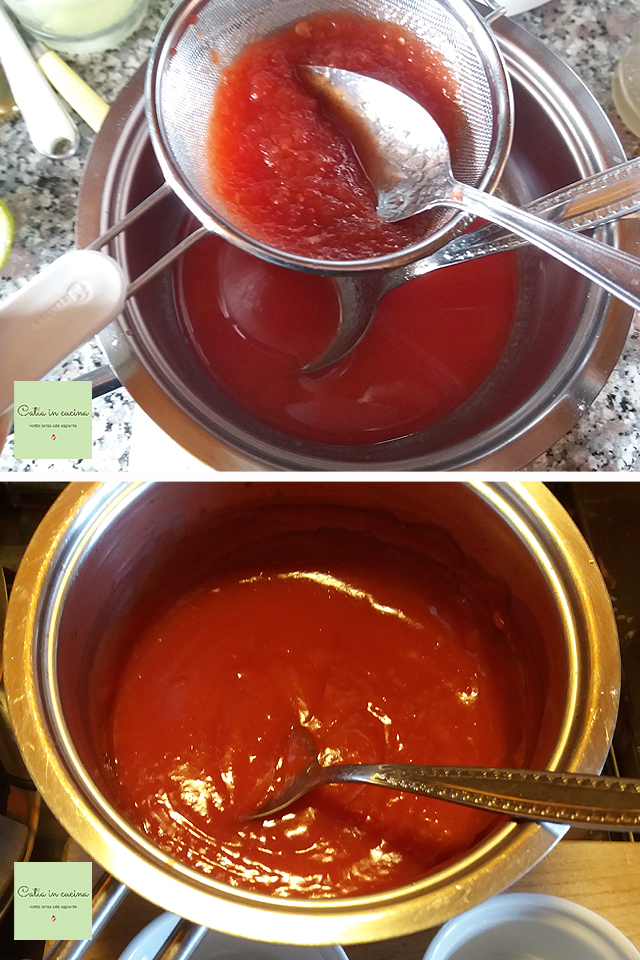
These two photos show the filtering of the marmalade to obtain the juice, and the jelly already thickened after cooking.
Pour the cornstarch into a saucepan.
Add a small part of the juice (filtered and free of fibers and/or seeds) and mix well with a spoon until the cornstarch dissolves, making sure there are no lumps.
Pour the rest of the juice. (Add sugar if using raw watermelon juice, but if using juice extracted from the marmalade, it’s not needed).
Mix well.
Add the lemon juice and grated zest.
I used half a lemon but in hindsight, a whole lemon fits. Of course, it’s a matter of taste.
Turn on the heat and bring to a boil while constantly stirring.
When it thickens and takes on a shiny color, it’s ready. Just a couple of minutes are enough.
Transfer into cups or single-serving pudding molds (with 250 g of juice, you get 2 molds).
Let cool at room temperature, then store in the fridge for at least 2 hours.
Enjoy! 🤩
Delicious Note
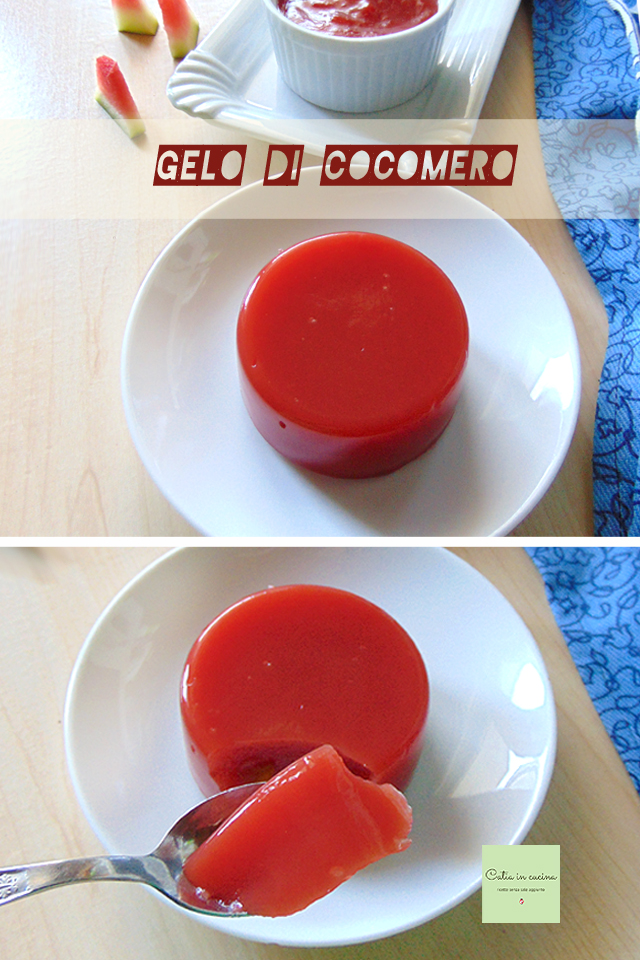
Chopped chocolate and pistachio crumbs are an ideal complement both as a decorative element and for adding a pleasant crunchy note. For my lemon-flavored version, I found the combination with pistachio perfect (I tried it after taking the photos). And you? Will you let me know what you prefer?
I’ll see you in the next recipe! (i.e., the watermelon marmalade).
In the meantime…
Visit me on social media!
If you’d like to chat, remember you can also find me on my Facebook page, and you can join my group -> Catia’s group, in the kitchen and beyond. Also, you can visit my Pinterest boards and Instagram profile, and you can sign up for my Newsletter and my new WhatsApp channel
