
These water and flour gnocchi are not common in my house, so much so that I didn’t even know the correct name! Can you tell me what they’re precisely called? 😊
Yes, I’m asking you, those of you who have them in your DNA, who learned to make them from your mom or grandma, who have known them forever: are they called flour gnocchi? or water and flour gnocchi as I decided to name them? or cooked flour gnocchi? or simply gnocchi without potatoes?
The only gnocchi that existed in my home were always just potato ones, and only as an adult did I discover that you could make gnocchi without potatoes, and that there are also so many variations that you can experiment to your heart’s content, which for me is the best.
Years ago, I tried making zucchini gnocchi, do you remember them? (they were even liked by the family members who don’t like zucchini! Such a miracle that allowed me to make them a couple more times!).
But lately, I’ve been focusing on the most basic version: the water and flour gnocchi I’m telling you about today. They’re super quick to make, no time lost cooking potatoes, three minutes and the dough is ready, and shortly after, with a few quick moves, the rolls are ready, and then while waiting for the water to boil, so are the gnocchi. It almost takes more time to cook the sauce than to make the gnocchi.
Another merit of these water and flour gnocchi is that they never have consistency problems – with potatoes, if you don’t have the right ones, it can be a problem – instead, these have always turned out nice and firm.
Conclusion: water and flour gnocchi are total practicality + guaranteed success made gnocchi.
Ready for the recipe?
⚬ ⚬ ⚬
More gnocchi? Here they are! 👇
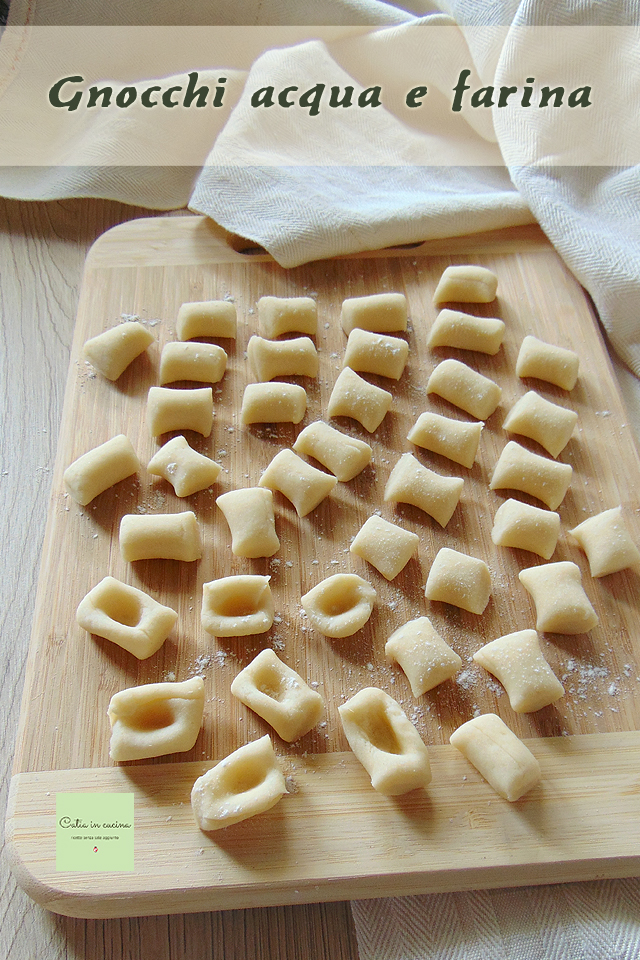
- Difficulty: Very Easy
- Cost: Very Cheap
- Preparation time: 20 Minutes
- Portions: 4
- Cooking methods: Boiling
- Cuisine: Italian
- Seasonality: All Seasons
Ingredients
- 3.5 cups Flour 1
- 1.9 cups Water
Tools
- Pot
- Spoon
- Skimmer
- Pastry Board
- Knife
Preparation
Bring the water to a boil and when it boils, lower the heat to a minimum and pour all the flour into the pot.
Quickly stir with a long-handled spoon until the flour detaches from the sides of the pot (which happens almost immediately) and gathers into a coarse dough.
This is a very quick operation, as the flour absorbs the water in a few seconds. For this reason, after a couple of tries, I abandoned the 50/50 water/flour ratio I initially tried in favor of a greater amount of water: perhaps because I usually use flour type 0 or 1 and not 00 (which I found in some recipes), or perhaps because I’m not fast enough with the spoon, but with half water and half flour, the flour clumped too quickly and there were lumps left in the dough. It’s true that they would mix in during kneading, but I felt they left the flour raw, which could be tasted a bit in the final result.
Transfer the dough onto the work surface and knead it immediately (as soon as your hands can withstand the heat).
It’s best to work the dough while it’s hot, you can divide it into two or three pieces to help dissipate the heat if needed.
When the dough is well mixed and smooth, you can cover it with a bowl and let it rest for 15-30 minutes (during which I usually prepare the sauce).
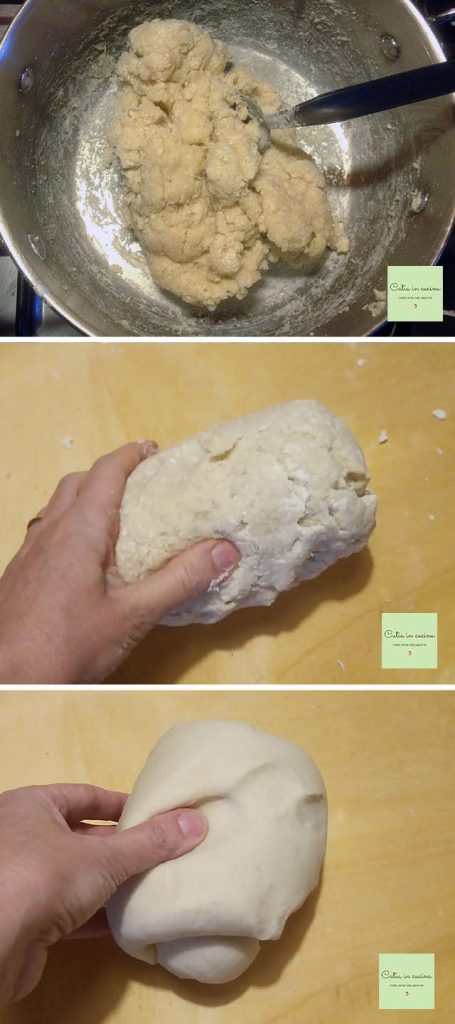
If you’re in a hurry, you can proceed directly with making the gnocchi without resting; I tried it and didn’t notice any significant difference in the final result.
To make the gnocchi, proceed in the classic way: form the rolls, cut the gnocchi, and – as is usual in my house – press each gnocco with the tip of your index finger, one by one, to form an indentation.
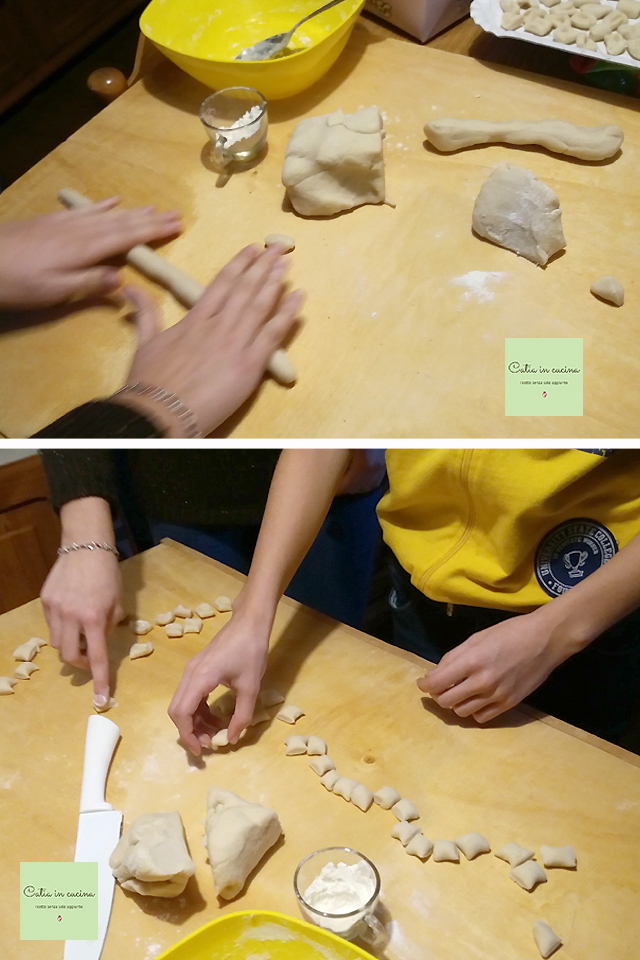
To speed up, you can use both hands, i.e., both index fingers, which I can’t show here as I have to hold the camera with one hand. 😊
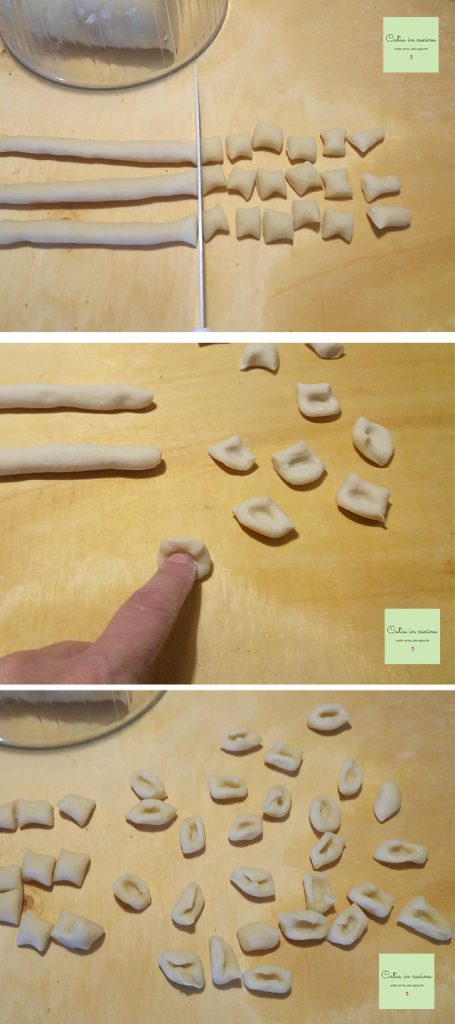
The indentation is a tradition in my house. My mom always made her potato gnocchi like this (and I’ve always done the same) because with the indentation, each gnocco catches the sauce better.
Among the videos on my Facebook page, you can see this short video showing how easy it is to make this ‘indentation of my homemade gnocchi’ (and probably of many other homes). Take a look!
If you don’t like this method – or if you’re used to rolling the gnocchi over the tines of a fork or on the specific gnocchi board – it’s fine, this base dough is malleable and can be shaped in different ways.
And then the beauty of these gnocchi manipulations, whatever they are, is that they are a great way to entertain or have our kids ‘work’ (depending on their age). 😊
Here they are, the hands of my kids!
Final step: cooking.
As with all gnocchi, cooking is very quick: pour the gnocchi into the boiling water, stir them, wait for the water to return to a boil, and for the gnocchi to float to the surface. At that point, scoop them out with a slotted spoon and transfer them to the pan with the sauce.
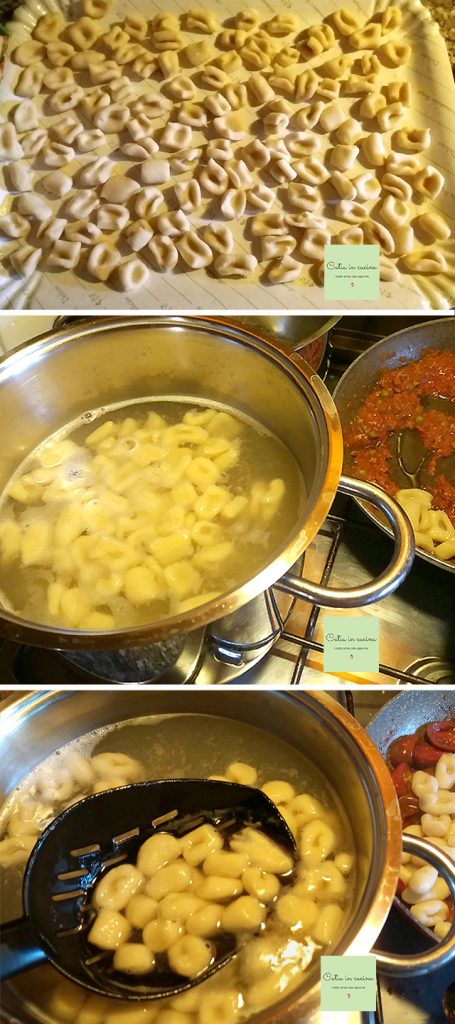
If you decide to make a large batch, these gnocchi can be frozen (even potato ones store well in the freezer).
I tried freezing them the last time I made them, that is, when at the very last moment while I was rolling out the dough… my husband showed up with pizzas!!! 😊 so I quickly finished preparing them and put them in the freezer.
A recommendation: to freeze the gnocchi in the best way, place them in the freezer spread out and separated from each other (on a tray like the one you see in the first of the three previous photos). After less than an hour, they will be firm and dry enough to be transferred into a freezer bag without fear of turning into a single frozen mass.
Here they are, my frozen water and flour gnocchi:
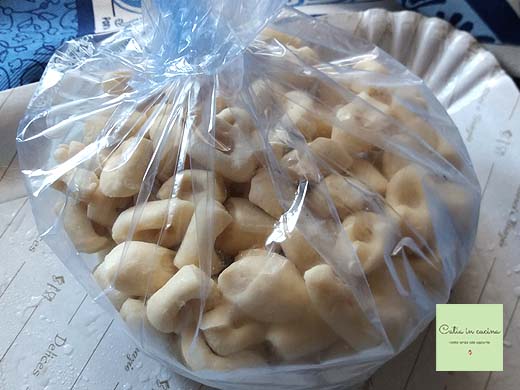
When cooking, frozen gnocchi should be treated the same as fresh ones: they are dropped into boiling water (while still frozen) and waited to float. Naturally, they will take a few more minutes to float because they need time to thaw, and because the water will take longer to return to a boil. The final result will be excellent and identical to freshly made gnocchi.
Lastly, I also want to point out that if you don’t have time to form the gnocchi right away, you can store the dough in the fridge, wrapped in plastic wrap. In this case, when making the gnocchi, it’s advisable not to work the dough while it’s cold but to take it out of the fridge in advance, giving it time to warm to room temperature.
Enjoy!
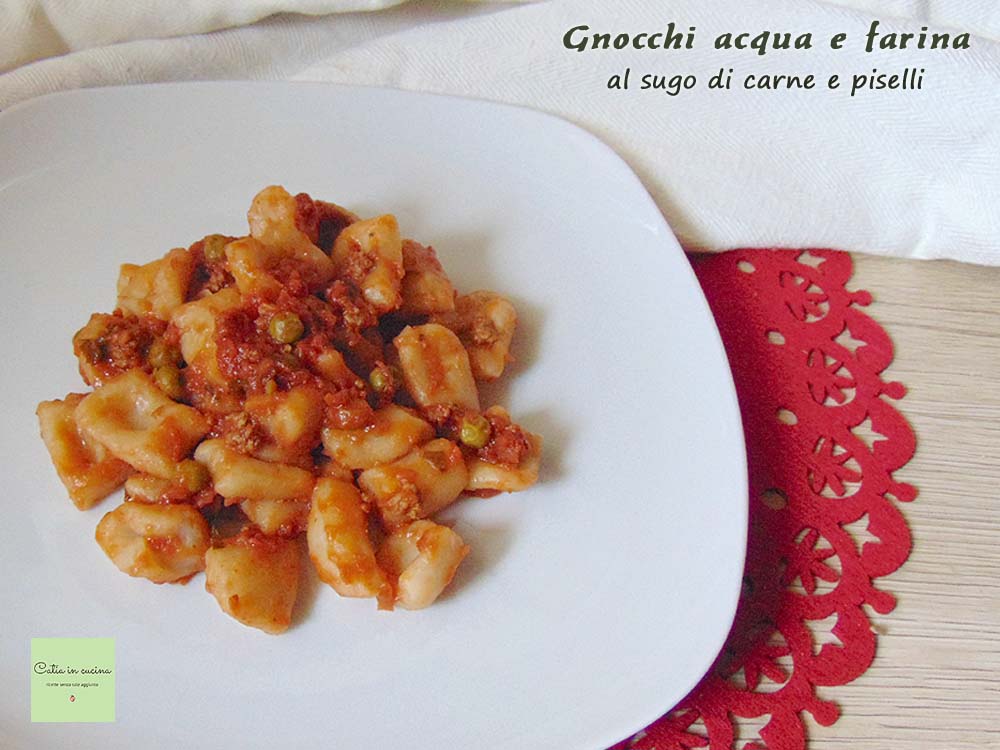
I leave you with a photo of my flour gnocchi dressed with a classic sauce: meat and pea sauce. Then in the next recipe I’ll talk about a more ‘modern’ but equally tasty sauce. 😊
See you soon!
Salt-Free Tips
 Today I don’t have any special salt-free tips except to renew my invitation to not salt the cooking water.
My water and flour gnocchi, just like potato ones, are salt-free even in the dough, and they are delicious with a good unsalted sauce. It’s all about getting used to it, but if you follow my tips, you already know this! 😊
If you are interested in reducing or eliminating salt, always remember to:
■ Decrease salt gradually, the palate has to get used to it gradually and shouldn’t notice the progressive reduction.
■ Use spices. Chili pepper, pepper, curry, nutmeg, cinnamon, cloves, cumin…
■ Use aromatic herbs. Basil, parsley, oregano, thyme, sage, marjoram, rosemary, mint…
■ Use seeds. Sesame, pine nuts, almonds, walnuts…
■ Use spicy vegetables or fruits. Garlic, onion, lemon, orange…
■ Use my salt-free vegetable granule and the gomasio.
■ Prefer fresh foods.
■ Avoid cooking in water, prefer cooking methods that do not disperse flavors (grill, foil, steam, microwave)
■ Avoid bringing the salt shaker to the table!
■ Occasionally break the rule. It’s good for your mood and helps you stick to it.
If you don’t want or can’t give up salt:
■ You can still try my recipes by salting according to your habits.
Follow Me!
On my WhatsApp channel and on Instagram, on my Facebook page, on Pinterest boards, in my two groups: Catia’s group, in the kitchen and beyond and Exactly what I was looking for! and if you want… subscribe to my Newsletter
