
Saint Blaise’s focaccia belongs to that simple and quiet cuisine that doesn’t aim to amaze but to accompany a gesture. On February 3rd, the day dedicated to Saint Blaise, an essential bread was prepared at home, often in the shape of a low focaccia, to take to church for the blessing of the throat. It wasn’t a festive food nor a rich recipe: it was a bread made with what was available, with flour, water, yeast, and salt, without aromatics and decorations, because what mattered was not the flavor but the meaning.
In many families, the focaccia replaced the traditional loaf simply because it was more practical to cook and transport. It was prepared in a pan, spread with oiled hands, marked with a small cross in the center, and baked until it remained light, soft, almost humble. After the blessing, it was broken with hands and shared, or stored to be consumed in the following months, especially in case of a sore throat, according to a popular devotion passed down over time.
It includes no sugar, no milk, no aromatic herbs, or salt on the surface. It is a focaccia with the texture of bread and the appearance of a flattened bread, designed to be simple, sober, and recognizable. Even the oil is used sparingly, only to oil and protect the dough, without making it glossy or crunchy like in modern versions.
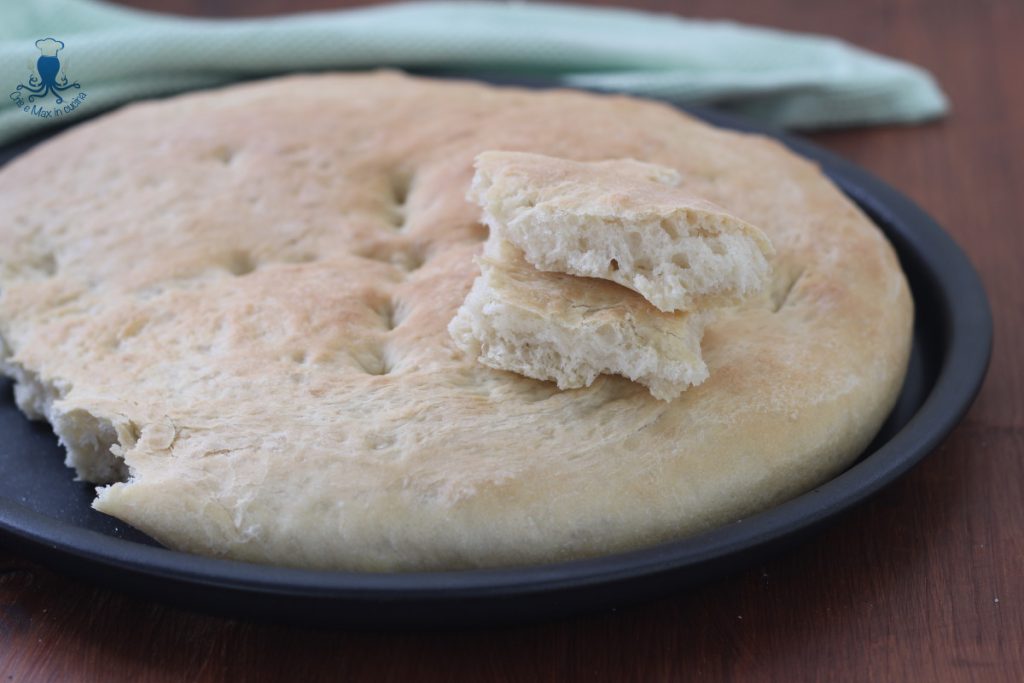
- Difficulty: Very easy
- Cost: Cheap
- Rest time: 4 Hours
- Preparation time: 15 Minutes
- Portions: 1 focaccia
- Cooking methods: Oven
- Cuisine: Italian
- Seasonality: Saint Blaise
Ingredients for Saint Blaise’s focaccia:
- 4 cups all-purpose flour
- 10 oz warm water
- 0.25 oz dry yeast (or 0.7/0.9 oz fresh)
- 2 tsp fine salt
- 3 tbsps extra virgin olive oil
- 1 tbsp extra virgin olive oil
Tools for Saint Blaise’s focaccia:
- 1 Bowl
- 1 Pan round diameter 11/12 inches
- 1 Oven De Longhi
Steps for preparing and baking Saint Blaise’s focaccia:
Pour the warm water into a large bowl and dissolve the yeast in it, stirring slowly until it disappears completely. Then add the flour, a little at a time, starting to knead slowly, without rushing, as it was done in the past. When the dough begins to gain consistency, add the extra virgin olive oil and continue working until the mass becomes soft and uniform. Only at this point add the salt and knead again, until the dough is elastic, smooth, and pleasant to the touch.
Shape into a ball, cover it with a clean cloth and let it rest in a quiet spot in the kitchen. During rising, the dough grows slowly, doubling in volume, it will take 2/3 hours depending on the warmth of the room.
When the dough has risen well, oil a round pan and gently transfer it inside. Spread it with oiled hands, without using a rolling pin, guiding it towards the edges without pressing too hard. With your fingertips, form dimples on the surface, then make a small cross in the center, with a simple and discreet gesture, as a traditional sign before baking. Finally, brush the surface with a little extra virgin olive oil.
Cover the pan again and let it rest for another twenty minutes. This second rest serves to relax the dough and make it softer after baking. Meanwhile, heat the oven.
Bake the focaccia in a static oven at 392°F (200°C) preheated and cook for 18/20 minutes until it stays light, just golden, without drying out. Once out of the oven, let it cool: this focaccia is not to be cut, but broken with hands, like bread, following tradition.
Curiosities and traditions
– A part of Saint Blaise’s focaccia, according to tradition, was kept as blessed bread. A small piece was broken in case of a sore throat, precisely because of its connection to the devotion towards Saint Blaise.
– Before baking, the dough was marked with a small cross in the center. It was not a decoration, but a symbolic gesture, made to distinguish the bread destined for blessing.
– After the blessing, the focaccia was not cut with a knife but broken with hands, like bread. This gesture was also part of the tradition.
– In some families, the focaccia was left to bake for a few more minutes, to dry it slightly and preserve it longer.
FAQ (Frequently Asked Questions)
Can I prepare it with a bread machine?
Yes. You can use the bread machine only for kneading and first rise (program “dough”), then spread the dough in the pan and perform a second rise before baking.
Is it mandatory to make the cross in the center?
No, but it is a traditional gesture.
The cross should be incised before baking, simply and discreetly. The size of the cross is 1.5/2 inches for each side and 3/4 inches total from tip to tip; it should be a mark, not a deep cut.Can I add rosemary or coarse salt?
No, if you want to stay true to tradition.
This focaccia was born as blessed bread, not as modern focaccia.Is a round or rectangular pan better?
A round pan is better: it recalls the shape of bread and is more consistent with tradition.
