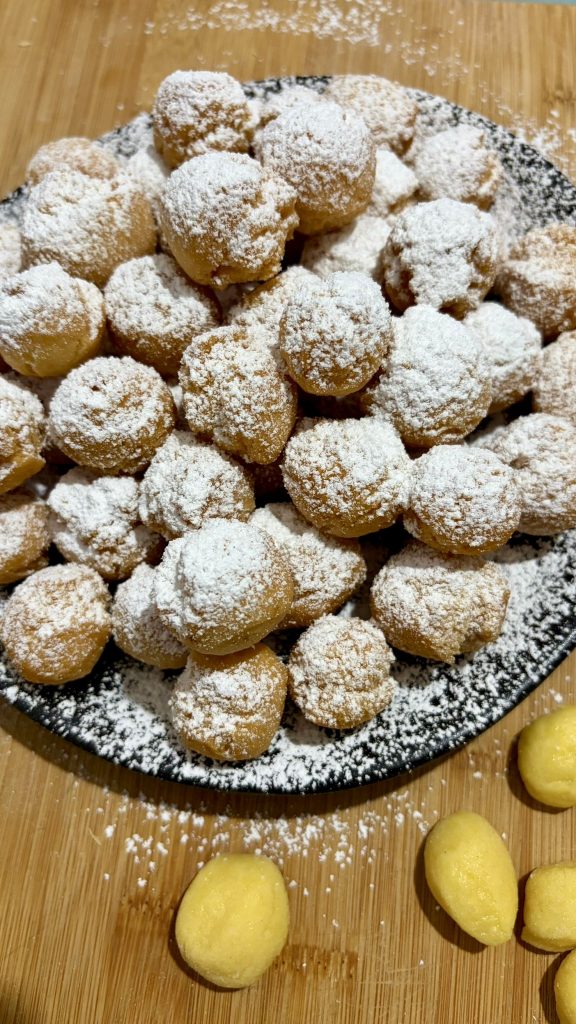
Grandma’s classic castagnole are prepared with a simple dough that can be worked by hand, scented with lemon, and fried until crispy on the outside and flaky on the inside. A traditional family recipe perfect for Carnival.
These are not soft spoon castagnole… these are the real castagnole, my grandmother’s ones.
The ones made without a digital scale, using spoons as measures and flour-dusted hands on the wooden table, while the kitchen filled with the scent of lemon and hot oil.
I hadn’t written down the recipe anywhere. I recovered it thanks to my aunt, who told it to me by voice, as it was done in the past: “flour, eggs, a bit of sugar, oil, liqueur, and lemon zest.”
The result is more compact castagnole, to be formed like gnocchi, rolled between your hands, and then plunged into hot oil, where they become golden, crispy on the outside, and flaky to the bite.
They are the castagnole of celebrations, trays full at the center of the table, and hands reaching for “just one more.”
- Difficulty: Easy
- Cost: Economical
- Preparation time: 10 Minutes
- Portions: 10
- Cooking methods: Stovetop
- Cuisine: Italian
- Seasonality: Carnival
- Energy 276.94 (Kcal)
- Carbohydrates 44.55 (g) of which sugars 9.22 (g)
- Proteins 8.23 (g)
- Fat 7.28 (g) of which saturated 1.56 (g)of which unsaturated 5.22 (g)
- Fibers 1.11 (g)
- Sodium 31.96 (mg)
Indicative values for a portion of 90 g processed in an automated way starting from the nutritional information available on the CREA* and FoodData Central** databases. It is not food and / or nutritional advice.
* CREATES Food and Nutrition Research Center: https://www.crea.gov.it/alimenti-e-nutrizione https://www.alimentinutrizione.it ** U.S. Department of Agriculture, Agricultural Research Service. FoodData Central, 2019. https://fdc.nal.usda.gov
Ingredients
- 4 cups all-purpose flour
- 4 eggs
- 4 tbsps sugar
- 4 tbsps vegetable oil
- 4 tbsps sambuca (or similar)
- 1 lemon (zested)
- 1 packet baking powder
Tools
- 1 Hand Whisk
- 1 Bowl
- 1 Pot
- 1 Lemon Grater
👩🍳 Step-by-Step Procedure
In a large bowl, combine the flour, sugar, eggs, vegetable oil, liqueur, baking powder, and grated lemon zest.
Start mixing with a fork or spoon.
When the dough becomes more consistent, transfer it onto a lightly floured surface and continue to work it by hand.
It should be soft like shortcrust pastry, smooth, and non-sticky. Do not add too much flour: only enough to prevent it from sticking to the surface.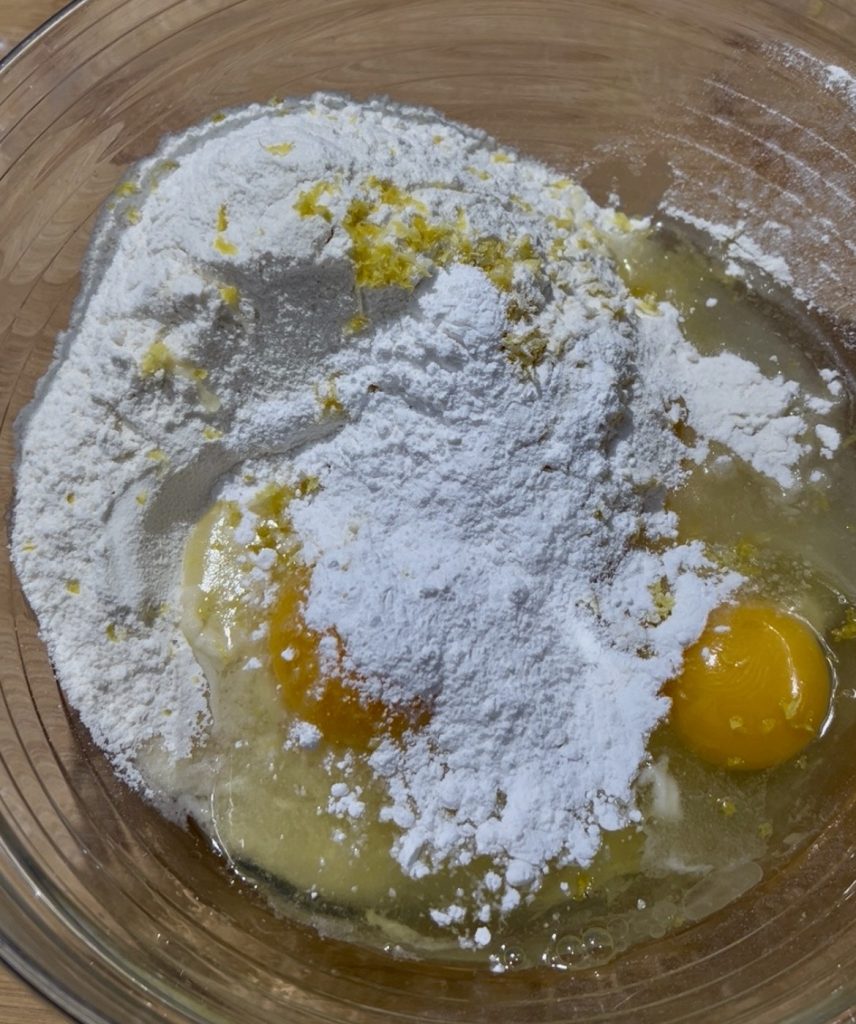
Take a piece of dough and stretch it with your hands into a log, just like making gnocchi.
With a knife or spatula, cut it into regular pieces.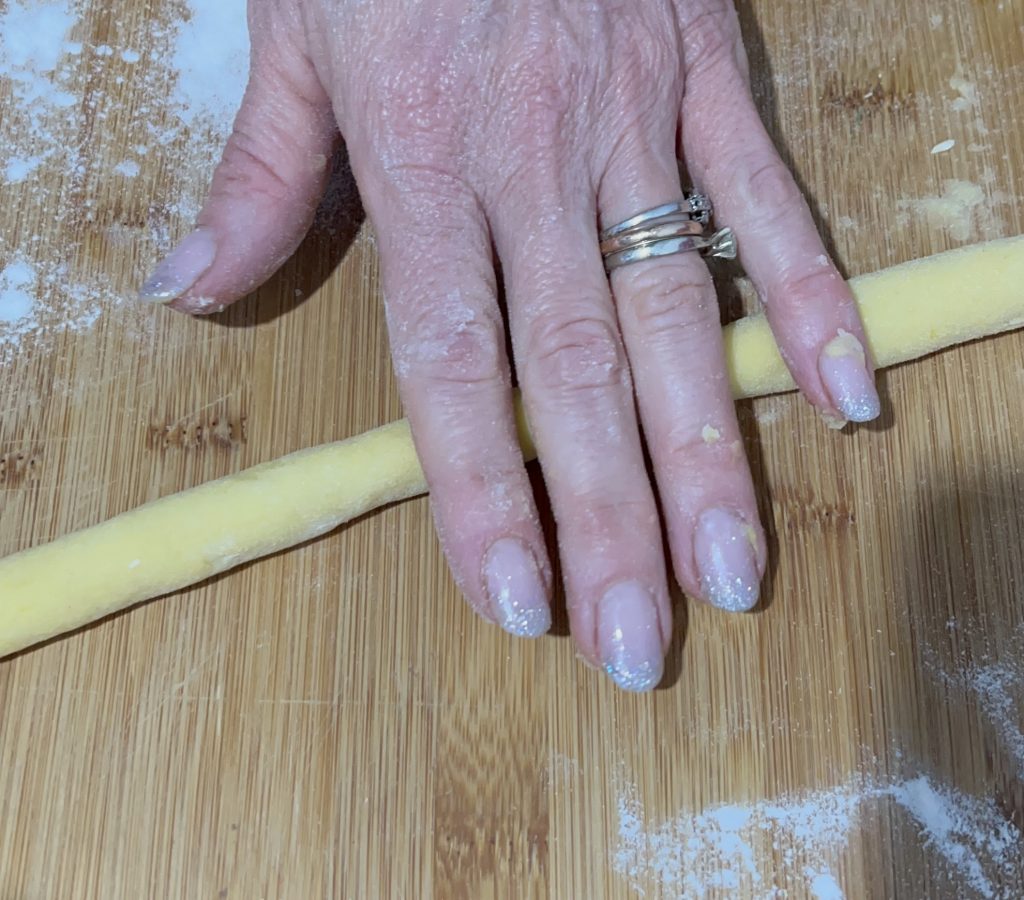
Take each piece and roll it between your palms into a round ball.
As you go, place the castagnole on a lightly floured surface.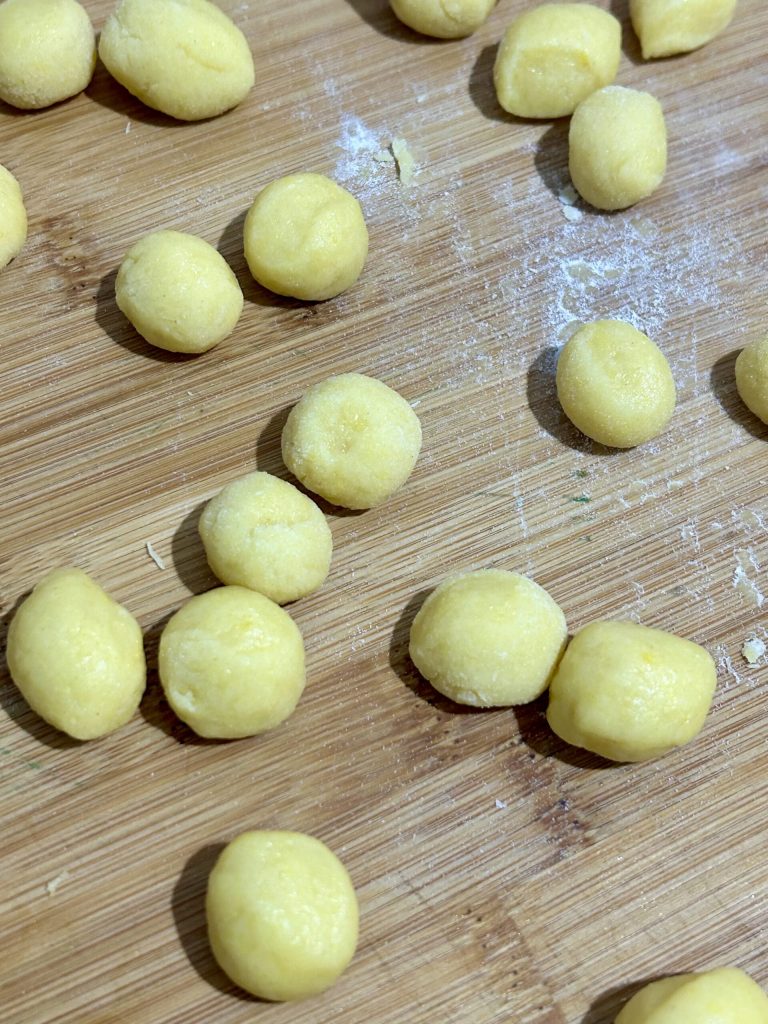
Heat plenty of oil in a high-sided pot. When the oil is hot, dip a few castagnole at a time.
Fry them, turning often, until they become golden and puffy.
Drain them with a slotted spoon and let them drip on absorbent paper.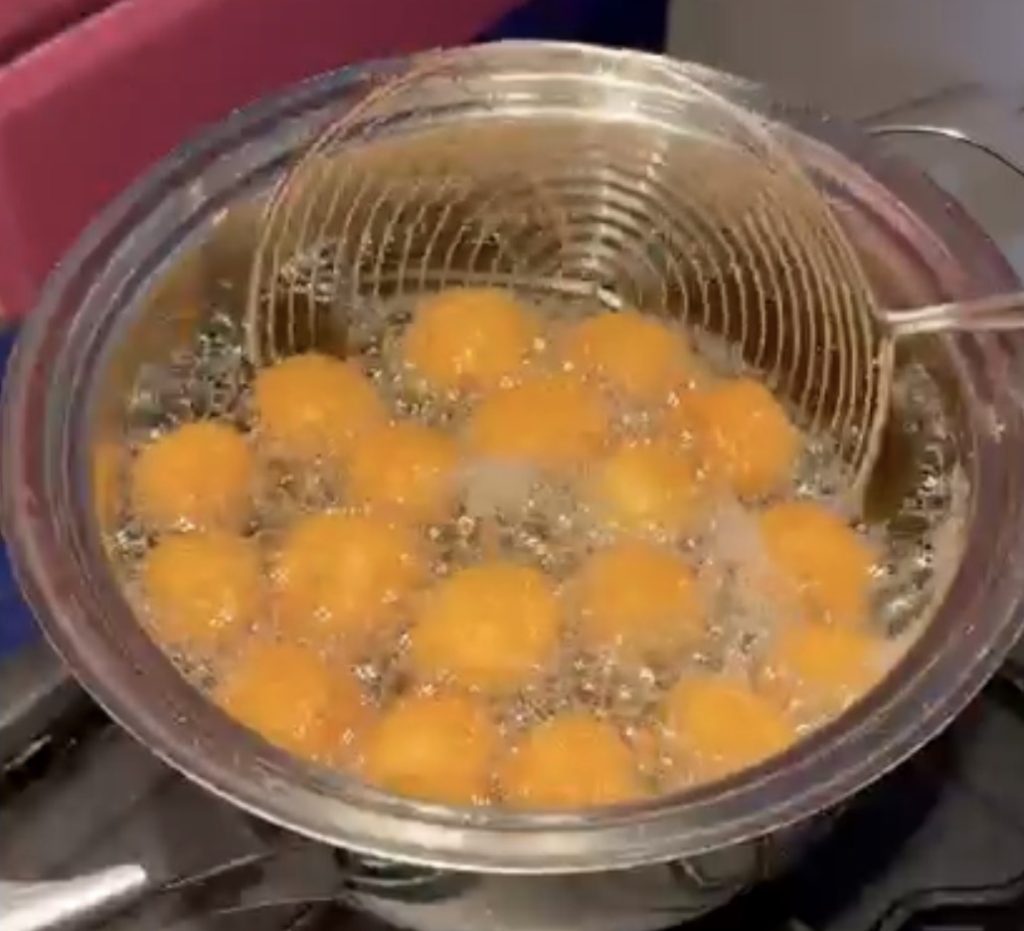
When they are just warm, place them on a serving dish and sprinkle with plenty of vanilla powdered sugar.
Serve immediately… because one leads to another.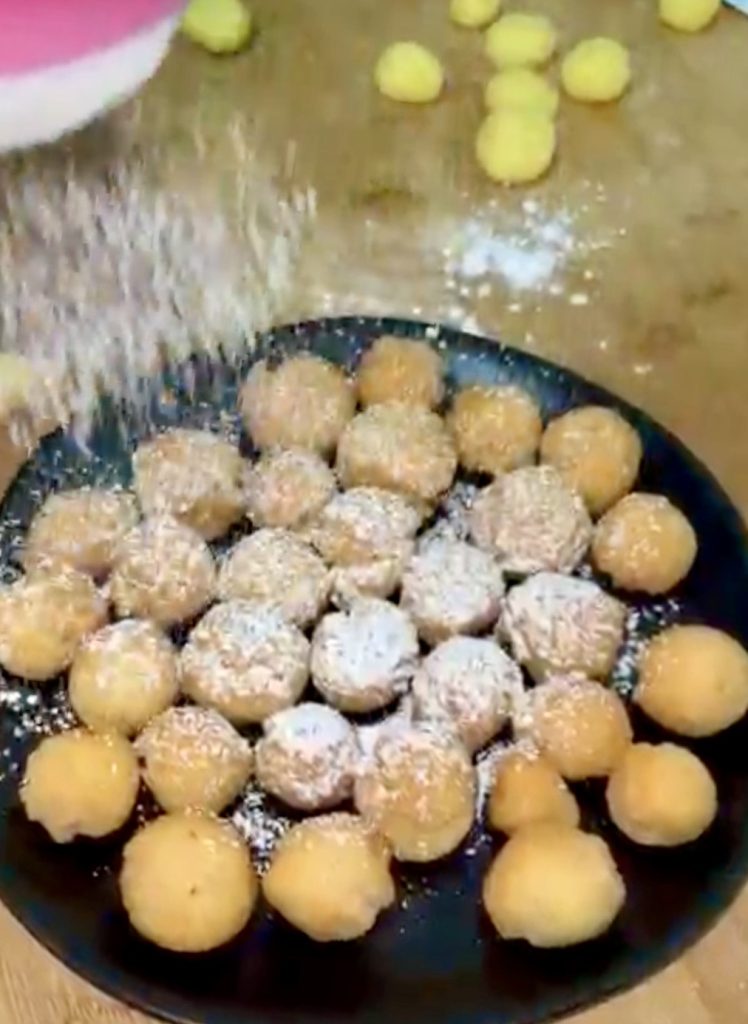
🧁 Final Notes
These castagnole are even better the same day, when the outside remains crispy and the inside flaky.
If you wish, you can replace sambuca with limoncello, anise, or rum to personalize the aroma without losing tradition.
Fry a few castagnole at a time: each batch cooks in about 3–4 minutes until evenly golden.
FAQ (Questions and Answers)
Can I bake the castagnole in the oven or air fryer?
This version is meant for frying, which makes them crispy on the outside and flaky inside. In the oven or air fryer, the result will be more like a soft cookie.
Can I prepare the dough in advance?
Yes, you can prepare it a few hours in advance and keep it in the fridge wrapped in plastic wrap. Take it out 10 minutes before shaping the castagnole.