The mango cream is always in my house when it’s Italian mango season. Yes, because I only buy tropical fruits if they are Sicilian. Why only Italian? Because it’s fresh fruit that doesn’t travel 3 or 6 thousand kilometers to get to us.
Sure, when supermarkets write “daily air delivery” they may be fresher, but in principle, they are certainly not sustainable.
Another not less important reason, those countries certainly don’t have our regulations on pesticides and substances used in agriculture.
So, delicious organic Sicilian mangoes can be found in winter, and they are a treat.
The mango with its juicy pulp, aromatic and fresh taste, a little tangy, is a fruit that everyone likes. Each mango weighs around 10-14 oz, with its green and orange skin.
The mango belongs to the Anacardiaceae family, it comes from India and is grown in all tropical areas. Rich in vitamin C, vitamin A, many minerals, polyphenols, antioxidants. It’s a sugary fruit, so don’t overdo it. We just need to be careful when handling it, because the skin contains an oil called urushiol that can sometimes cause dermatitis or sneezing. I won’t go into the properties, it seems that mango is good for multiple conditions.
Mango contains 55 calories per 100 grams (3.5 oz) of pulp, so it is often recommended in diets, but I often repeat, why do nutritionists recommend mango in summer? If you are on holiday in tropical areas, great, but we live in Italy and there are no tropical mangoes here!
So, Sicilian mango, naturally always peeled and well washed.
How to tell if a mango is ripe? It should be just soft on the surface, if it’s hard you can buy it anyway and leave it at room temperature for 4 or 5 days.
The best way to enjoy mango is naturally, although surely making a dahl or chutney is very satisfying too.
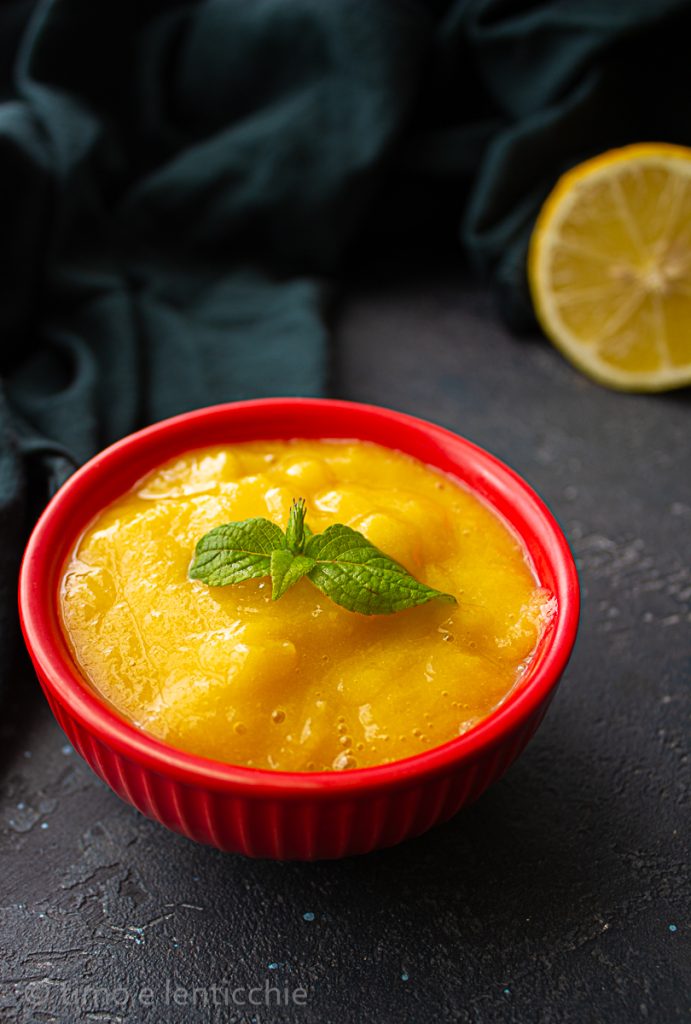
I admit this cream is really simple, but it’s so good and adaptable in a thousand variations that it becomes an essential basic preparation.
Below are more recipes with Sicilian tropical fruits.
- Cost: Economical
- Preparation time: 5 Minutes
- Cooking methods: No-Cook
- Cuisine: Italian
- Seasonality: Winter
Ingredients
- 7 oz mango (pulp)
- 1 lemon (juice)
Tools
- 1 Citrus Juicer
- 1 Immersion Blender
Steps for Mango Cream
Take the mango, wash it thoroughly, peel it, and cut into chunks. Place it in the immersion blender cup along with the juice of a lemon.
Blend well for a few seconds and pour into a bowl, served with mint leaves.
Tips and Storage
Mango cream cannot be frozen; it keeps well closed for a couple of days in the refrigerator. You can use mango cream on vegetables, in a bowl with cereals or legumes, in smoothies, in desserts.