Perfect for a fresh barley salad and mountain flowers, a blooming foraging from our mountains.
Today I want to talk to you about edible flowers of the summer mountain meadow, where the eye gets lost among the green and the thousand colors of the flowers.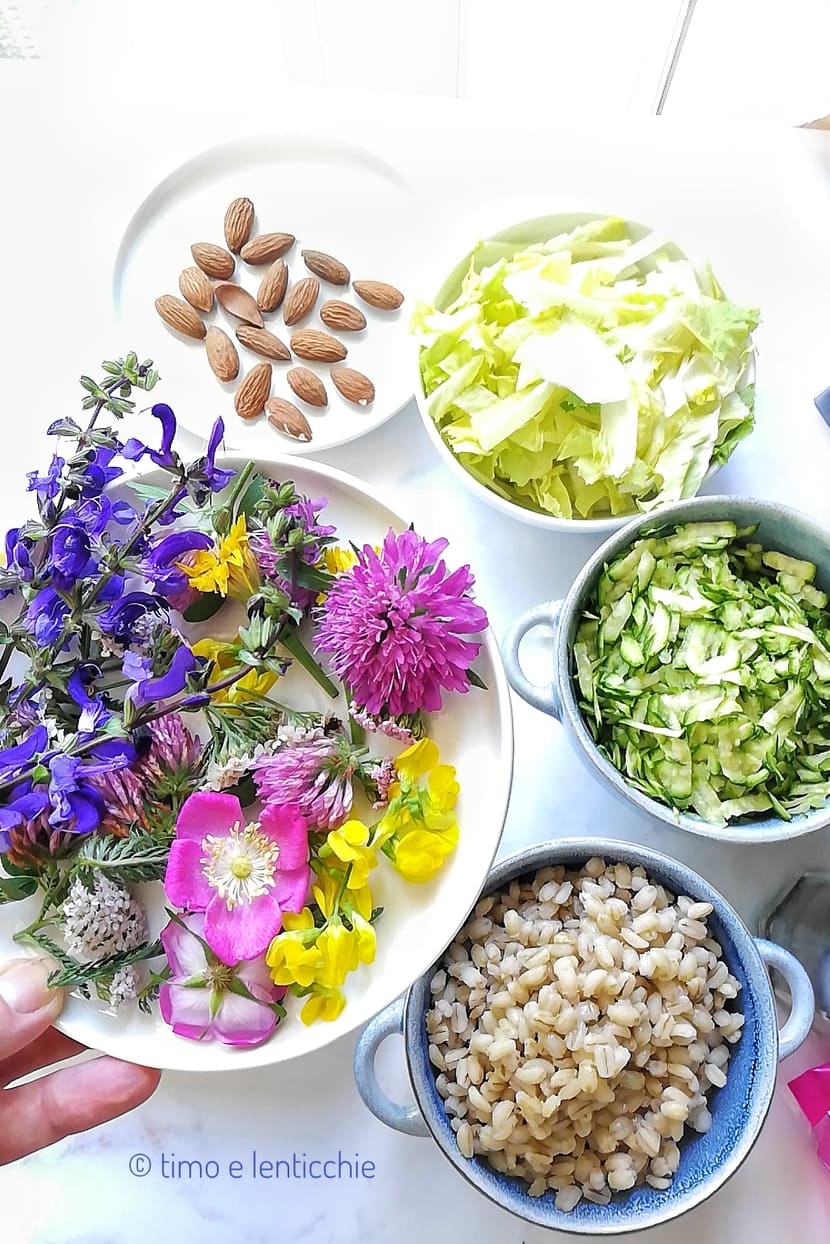
That blooming grass eaten by the spotted cows grazing and that we can bring to the table in a beautiful Barley Salad and Mountain Flowers like this one.
I naturally picked just a few little flowers for my salad, nothing more, no protected or high mountain flowers, just meadow flowers in a clean environment.
Let’s be careful not to pick any wild grass in the city or polluted environments.
What flowers did I choose during my hike at 3937 feet this weekend?
I can’t help but start with yarrow, one of the wild medicinal plants par excellence.
Achillea millefolium, its name derives from Achilles. Pliny the Elder tells that Achilles used Yarrow to heal the wounds of king Telephus, which he himself had inflicted.
Indeed, Yarrow is an excellent cicatrizant, but not only that. Yarrow has so many properties that I recommend the article by granosalis, Claudia is an invaluable source of news on wild flowers and fruits.
For this reason, little yarrow flowers and leaves, even if slightly bitter, go very well in salad.
Salvia pratensis, Meadow Sage:
The first time I picked meadow sage was with Annalisa Malerba, another great connoisseur of wild herbs. That time she let us taste the chips of meadow sage leaves, a marvel. Just wash and dry the leaves, massage them with an emulsion of oil, lemon, and salt, and dry them for 8 to 12 hours in a dehydrator. Being a cousin of the common sage, it has the same wonderful properties, excellent in omelets or soups. Naturally, the leaves should be picked before flowering in spring. But today we use the beautiful flowers in our salad.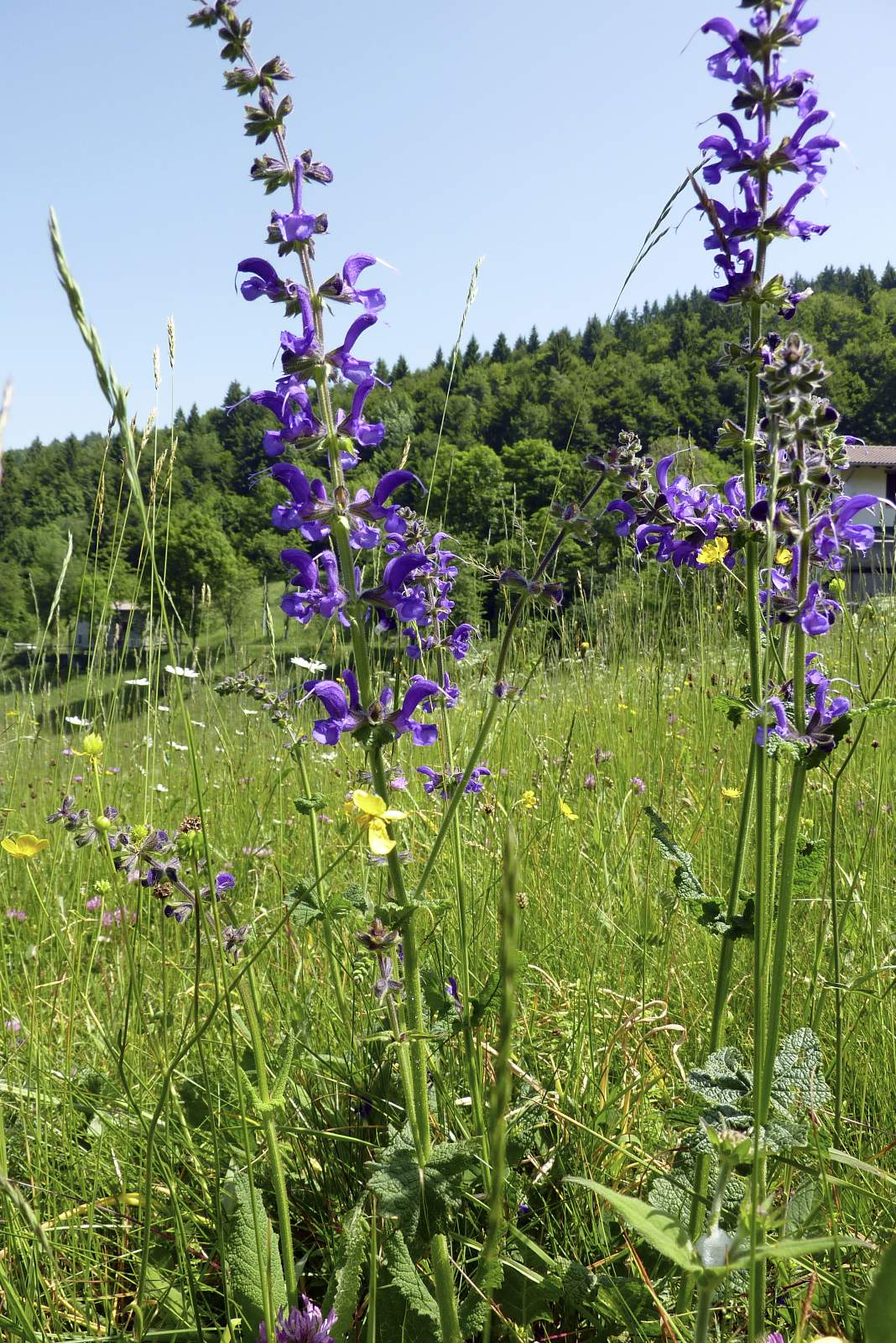
Knautia arvensis known as Common Field Scabious or Widow Flower: It is quite common to encounter it in the meadows in summer, with its beautiful purple-pink flowers. It is found throughout Italy except in Calabria, Sicily, and Sardinia. It is used for its astringent, diuretic, depurative, and homeopathic properties. It is really beautiful to enrich our dishes. The tenderer leaves can be added to soups or omelets or made into a nice decoction if we have a cold.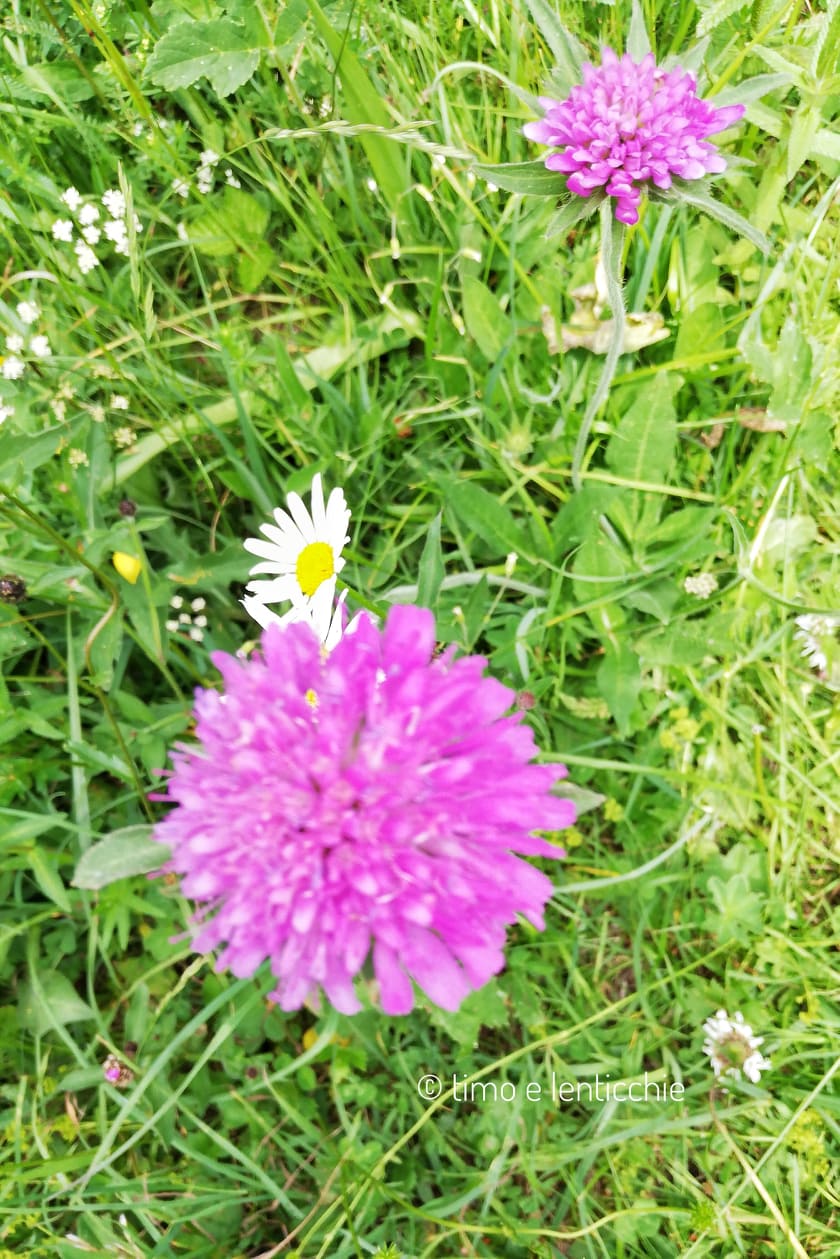
Trifolium pratense, Red Clover: Did you also suck the very sweet meadow clover flowers as a child? I did, so red clover takes me back to my childhood and it can’t be missing from my dishes. Clover has many properties including diuretic, depurative, expectorant, antispasmodic. Besides containing natural phytoestrogens, it’s much used in menopause supplements. Clover is also an antioxidant, mineralizes the bones. Legend has it that clover leaves represent: the first leaf hope, the second trust, and the third love,… can we find a four-leaf clover? the fourth leaf represents luck. So let’s abound with clover in soups, casseroles, or savory pies. I’m not posting a photo of the clover flower because you all know it.
Crepis biennis Meadow Hawk’s-beard This little yellow flower looks a lot like the dandelion flower, in fact, crepis belong to the asteraceae species. Bitter diuretic herbs, so let’s use them in the same way, I only picked a few little flowers.
Lotus corniculatus Bird’s-foot Trefoil looks like little brooms, they are immediately recognizable.
The Infusion of flowers has a sedative effect, useful in cases of distress, depression, insomnia, and tachycardia: half a teaspoon of dried flowers in a cup of boiling water, filtered and sweetened, to be drunk once or twice a day.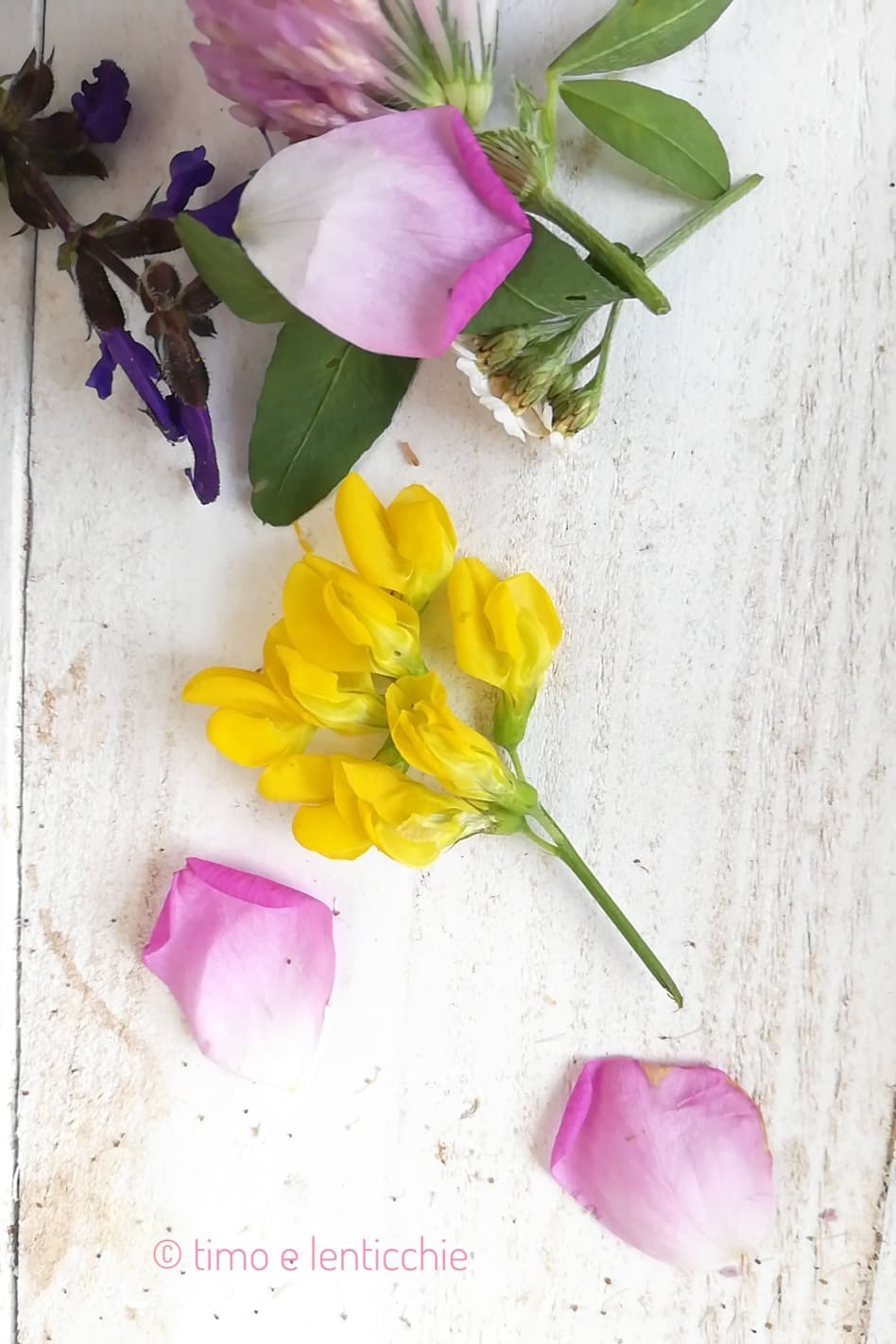
And finally my favorite, the wild mountain rose or pendulous rose. The name pendulous comes from dangling, in relation to the branches and drooping nature that characterize this species, as you can see from my photo. Imagine that the pendulous rose withstands up to 4 degrees Fahrenheit. As we know, roses are edible.
I have often talked about alimentation and wild herbs on the blog to the point of having a dedicated recipe category where you can discover edible wild flowers and herbs.
I leave you some recipes with wild herbs
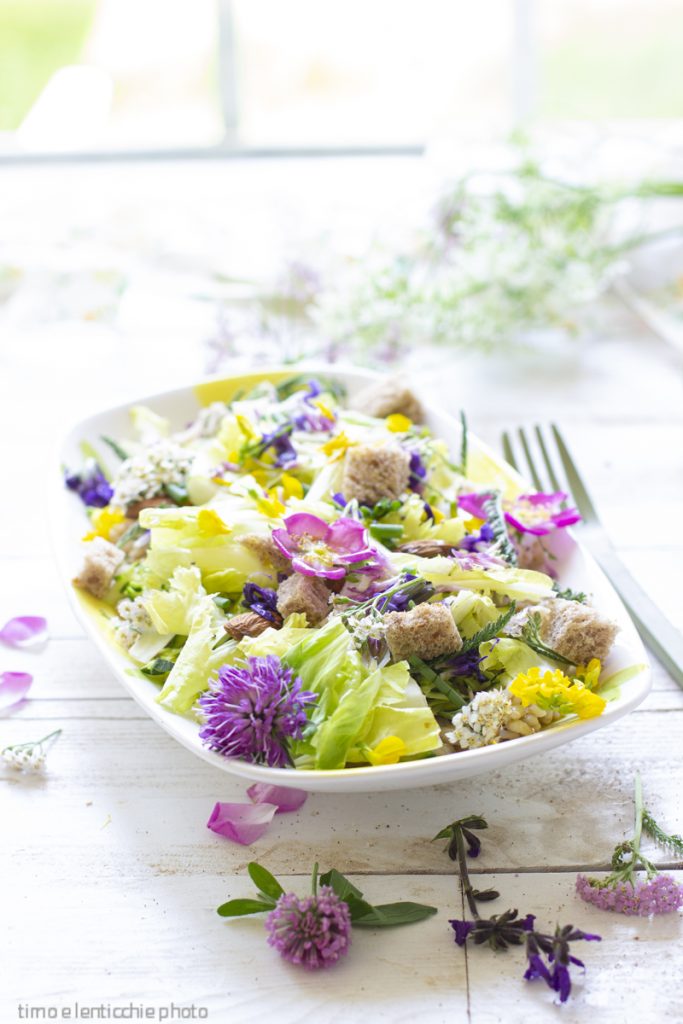
- Difficulty: Very easy
- Cost: Very economical
- Preparation time: 10 Minutes
- Portions: 4
- Cooking methods: No cooking
- Cuisine: Italian
- Seasonality: Spring, Summer
Ingredients for Barley Salad and Mountain Flowers
- 3.5 oz pearl barley
- 2 zucchini
- 3.5 oz escarole (endive)
- 1 oz almonds
- 1.75 oz bread croutons
- 1 bunch flowers (from the mountains)
- 1 tablespoon extra virgin olive oil
- 1 tablespoon lemon juice
- 1 pinch sea salt
- 1 tablespoon sunflower seeds
Tools
- 1 Plate
- 1 Knife
- 1 Cutting Board
Preparation of Barley Salad and Mountain Flowers
Wash the barley well and boil it in lightly salted water. Drain and set aside to cool.
Wash, trim, and grate the zucchinis using a coarse grater. Wash and cut the crisp white escarole into strips.
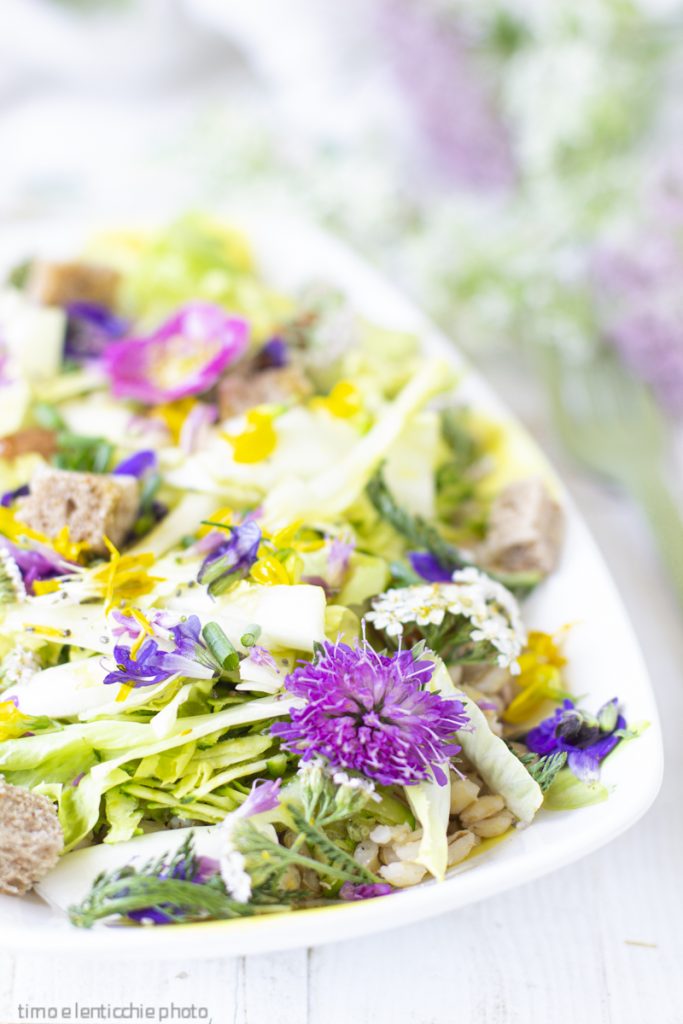
On a plate, combine the barley, zucchini, escarole, complete with mountain flowers, whole wheat bread croutons, toasted sunflower seeds, and dress with an emulsion of olive oil, lemon, and sea salt.
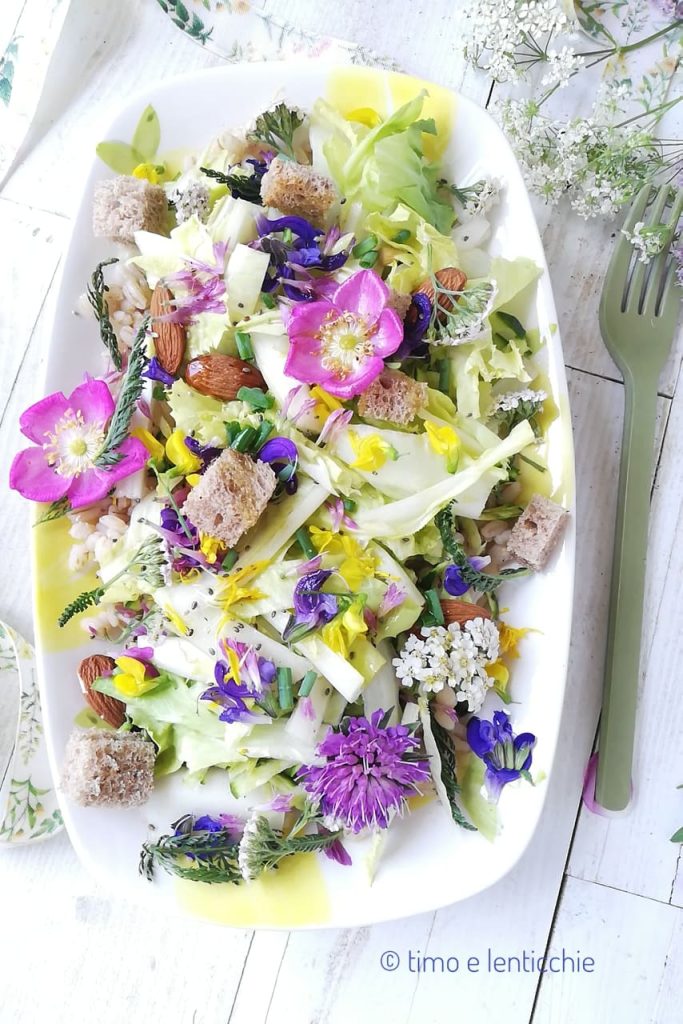
Tips on Barley Salad and Mountain Flowers
You can vary the type of grains and summer vegetables for your salad, be very careful when gathering flowers, as some are toxic. Maybe join some lessons on wild herbs with an expert before picking.
They will explain how the herbs should be collected: a few, just some stems without the roots, a few leaves or flowers, nothing more, don’t overdo it!
The salad should be consumed shortly after preparation.