
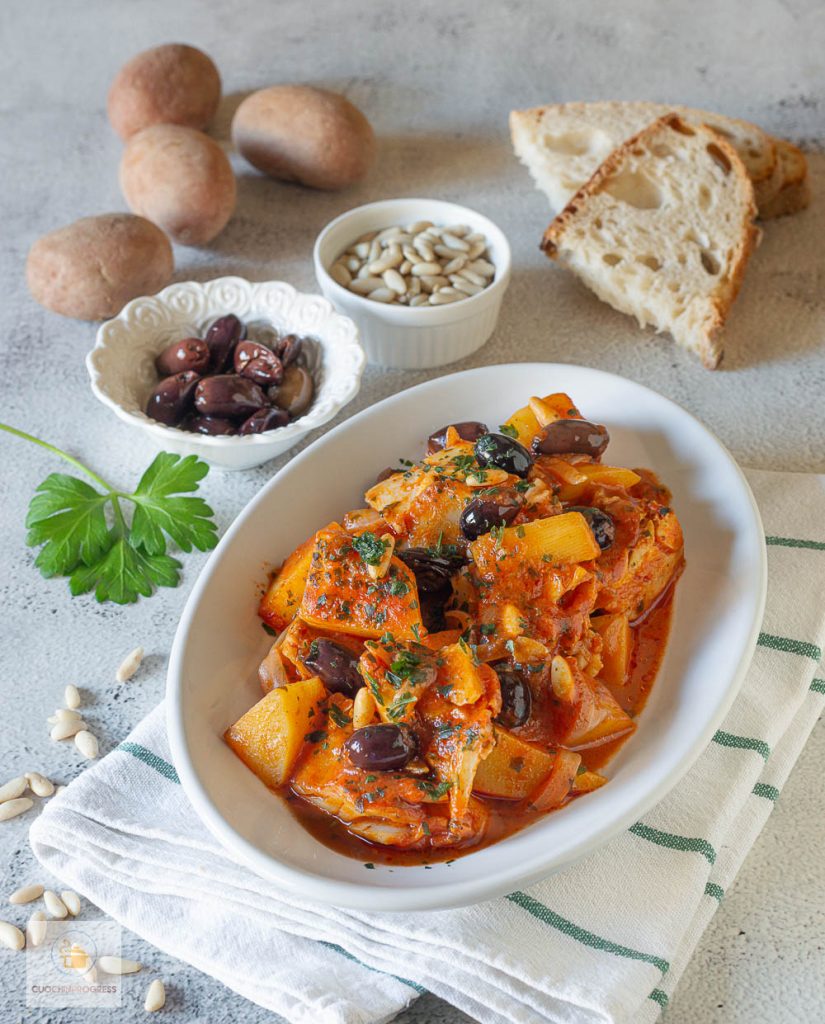
Lo STOCKFISH GENOESE-STYLE is one of the signature dishes of Ligurian tradition, an interweaving of aromas and flavors that tell the story of the Riviera’s sea-and-land cuisine. Tender pieces of soaked stockfish are slowly stewed with potatoes, tomatoes, Taggiasca olives and pine nuts, creating a rich and fragrant sauce that releases all its intensity with every bite.
It is a recipe that combines simplicity and substance, perfect to bring to the table on convivial days, when the desire is to share authentic, history-filled dishes. Served with rustic bread or soft polenta, stockfish Genoese-style becomes a true comfort food, able to win over with its genuine, timeless goodness.
You might also like:
- Difficulty: Very easy
- Cost: Medium
- Preparation time: 10 Minutes
- Portions: 4 Servings
- Cooking methods: Stovetop
- Cuisine: Italian
- Seasonality: All seasons, Christmas
Ingredients
- 2.2 lbs stockfish (already soaked)
- 1 golden onion (large)
- 1 lb 2 oz potatoes
- 2 cloves garlic
- tomato purée (or canned tomatoes)
- 1 oz (about 1/4 cup) pine nuts
- 3 oz (about 1/3 cup) Taggiasca olives
- 1 bunch parsley
- to taste extra virgin olive oil
- to taste salt
- to taste black pepper
Tools
- 1 Large pan
- 1 Cutting board
- 1 Knife
Steps
Cut the soaked stockfish into even pieces, removing any bones and the skin.
In a large saucepan heat a drizzle of olive oil and sauté the onion, garlic and chopped parsley for a few minutes.
Add the pine nuts and let them flavor the mixture for a couple of minutes.Add the tomato purée or crushed canned tomatoes, season with salt and pepper and cook over medium heat for 10-15 minutes.
Add the pieces of stockfish, the potatoes cut into chunks and half a glass of water.
Cover with a lid and let cook over low heat for about 30 minutes, stirring occasionally and adding a little water if needed.Add the Taggiasca olives, more chopped parsley and let infuse for another 10 minutes.
When cooking is complete, turn off the heat, cover and let the stockfish Genoese-style rest for 10 minutes before serving.
As with many stewed dishes, stockfish Genoese-style is even better if prepared in advance and left to rest for a few hours before serving.
Curiosities
Stockfish arrived in Liguria thanks to the intense commercial exchanges between Genoese merchants and those of Northern Europe, particularly Norway, where cod was air‑dried in the cold wind and preserved for long periods. Because of its long shelf life and ease of transport, it became a valuable food for sea voyages and quickly found a place in Ligurian cuisine, which reinterpreted it with local flavors such as Taggiasca olives, pine nuts and capers.
Even today, stockfish Genoese-style is one of the most loved recipes of the tradition, served during patronal festivals and family lunches, a testament to the bond between sea, history and gastronomic culture.
Differences between Stockfish and Salted Cod
🔹 Stockfish
It is cod preserved by air‑drying in cold wind.
Traditionally produced in Norway (especially the Lofoten islands).
The flesh becomes very dry and firm, but retains all its proteins.
Before cooking it must be soaked in water for several days (up to 10), changing the water frequently.
It has a milder flavor and a firm texture.
Typical in recipes such as stockfish alla vicentina or Genoese-style stockfish.
🔹 Salted cod (Baccalà)
It is cod preserved with salt.
After salting it is aged and often sold already desalinated.
Before use it must be soaked in water (2-3 days) to remove excess salt.
It has a stronger, saltier flavor compared to stockfish.
It features in dishes like fried salted cod, Livornese-style salted cod or creamed baccalà.
