
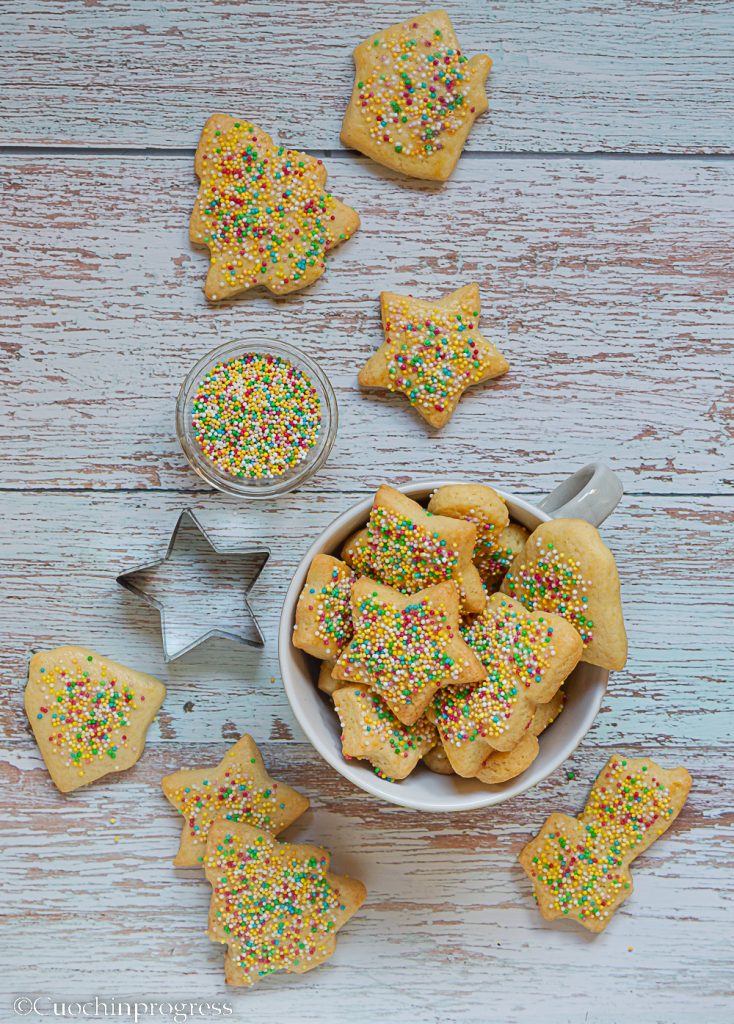
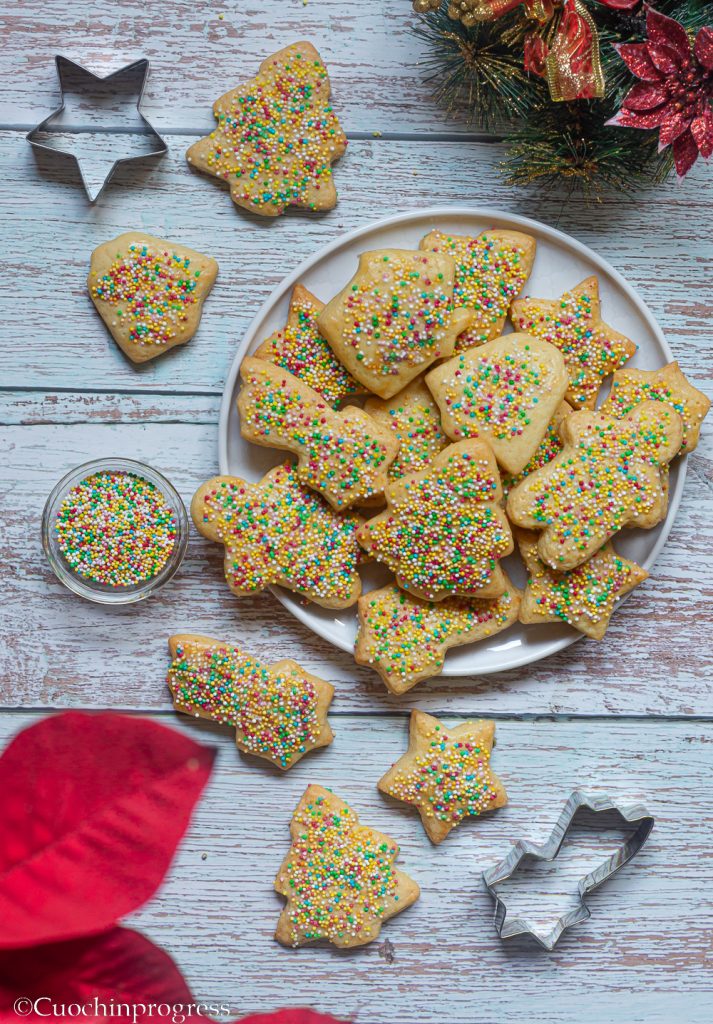
The BEFANINI are classic cookies from the Tuscan tradition prepared for the Christmas holidays, especially for Epiphany. They are simple yet indulgent cookies in holiday shapes, made with a soft, very fragrant shortcrust pastry and decorated with colorful sprinkles. They are perfect to put in the Befana stocking and to enjoy at breakfast or as a snack.
Popular tradition attributed to the befanini the property of guaranteeing abundant breast milk to girls. They traditionally represent typical Epiphany figures found in nativity scenes: the angel, the guiding star, the dromedary and the Magi. As with all traditional recipes, this one can vary from family to family and from area to area. In some places the name also changes and they are called befanotti.
Take note of the few simple ingredients and have fun creating these little cookies with the kids at home.
SEE ALSO:
- Difficulty: Very easy
- Cost: Very inexpensive
- Rest time: 1 Hour
- Preparation time: 10 Minutes
- Portions: 38 Befanini
- Cooking methods: Oven
- Cuisine: Italian
- Seasonality: Autumn, Winter
- Energy 71.33 (Kcal)
- Carbohydrates 9.50 (g) of which sugars 3.88 (g)
- Proteins 1.15 (g)
- Fat 3.31 (g) of which saturated 2.09 (g)of which unsaturated 1.17 (g)
- Fibers 0.17 (g)
- Sodium 4.80 (mg)
Indicative values for a portion of 15 g processed in an automated way starting from the nutritional information available on the CREA* and FoodData Central** databases. It is not food and / or nutritional advice.
* CREATES Food and Nutrition Research Center: https://www.crea.gov.it/alimenti-e-nutrizione https://www.alimentinutrizione.it ** U.S. Department of Agriculture, Agricultural Research Service. FoodData Central, 2019. https://fdc.nal.usda.gov
Ingredients
- 2 cups all-purpose flour (farina 00)
- 1/2 cup butter
- 1/2 cup granulated sugar
- 2 tsp baking powder
- lemon zest
- 1 tsp vanilla extract
- 1 egg (medium, at room temperature)
- 2 tsp rum
- 1 egg white
- as needed colored sprinkles
Tools
- 1 Bowl
- Cookie cutters
- 1 Pastry brush
- 1 Baking sheet
- Parchment paper
Steps
In a bowl place the flour and the cold butter cut into pieces. Work quickly with your fingertips until you obtain a sandy mixture.
Add the sugar, lemon zest, vanilla extract, the egg, the rum, and the sifted baking powder and mix the ingredients until you obtain a soft and compact dough. Since befanini are mainly intended for children, you can replace the rum with a rum-flavored extract that is alcohol-free.
Form a disk with the dough, wrap it in plastic wrap and place it in the refrigerator to firm up for at least 1 hour.
After the resting time, take the dough and roll it out, dusting with flour, to a thickness of about 1/8 inch (3–4 mm). Cut out the holiday shapes you prefer and place the cookies on a baking sheet lined with parchment paper, leaving a little space between them.
Brush them with the egg white and cover them with colored sprinkles.
Bake the befanini in a preheated static oven at 356°F for a maximum of 10 minutes.
As soon as they are lightly golden at the edges, remove them from the oven and let them cool completely.
STORAGE AND VARIATIONS
STORAGE: Befanini can be kept in airtight glass jars for about 15 days without losing their fragrance.
STORAGE: Befanini can be kept in airtight glass jars for about 15 days without losing their fragrance.
VARIATION: A variation of the Tuscan befanini is the Marche version, made with a shortcrust pastry flavored with anise and topped with a simple water-and-sugar glaze, then decorated with sugar sprinkles.
