
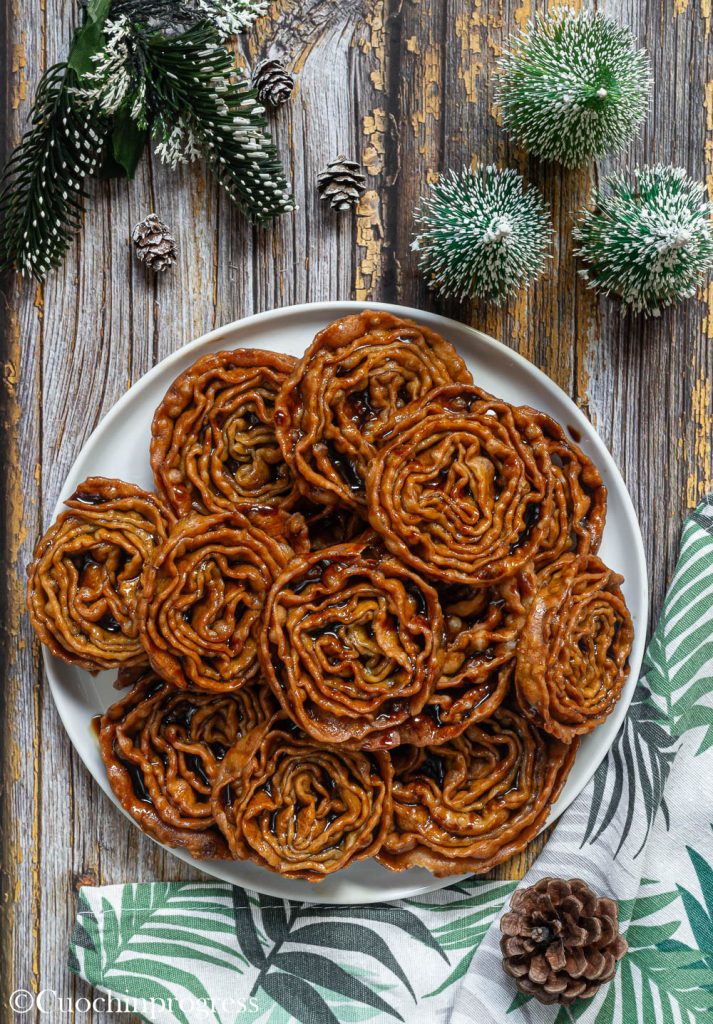
The APULIAN CARTELLATE are Christmas pastries from the Apulian tradition and, to some extent, also from Lucania. They have an extremely ancient history, probably linked to the Arabs, but in Christian times they have often been associated with the halo or the swaddling bands used to wrap Baby Jesus in traditional nativity images. In any case, it is a simple pastry but rich in flavor and crunch, perfect to bring to the table during the Holidays when you want goodness, beauty and tradition.
These sweets are made from simple ingredients and require only a bit of attention and manual skill the first time you make them. For this reason I provide the recipe step by step, with photos and indications, which will make everything easy and help you reach the result without effort. These delicious spirals of very light dough, well fried, will become a true treat thanks to the vincotto and honey which, according to tradition, will give the flavors and aromas of old-fashioned sweets.
SEE OTHER REGIONAL CHRISTMAS RECIPES:
- Difficulty: Very easy
- Cost: Budget-friendly
- Rest time: 8 Hours 30 Minutes
- Preparation time: 25 Minutes
- Cooking methods: Frying
- Cuisine: Italian
- Seasonality: Autumn, Winter
Ingredients
- 4 cups all-purpose flour
- 3/4 cup white wine
- 7 tbsp extra virgin olive oil
- 1 pinch salt
- 2 1/8 cups peanut oil
- 1 cup vincotto (or honey)
Tools
This content contains one or more affiliate links
- 1 Pasta roller
- 1 Bowl
- 2 Small saucepans
- 1 Fluted pastry wheel
Steps
To prepare the APULIAN CARTELLATE, first place the wine in a small saucepan and warm it gently over the heat.
Sift the flour onto your work surface, into a bowl or in the mixer. Make a well in the center and pour in the lukewarm wine, the olive oil and a pinch of salt.
Begin to combine all the ingredients with a fork and continue kneading with your hands for 10 minutes, or until you obtain a homogeneous, smooth dough that is not too hard and not too soft.
If it is too stiff add a little more wine, otherwise more flour.
Let the dough rest for 30 minutes under a cloth.
Then tear off pieces and, using the pasta roller, roll out strips (use setting no. 4 on the pasta roller).
Cut the strips with a pastry wheel into diamond shapes about 9 7/8 in long and 1 3/16 in wide.
Pinch the dough with your fingers to seal it.
Roll the strips onto themselves to form roses, pinching the spiral in a few places to prevent them from opening during frying. Be very careful in this phase because the dough can easily stick and lose its characteristic shape.
As you form your cartellate, place them on a work surface covered with a clean, dry cloth and let them dry for 8 hours.
Pour plenty of seed oil into a deep pan and as soon as it reaches a temperature of 338°F, perform the toothpick test: once a toothpick inserted into the oil sizzles, fry the cartellate in batches for about 1 minute per side, until golden.
Drain them and let them dry on absorbent paper.
Place the vincotto in a small saucepan and warm it slightly. Dip the cartellate into it, a few at a time, let them soak from all sides and lay them out on a serving plate. If you use honey the procedure is the same.
Let them rest for a few minutes and enjoy the Apulian cartellate.
OVEN VARIANT
For a lighter version you can bake the Apulian cartellate in the oven at 356°F for 20 minutes. Once baked, you can dress them with the classic pairing of vincotto or dip them into 3/4 cup of honey warmed in a bain-marie, or simply dust them with powdered sugar.
