
Egg tagliolini and egg pasta in general are cornerstones of Italian culinary tradition. In pasta making, the egg plays an important role and, depending on the type and size used, it may or may not require the addition of other liquids such as water or oil. The olive oil listed in the ingredients is not mandatory, but it gives shine and elasticity to the dough.
In regional Italian tradition there are dozens of recipes and variations for preparing egg pasta; below you will find the most commonly used version.
YOU MIGHT ALSO LIKE:
- Difficulty: Very easy
- Cost: Very inexpensive
- Rest time: 30 Minutes
- Preparation time: 15 Minutes
- Portions: 4 servings
- Cuisine: Italian
- Seasonality: All seasons
- Energy 410.83 (Kcal)
- Carbohydrates 71.36 (g) of which sugars 1.69 (g)
- Proteins 16.68 (g)
- Fat 8.20 (g) of which saturated 2.32 (g)of which unsaturated 2.21 (g)
- Fibers 2.19 (g)
- Sodium 259.29 (mg)
Indicative values for a portion of 150 g processed in an automated way starting from the nutritional information available on the CREA* and FoodData Central** databases. It is not food and / or nutritional advice.
* CREATES Food and Nutrition Research Center: https://www.crea.gov.it/alimenti-e-nutrizione https://www.alimentinutrizione.it ** U.S. Department of Agriculture, Agricultural Research Service. FoodData Central, 2019. https://fdc.nal.usda.gov
Ingredients
- 3 1/3 cups 00 flour
- 4 eggs (medium at room temperature)
- 1 tbsp extra virgin olive oil
- 1/3 tsp salt
WHAT YOU’LL NEED FOR EGG TAGLIOLINI
- 1 Pasta machine
- 1 Bowl
- 1 Work surface
- 1 Fork
PREPARATION: EGG TAGLIOLINI
Preparing egg tagliolini is very easy.
Put the flour in a bowl or on the work surface and make a well in the center. Add the eggs, the oil and the salt, and mix everything well with a fork until fully combined.
When most of the flour has been incorporated into the mixture, start working with your hands to obtain a homogeneous dough.
If the dough cannot incorporate all the flour, remove the excess; if the dough is too soft or too sticky, add a little flour.Knead everything until you get a smooth, homogeneous ball.
If you prefer, you can use a stand mixer with the paddle or dough hook.
Once you have formed the dough, wrap it in plastic wrap and let it rest for at least 30 minutes at room temperature.After the 30 minutes of resting, divide the dough, flatten it slightly and pass it through the pasta machine. Pass it twice for each setting until you reach 4.
Place the sheets obtained on a cutting board and let them dry for a few minutes.
Then pass the sheets through the pasta machine to obtain the desired pasta shape, in this case tagliolini.
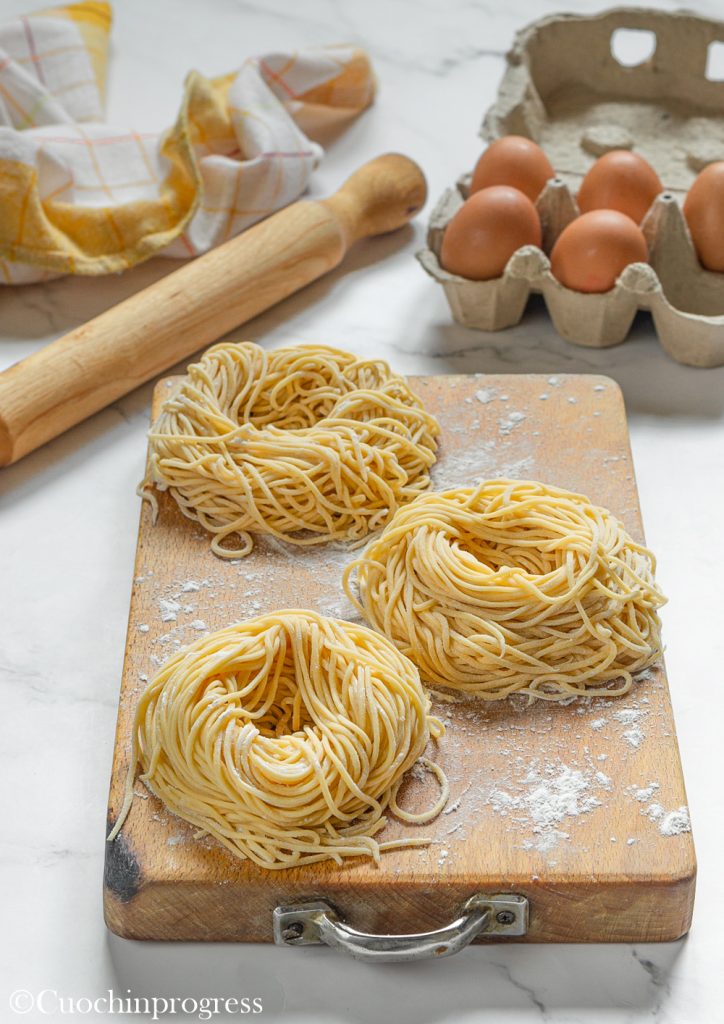
Gather the egg tagliolini on a tray dusted with a little flour or, even better, a little semolina, until ready to cook.
STORAGE
Drying: After preparing the tagliolini, let them dry slightly before storing. This helps prevent them from sticking during storage.
Freezing: If you don’t plan to eat the tagliolini right away, you can freeze them to keep them longer. Arrange them on a tray so they’re separated, then put the tray in the freezer to freeze the tagliolini individually. Once frozen, transfer them to a freezer bag or an airtight container.
