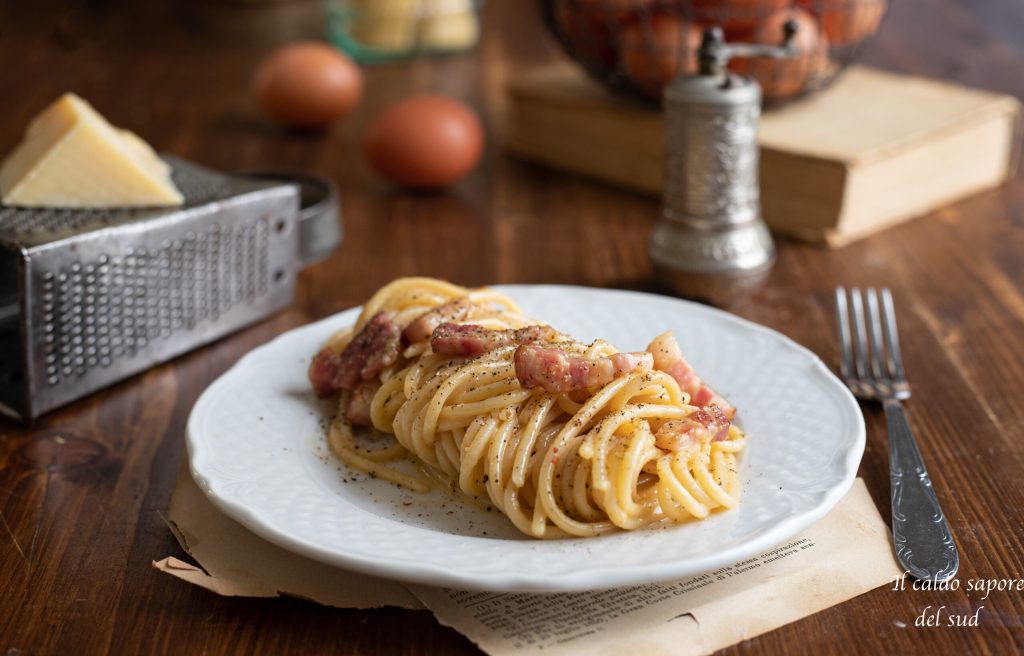
The pasta alla carbonara is one of the signature dishes of Italian cuisine, a first course loved all over the world as much as the famous Amatriciana. A recipe that looks simple at first glance, but is also one of the easiest to get wrong. Getting a creamy carbonara without cream, with eggs that don’t scramble and without making a frittata is the secret to bringing a perfect dish to the table. In this recipe we’ll see how to prepare pasta alla carbonara simply, obtaining a rich, flavorful cream with just a few ingredients.
The creamy carbonara, fragrant and irresistible, perfectly represents our tradition, just like pasta alla Norma, baked pasta, spaghetti alla Nerano or Spaghetti alla Gennaro. Because, let’s be honest, you can never say no to a good plate of Italian pasta.
Today we talk about pasta alla carbonara without onion and without cream, a typical dish of Roman cuisine, now become a national and international heritage. Yet, despite its fame, there is no single shared version: over the years hundreds of interpretations have been born, some very far from the original recipe, so much so that in some cases there is little left of the egg, as even happens in vegan carbonaras, where it is replaced with turmeric.
Some people use pancetta in the carbonara, others staunchly defend guanciale, some use only pecorino, some Parmigiano, some both and some – making purists scream – even add cream. Some use parsley, some onion, some garlic and some nothing. Butter, oil, fish or zucchini variations exist too. Many versions, all respectable, but often a little far from the simplicity of the original recipe, which remains the most authentic and delicious.
Today we will prepare grandma’s pasta alla carbonara, very close to the Roman tradition, with a small variation: I will use Tuscan pecorino instead of Pecorino Romano and add a little Grana Padano to obtain a milder and more delicate taste.
Other than that, let’s discover how to make grandma’s true pasta alla carbonara. Before that, if you want to stay updated on all my recipes, you can follow my Facebook page and my Instagram profile.
Also take a look at these classic first courses of Italian cuisine:
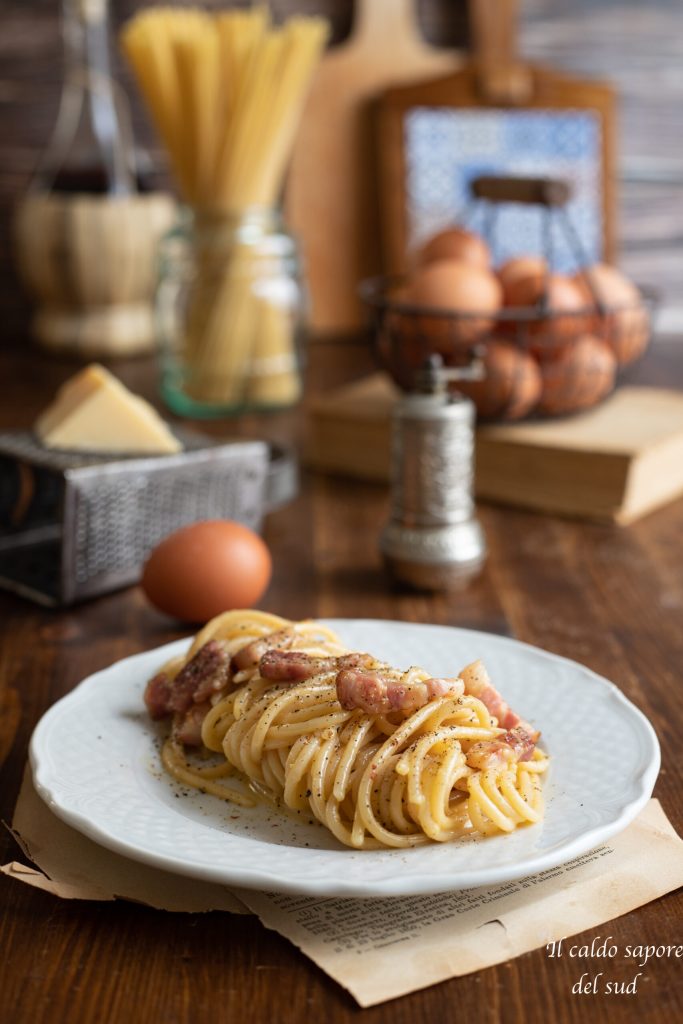
- Difficulty: Very easy
- Cost: Very inexpensive
- Preparation time: 10 Minutes
- Portions: 3-4
- Cooking methods: Stovetop
- Cuisine: Italian
Ingredients to make carbonara
- 10.6 oz spaghetti (size 5 or 7)
- 7 oz guanciale (aged, spiced)
- 4 egg yolks (or 3 yolks and 1 whole egg)
- 3/4 cup Parmigiano Reggiano PDO (or Grana Padano)
- 3/4 cup Tuscan pecorino (or Pecorino Romano)
- to taste salt
- to taste black pepper (freshly ground)
Tools
- Pots
- Bowls
- Skillet
Preparation of Pasta alla Carbonara: the original Roman recipe
Put salted water on the stove to cook the pasta.
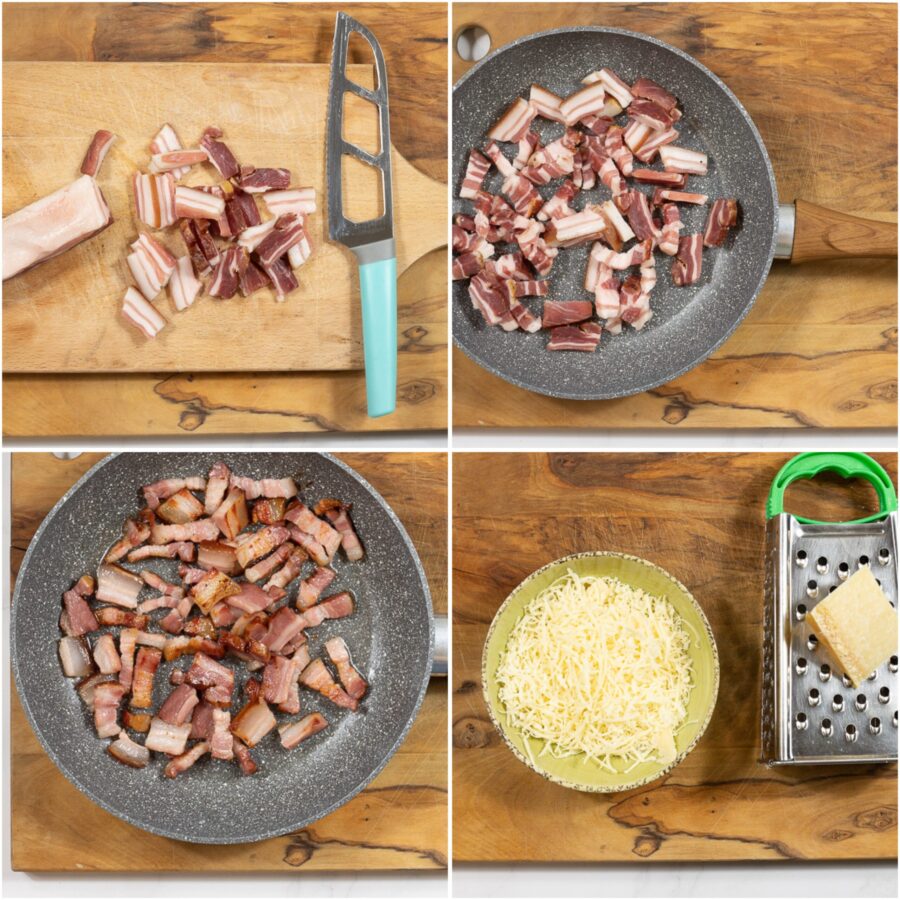
Cut off the rind from the guanciale, then slice it first and then cut into strips about 3/8 inch thick.
Place the guanciale in a heavy-bottomed skillet, set over the lowest heat and let it brown very slowly in its fat for about 10 minutes, being careful not to burn it, as it would become bitter. Separate the fat from the guanciale and set it aside (step omitted by oversight). Grate the cheese.
Pour the egg yolks into a bowl — usually one large yolk per person plus one extra, but you can replace two yolks with one whole egg (some people do). Work the yolks with 3/4 of the cheese, a little black pepper and the reserved guanciale fat until you obtain a creamy mixture (“carbocrema” for some).
As for the cheese, you should use only Pecorino Romano; for me it’s too strong, so I replace it with Grana Padano and Tuscan or Sardinian pecorino.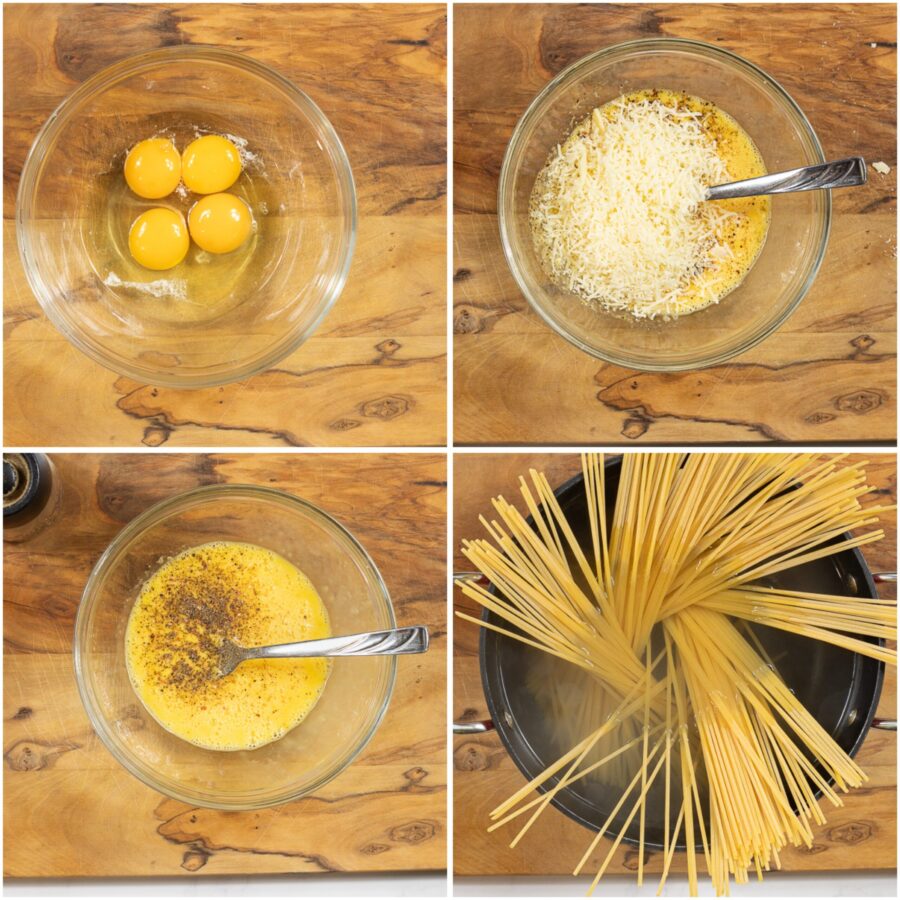
After these steps, drain the pasta al dente, reserving some of the cooking water, pour it into the skillet with the browned guanciale, add the yolk cream and mix over very low heat until the pasta reaches a creamy consistency, but do not overcook: you must avoid the egg from scrambling; if needed, add a bit of the reserved cooking water.
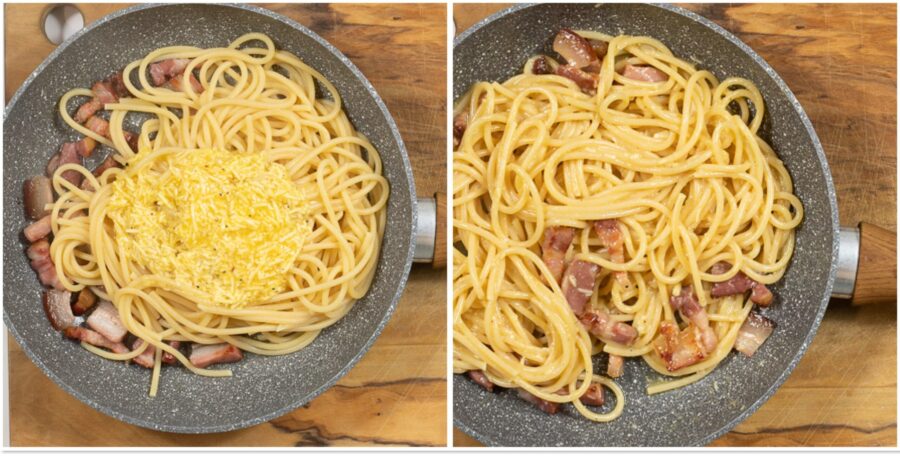
Plate the pasta alla carbonara, garnish with a little more cheese and extra black pepper and serve immediately.
What is the secret to a perfect creamy carbonara?The secret is to use room-temperature eggs, mix off the heat and add a little pasta cooking water to get a smooth, enveloping cream.
What is the original recipe for pasta alla carbonara?The original pasta alla carbonara recipe calls for few ingredients: pasta, guanciale, egg yolks, Pecorino Romano and black pepper. No cream, onion or garlic are expected. The creaminess is achieved only thanks to the egg and the cheese.
Can you make pasta alla carbonara without cream?Yes, the true pasta alla carbonara is made without cream. The creaminess is obtained by mixing the yolks with the pecorino and tossing the pasta off the heat for a velvety, natural consistency.
Is it better to use guanciale or pancetta in carbonara?In traditional Roman carbonara guanciale is used, which gives a more intense and authentic flavor. Pancetta is a common variant, but it changes the final taste of the recipe.
Why does carbonara sometimes turn into a frittata?Carbonara becomes a frittata when the egg cooks too much. To avoid this, you must toss the pasta off the heat, mixing quickly with the egg and cheese cream.
What type of pasta is best for carbonara?Spaghetti is the most used pasta for carbonara, but rigatoni, mezze maniche and tonnarelli are also perfect because they hold the cream well.
Is pasta alla carbonara a Roman dish?
Yes, pasta alla carbonara is a typical dish of Roman cuisine, and over the years it has become one of the symbols of Italian cuisine worldwide.
Can you use Parmigiano in carbonara?Traditionally only Pecorino Romano is used, but in many families a bit of Parmigiano is also added to make the flavor milder.
Can carbonara be prepared in advance?Pasta alla carbonara is best freshly made. Preparing it in advance causes loss of creaminess and changes the texture of the egg.
Is there carbonara without eggs?
There are alternative versions of carbonara, such as vegan ones, but the traditional recipe always includes egg as a fundamental ingredient.How do you prevent the eggs from scrambling in carbonara?
It’s important to toss the pasta off the heat to prevent the eggs from cooking too much and creating a frittata effect.