
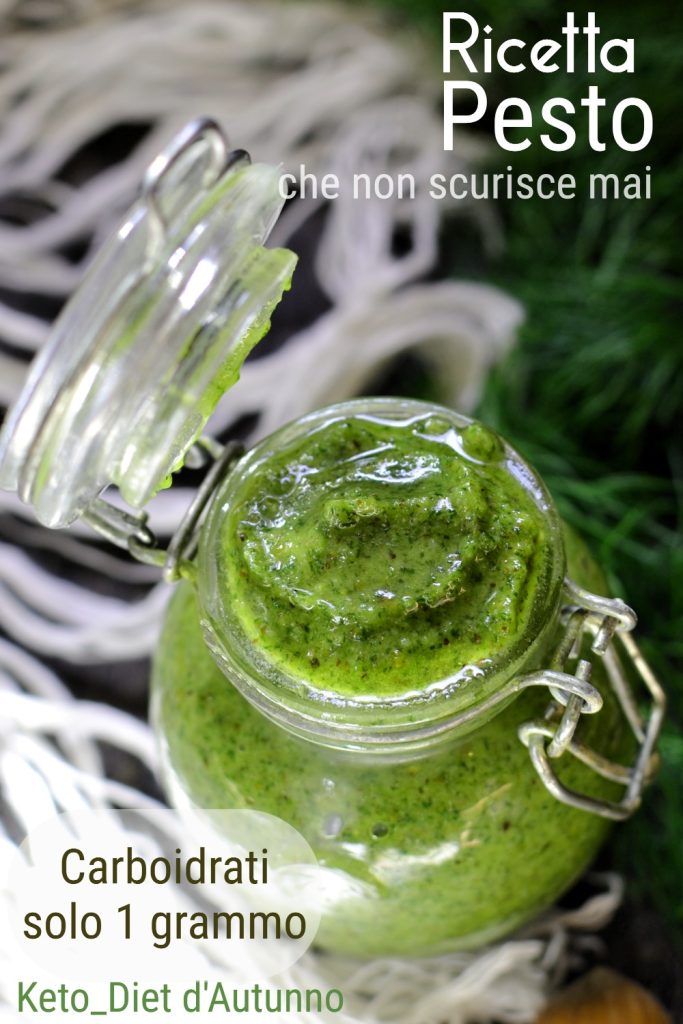
I love Autumn; the colors and shades of this season are wonderful. The weather is mild. Gardens are carpeted with yellow-orange leaves. Vegetable plots are full of wonderful vegetables in every respect (taste and health). Among all the lettuces and cabbages, there are fennel bulbs with their satiating, cleansing and antioxidant properties, rich in vitamins and minerals. The same properties are contained in their bundle of leaves, also called the fronds. It’s a real shame to waste so much goodness. You can make a delicious risotto like this one. Or, today we’ll see how to use fennel fronds to make a delightful keto pesto, autumn/winter style, that doesn’t darken and doesn’t oxidize like basil pesto. It’s as good as, if not better than, basil pesto. Suitable for a ketogenic diet: 1 serving (20 g / 0.7 oz = 2 teaspoons) has only 1 g of carbohydrates. Use it in many ways: to dress pasta, spread on crostini, to dress a mixed fennel-based salad, or to flavor a chicken breast in a pan. The taste of fennel pairs wonderfully with mushrooms, potatoes and rabbit meat, therefore the frond pesto is great added to roasted or boiled side potatoes, or prepared specifically for stuffing rabbit.
- Difficulty: Very easy
- Cost: Medium
- Preparation time: 1 Minute
- Portions: 4
- Cooking methods: No cooking
- Cuisine: Italian
- Seasonality: Autumn, Winter
- Energy 97.07 (Kcal)
- Carbohydrates 0.80 (g) of which sugars 0.27 (g)
- Proteins 2.38 (g)
- Fat 9.82 (g) of which saturated 2.08 (g)of which unsaturated 2.72 (g)
- Fibers 0.48 (g)
- Sodium 179.76 (mg)
Indicative values for a portion of 1 g processed in an automated way starting from the nutritional information available on the CREA* and FoodData Central** databases. It is not food and / or nutritional advice.
* CREATES Food and Nutrition Research Center: https://www.crea.gov.it/alimenti-e-nutrizione https://www.alimentinutrizione.it ** U.S. Department of Agriculture, Agricultural Research Service. FoodData Central, 2019. https://fdc.nal.usda.gov
Ingredients for 120 g of pesto
This pesto is suitable for a keto diet (1 serving of 20 g / 0.7 oz has only 1 g of carbohydrates)
- 0.9 oz fennel leaves (leaves only)
- 5 tbsp Parmigiano Reggiano PDO
- 0.9 oz toasted hazelnuts
- 2.5 tbsp extra virgin olive oil
- 1 pinch salt
- 2 tbsp pecorino
Tools
Preparation of Fennel Frond Pesto
With this recipe you can prepare a jar of pesto weighing 120 grams (about 4.2 oz). Enough to dress 6 servings of pasta. We use toasted hazelnuts, but they can be easily replaced with pine nuts or walnuts.
To prepare fennel-frond pesto, put into the bowl of a food processor: 25 g of hazelnuts (or pine nuts) — approximately 0.9 oz — + 25 g of fennel leaves (if possible take the central part as it is more tender) — approximately 0.9 oz — + 25 g of Parmigiano Reggiano PDO — about 5 tablespoons — + 10 g of Pecorino Romano — about 2 tablespoons — + 35 g of high-quality extra virgin olive oil — about 2 1/2 tablespoons — + a pinch of salt (if you follow a salt-free diet you can omit it from this recipe, which is already tasty and flavorful on its own). You can add 1 small clove of garlic if desired.
Run the food processor for a few moments, then scrape down the mixture to bring everything back to the bottom and repeat until the creamy consistency satisfies you (I repeated 4 times). If needed, add a little more oil.
Storage of Fennel Frond Pesto
Fennel-frond pesto (which is nothing more than the leaves) is stored in a glass jar, taking care not to create air bubbles.
Once the jar with the pesto is ready, place it in the refrigerator (not on the door; it’s advisable to place it in the lower part of the fridge, where the temperature is cooler and more stable).
Therefore, fennel-leaf pesto keeps in the refrigerator for about 1 week. For longer times it can be frozen. In that case you can use small single-portion jars, or organize portions according to your household. Consider that 1 teaspoon of pesto weighs about 10 g (about 0.35 oz) and that to dress one portion of pasta you need 20 g (about 0.7 oz / 2 teaspoons). In any case, you must remove the pesto jar from the freezer a few hours in advance to have it creamy at the time of use.
Questions and Answers about Fennel Frond Pesto
If you have doubts about this fennel-frond pesto recipe, ask a question or read below to see if there are answers useful to your concerns.
To make pesto with fennel leaves, which part of the plant should I use?
To prepare fennel-frond pesto, the best part of the plant to use is the central portion, which looks tender and juicy, has a delicate flavor and a light green color. But if the quantity of pesto to be prepared is large, you can certainly use all the leaves; the important thing is to strip the branches and use only the tender fronds (just as you would do with rosemary).
Can I use the fennel bulb (the white part usually eaten) to make the pesto, or is it only possible with the leaves?
To make fennel pesto, you can also use the white bulb instead of the leaves: just clean it and cut it into small pieces, then cook it 5 minutes in about 1/4–1/2 inch of water with a pinch of stock until al dente. At that point blend it the same way as the leaves, adding the same ingredients listed in the frond pesto recipe (hazelnuts or pine nuts or walnuts + oil + Parmigiano and Pecorino).
Does fennel-frond pesto use the same ingredients as basil pesto?
To make pesto with fennel leaves you can use pine nuts, Parmigiano, Pecorino, oil and salt, just like basil pesto. But from taste tests, the toasted-hazelnut version turned out to be better for fennel-frond pesto. Of course everyone can experiment and decide which pesto they prefer. As far as I’m concerned, the version with toasted hazelnuts is delicious even omitting the Pecorino.
Is this pesto suitable for a ketogenic diet?
Yes, fennel-frond pesto is suitable for the Keto diet. 1 serving of 20 g (about 0.7 oz) contains only 1 g of carbohydrates, 5 g of protein, 11 g of healthy fats and 127 calories. Naturally, if you intend to use the pesto to dress pasta while on a keto diet, you must choose a keto-appropriate pasta, such as these konjac spaghetti with only 2 g of carbohydrates every 100 g.
