
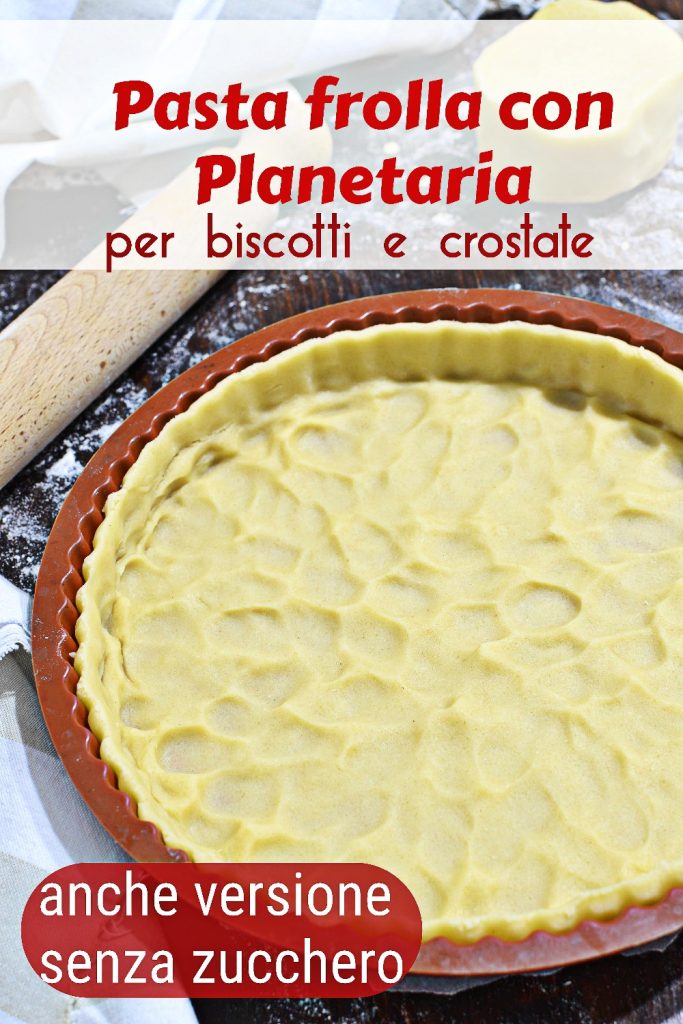
Making a perfect shortcrust pastry with a stand mixer in just 1 minute is possible, and it’s also the best way to obtain a dough that is crumbly, homogeneous and stress-free. This is a tried-and-true recipe, ideal for cookies, tarts and baked desserts, perfect when you have little time but don’t want to give up quality.
This shortcrust pastry using a stand mixer does not require mandatory resting time, it’s worked quickly and can even be made in a double batch and stored in the refrigerator for several days. A basic foundation to always have ready.
Quick shortcrust: why use the stand mixer
The stand mixer allows you to:
• work the dough very little, avoiding gluten development
• obtain a melting and crumbly shortcrust
• save time (1 real minute of mixing)
• keep a controlled temperature
It’s the ideal method especially for those who frequently make desserts or work with medium-large quantities.
Basic rules for a perfect shortcrust
Shortcrust pastry is a highly variable basic preparation, but there are some fundamental rules:
• Quality butter: determines crumbly texture and flavor. Typically between 300 and 500 g of butter per 1 kg of flour.
• Balanced sugar: too much sugar makes the dough hard after baking. Average amount: 300–500 g per 1 kg of flour.
• Eggs: egg white makes the dough softer and the shortcrust firmer after baking; the yolk makes the shortcrust golden and crumbly.
• Low-gluten flour (W up to 170): the shortcrust should not be elastic.
Related articles:
- Difficulty: Very easy
- Cost: Inexpensive
- Preparation time: 1 Minute
- Portions: 1 Piece
- Cooking methods: No-bake
- Cuisine: Italian
- Seasonality: All seasons
- Energy 485.36 (Kcal)
- Carbohydrates 51.82 (g) of which sugars 16.87 (g)
- Proteins 7.89 (g)
- Fat 28.59 (g) of which saturated 17.91 (g)of which unsaturated 10.41 (g)
- Fibers 1.10 (g)
- Sodium 22.58 (mg)
Indicative values for a portion of 100 g processed in an automated way starting from the nutritional information available on the CREA* and FoodData Central** databases. It is not food and / or nutritional advice.
* CREATES Food and Nutrition Research Center: https://www.crea.gov.it/alimenti-e-nutrizione https://www.alimentinutrizione.it ** U.S. Department of Agriculture, Agricultural Research Service. FoodData Central, 2019. https://fdc.nal.usda.gov
Ingredients for shortcrust pastry for cookies and tarts
Sugar can be replaced with a mix of erythritol and stevia. At the end of the article you’ll find complete indications for the best results.
- 2 eggs
- 1/2 cup + 2 tbsp granulated sugar (or the same weight erythritol + stevia mix)
- 3 1/4 cups all-purpose flour (00)
- 2 egg yolks
- 1 cup + 1 1/2 tbsp butter
Tools
- 1 Food processor Ferrari stand mixer in stainless steel
Preparation
• Place the softened butter in the bowl of the stand mixer (left at room temperature for about 2 hours or briefly softened in the microwave).
• Add the sugar and run the mixer with the paddle attachment, speed 2, for 10 seconds.
• Add the yolks and mix for another 10 seconds.
• Add all the flour and let the mixer run for 20 seconds.
• Turn off, detach any dough from the bowl walls with a spoon, then run again for another 20 seconds at speed 2.
👉 Total mixing time: about 1 minute
Useful tips
The shortcrust pastry can be used immediately.
In summer, if the dough is too soft, refrigerate for 5–10 minutes.
It keeps in the refrigerator for 3–4 days, well wrapped.
Baking
• Tarts: 374°F (190°C) for 35–40 minutes
• Cookies: 338°F–356°F (170–180°C) for 10–15 minutes
Times may vary depending on the oven.
Variations
• Lactose-free: replace the butter with the same amount of vegetable margarine.
• With oil: use about half the weight of the butter, adding it at the end of the dough.
Shortcrust without sugar: with erythritol and stevia
In this recipe you can replace granulated sugar with an erythritol and stevia mix, still obtaining a well-workable shortcrust.
• To replace 120 g of sugar use about 110–120 g of erythritol + stevia mix (equivalent sweetness to sugar).
• The dough will be slightly less soft than the classic version, but still pliable.
• Cookies will be crumbly and slightly more crunchy, while the tart will be compact but not hard.
• For better results use finely granulated erythritol and, if necessary, add half an extra yolk.
Questions and Answers
Does the shortcrust need to rest?
No, it can be used immediately. Only in case of very high temperatures is a short rest in the refrigerator recommended.
Can I freeze the shortcrust?
Yes, it can be frozen for up to 2 months if well wrapped.
Can I use whole eggs instead of yolks?
Yes, but the shortcrust will be less crumbly compared to the version made with yolks only.
