
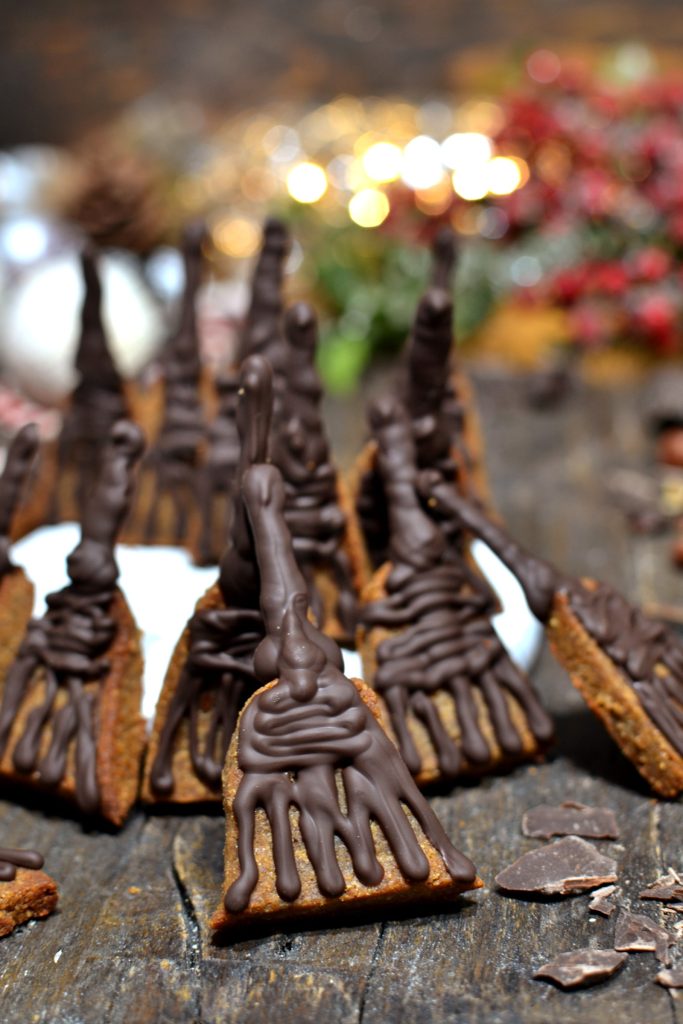
I Broom-shaped Cookies for Befana I made them together with my little niece who had a lot of fun drawing the broom on cardboard to use as a template, but also kneading and decorating with chocolate. These are light and showy treats, perfect for breakfast or snack, also great for children. The shortcrust is free of sugar, gluten, butter and lactose — ideal for those with intolerances or following a healthy diet. You can mix them with a Thermomix, a stand mixer or by hand, and decorate with dark chocolate. A mildly sweet dessert that wins hearts without weighing you down.
Depending on tastes or preferences, you can also make the Befana brooms with regular flour, sugar and butter -> here is the recipe
- Difficulty: Easy
- Cost: Medium
- Preparation time: 20 Hours
- Portions: 64
- Cooking methods: Oven
- Cuisine: Italian
- Seasonality: Epiphany, Winter
- Energy 61.29 (Kcal)
- Carbohydrates 4.34 (g) of which sugars 1.79 (g)
- Proteins 1.58 (g)
- Fat 4.30 (g) of which saturated 1.09 (g)of which unsaturated 1.43 (g)
- Fibers 0.73 (g)
- Sodium 22.38 (mg)
Indicative values for a portion of 13 g processed in an automated way starting from the nutritional information available on the CREA* and FoodData Central** databases. It is not food and / or nutritional advice.
* CREATES Food and Nutrition Research Center: https://www.crea.gov.it/alimenti-e-nutrizione https://www.alimentinutrizione.it ** U.S. Department of Agriculture, Agricultural Research Service. FoodData Central, 2019. https://fdc.nal.usda.gov
Ingredients
- 5.3 oz quinoa flour (or oat)
- 5.3 oz hazelnut flour (or almond flour)
- 5.3 oz peanut butter (or ghee)
- 1.8 oz sweetener (stevia, erythritol or other)
- 2 egg yolks
- 1 egg
- 0.18 oz psyllium husk powder (psyllium (about 1 tsp))
- 0.14 oz inulin (inulin (≈1 tsp))
- 2 tbsp water
- 7.1 oz 75% dark chocolate
Tools
- 1 Rolling pin stainless steel rolling pin with adjustable rings for cookie thickness and more. Useful and highly recommended.
- 1 Cookie cutter Befana broom-shaped cookie cutter
Preparation
The dough for the cookies can be made by hand, with a stand mixer or with a Thermomix. As for the cutter, I don’t use it — I prefer to make the cookies freehand — but you can use a Befana broom cookie cutter if you prefer.
In a large bowl pour the quinoa (or oat) flour, the hazelnut flour, the inulin and the psyllium husk powder. Whisk well by hand.
Add the erythritol, the peanut butter and the warm water little by little. Knead by hand or with a stand mixer until you obtain a homogeneous, compact dough.
Wrap the dough in plastic wrap and let it rest in the fridge for 30 minutes.
Roll the dough to a thickness of about 1 9/16 in on a lightly floured surface (or between two sheets of parchment paper), then cut broom shapes using a cardboard template as a guide — it’s easy, here’s how: draw a broom without a handle (1 9/16 in height / 1 9/16 in lower width and 3/4 in upper width). Then cut it out with kitchen scissors.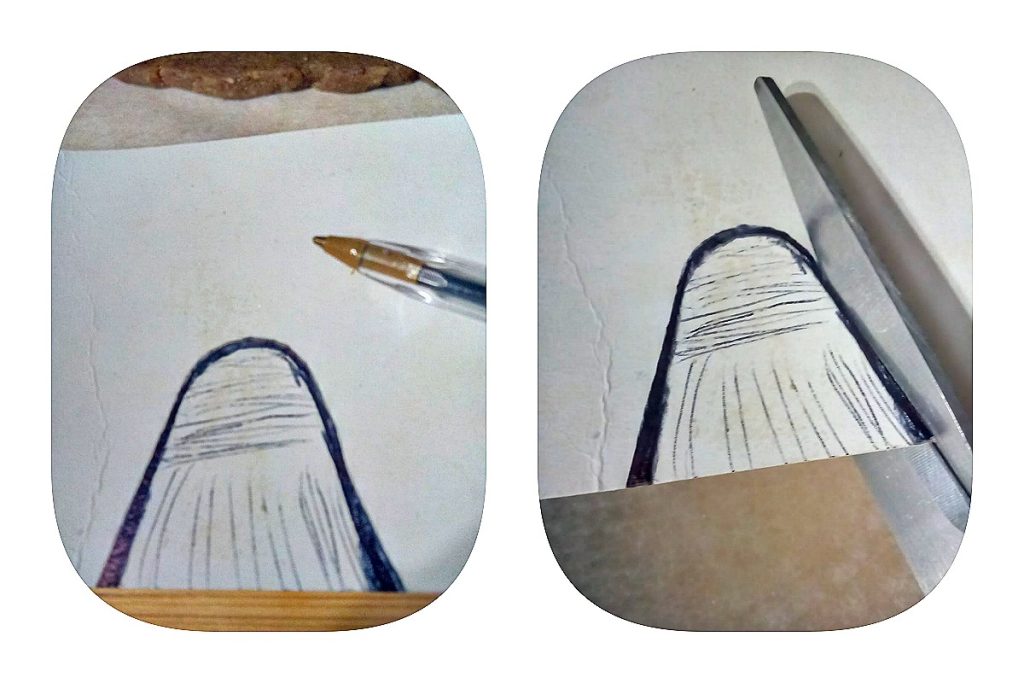
Use the cardboard broom as a stencil: place it on the sheet of dough and cut its outline with a knife. At the end, gather the scraps of dough into a ball, then roll again between two sheets of parchment paper and create more brooms. Continue until the dough is finished (you should get roughly 64 cookies).
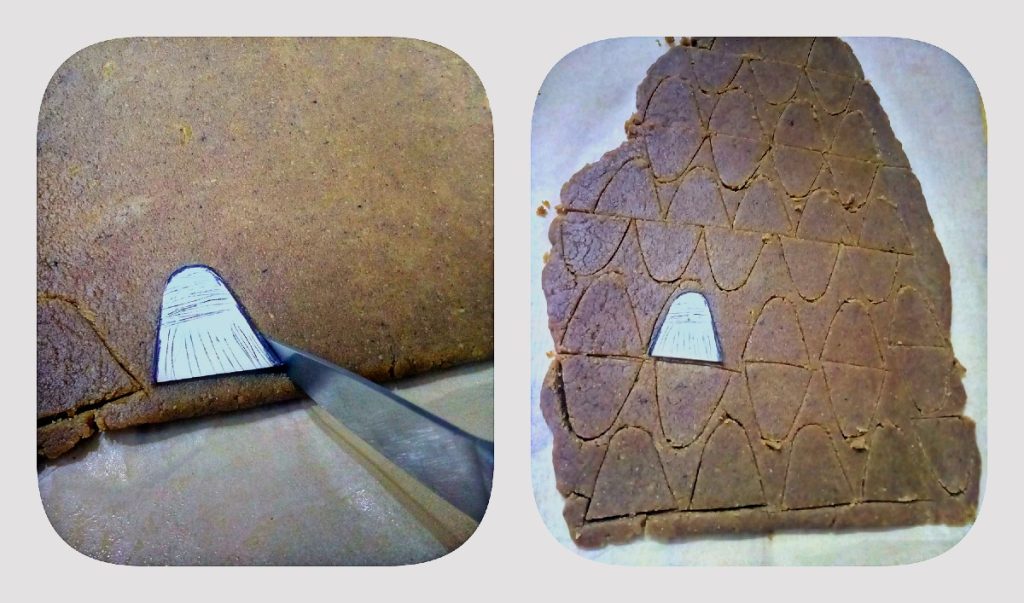
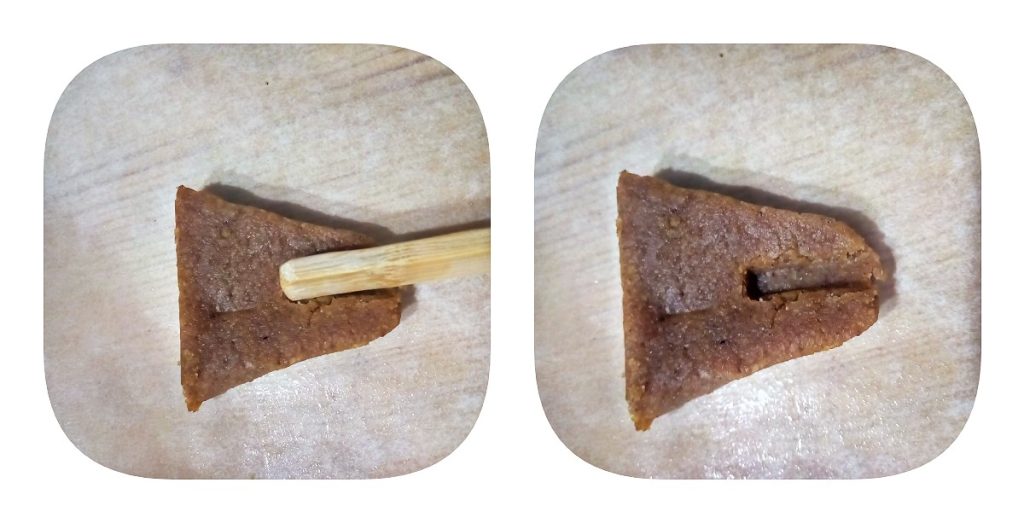
Take a wooden skewer like this one (or something similar) and press it into the point where the broom handle will be created.
Bake the cookies in a preheated oven at 356°F for 15 minutes.
Melt the dark chocolate in the microwave or using a bain-marie.
Meanwhile, line up the cookies on your work surface and, where the broom handle will be, place a small riser about 3/8 in thick (as in the adjacent picture).
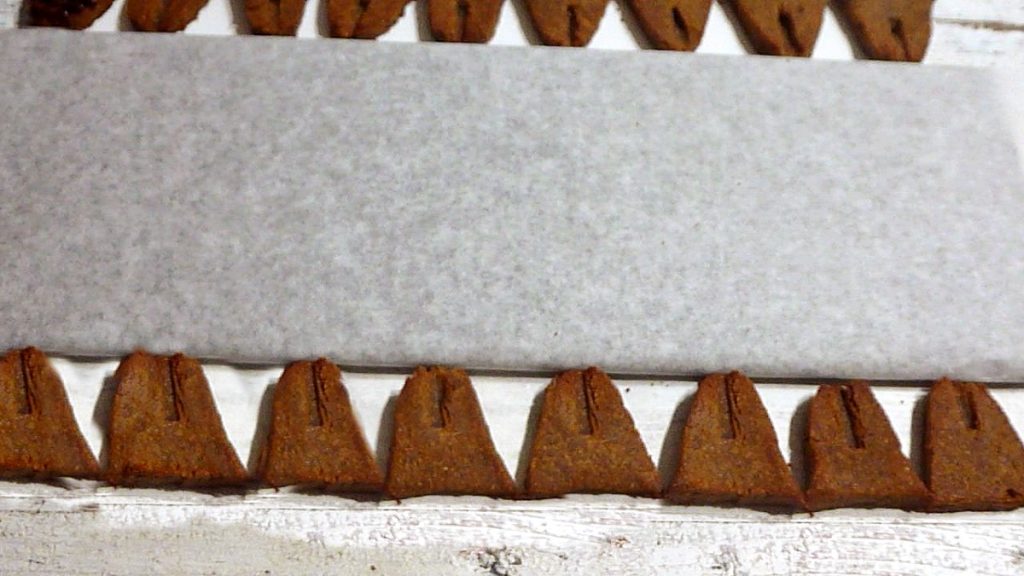
Transfer the melted chocolate into a piping bag and create first the handle.
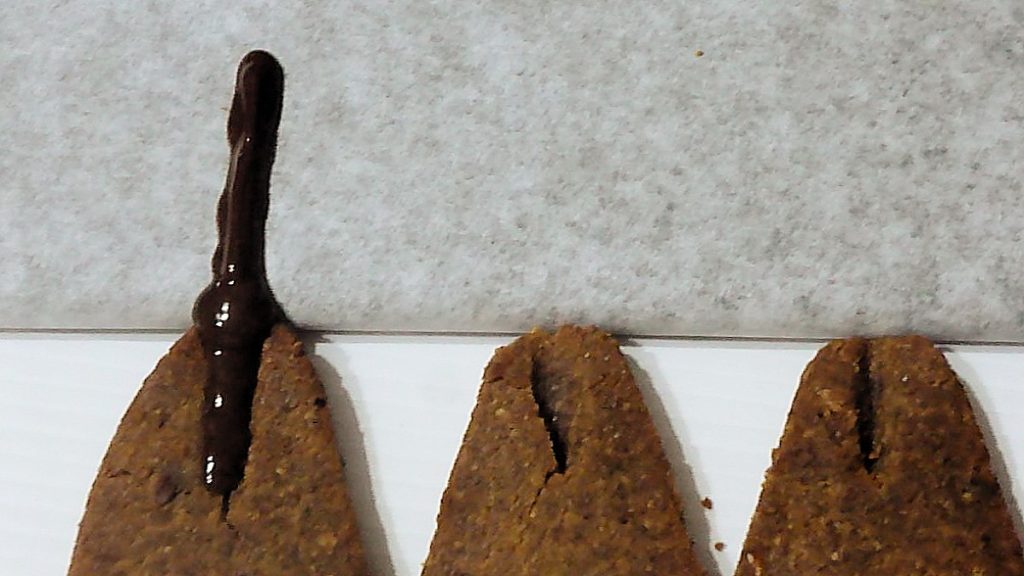
Then pipe thinner lines for the broom bristles (vertical lines on the lower part of the broom and horizontal lines on the upper part).
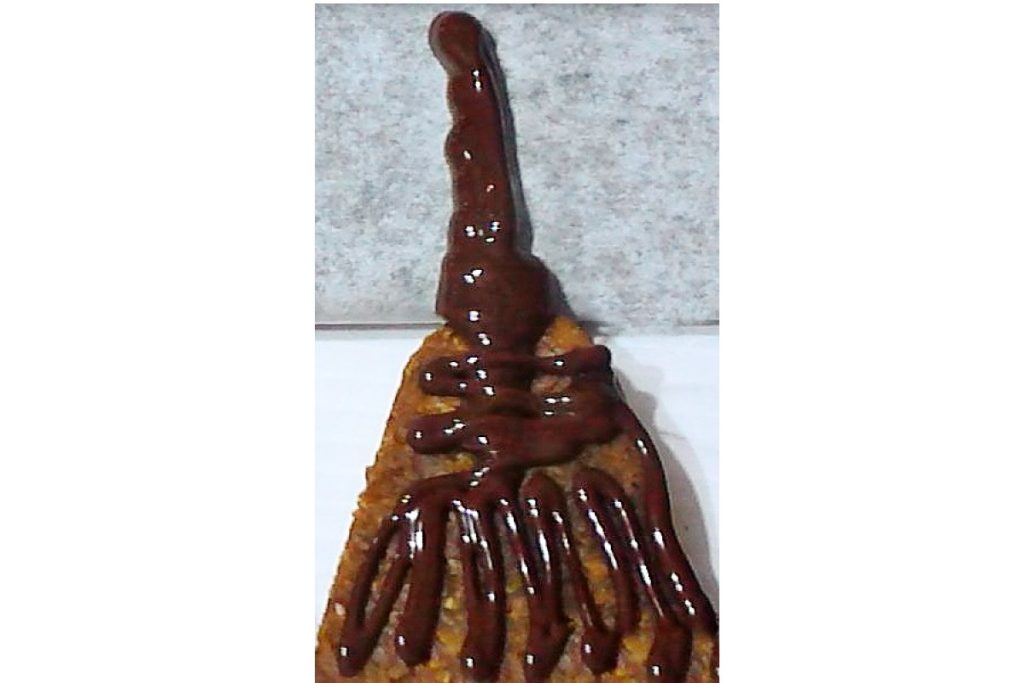
Let the chocolate set, then carefully lift each broom to detach the chocolate handle from the tray lined with parchment paper (take care not to break the handles).
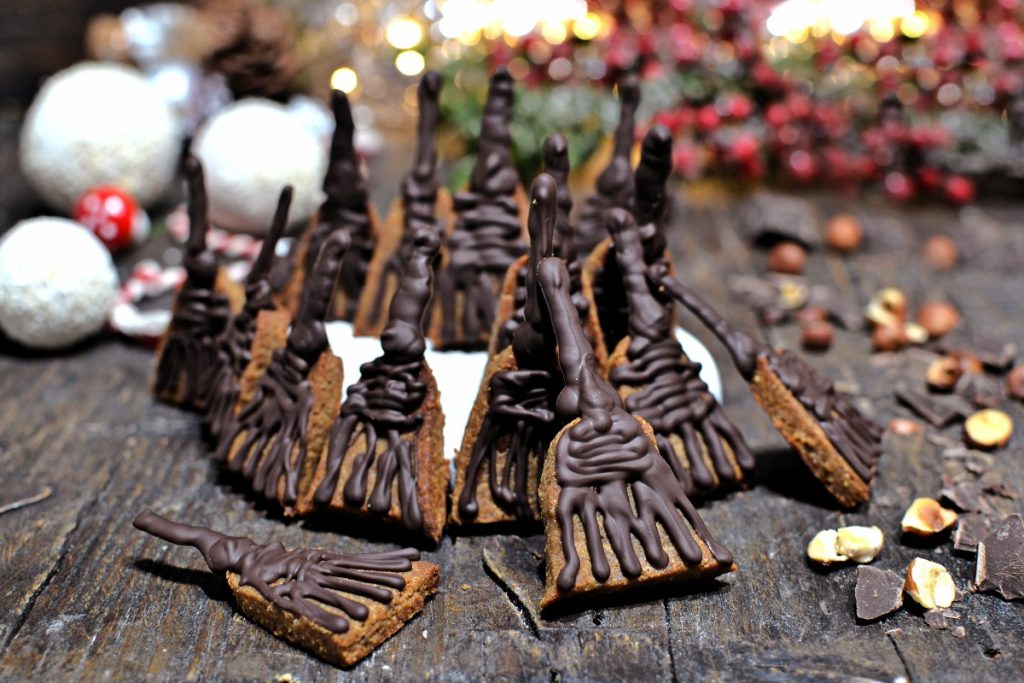
The Befana broom-shaped cookies are ready — tasty and impressive.
The explanation is very detailed but they are simple and quick to make, and you can easily make them together with your children.
Put the quinoa flour, hazelnut flour, inulin, psyllium husk powder and erythritol into the Thermomix bowl. Mix 10 sec / speed 5.
Add the peanut butter and the warm water. Knead 30 sec / speed 5 + 1 min / Dough mode.
Transfer the dough to a surface, wrap it in plastic and refrigerate for 30 minutes.
Roll out the dough and cut the broom shapes using the cardboard template.
Place the cookies on a baking tray lined with parchment paper.
Bake in a conventional oven at 356°F for 12–15 minutes.
Decorate with melted dark chocolate.
More Befana treats
Alcohol-free Befana sugar coal recipe
Alcohol-free Befana sugar coal recipe
Step-by-step Befana broom shortcrust cookies
Step-by-step Befana broom shortcrust cookies
Frequently Asked Questions
Useful questions and answers about the Befana broom-shaped cookies:
Can I eat these Befana cookies if I’m lactose intolerant?
Yes, you can eat the Befana broom-shaped cookies even if you are lactose intolerant: the recipe contains no milk, butter or dairy derivatives. Peanut butter is used instead of butter, and there are no risky ingredients.
Can I eat these Befana cookies if I’m gluten intolerant?
Yes, you can eat the Befana broom-shaped cookies even if you are gluten intolerant: the recipe is made with naturally gluten-free flours such as certified oat and hazelnuts, with no traces of wheat or derivatives.
Can I prepare the Befana broom cookies without special ingredients?
Of course! The broom-shaped cookies can be simplified using oat flour, chopped hazelnuts, eggs and peanut butter. Even without psyllium and inulin, the shortcrust can turn out perfect if well balanced.
Are the broom-shaped cookies compatible with a keto or low-carb diet?
Yes, the broom-shaped cookies are compatible with a low-carb diet thanks to the use of erythritol and fiber-rich flours like quinoa and hazelnuts. Each cookie weighs about 13 g and contains only 1.2 g net carbs, so it can be suitable for ketogenic diets as long as it fits within daily limits. The recipe is sugar-free, gluten-free and butter-free — perfect for those seeking light and nutritious desserts.
How should I store the broom-shaped cookies after baking?
Store the broom-shaped cookies in a tin box or airtight container for 5–6 days. If decorated with dark chocolate, it’s best to keep them in a cool place to prevent melting.
Are these Befana broom cookies suitable for diabetics?
Yes, the broom-shaped cookies are suitable for diabetics because they contain no sugar but erythritol, a natural sweetener with zero glycemic impact. The recipe is also high in fiber and low in net carbohydrates, ideal for controlled diets.
Do I have to use cardboard to create the broom cookie shapes?
The broom handles are made with melted chocolate to avoid breakage: since the cookies are small, a dough handle would be too thin and fragile. Chocolate provides stability, is more resistant and adds a delicious touch everyone loves.
Why make the broom handles with melted chocolate instead of the same shortcrust dough?
To avoid the risk of them breaking — the cookies are small, so dough handles would be thin and brittle. Using chocolate not only makes them tastier but also eliminates that risk.
