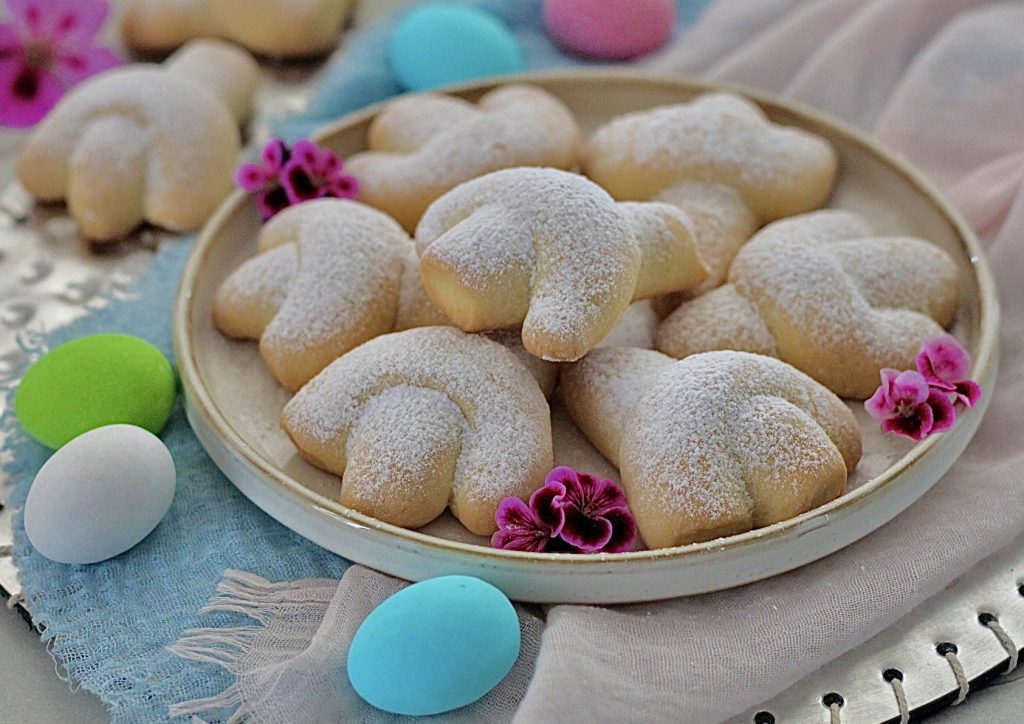
The colombine made with olive oil are delightful Easter cookies that combine tradition and lightness in a symbolic and festive shape.
These Easter treats, inspired by the classic Colomba cake, represent peace and rebirth, but in a simpler, everyday version perfect for sharing with family.
They are butter-free cookies, made with extra virgin olive oil, which makes them a healthier and lighter choice compared to traditional recipes. Thanks to this ingredient, the Easter colombine are easier to digest, with a delicate texture and a balanced flavor, ideal even for those looking for less rich yet still indulgent alternatives.
This Easter cookie recipe is easy and quick, suitable even for those with little kitchen experience. They are also perfect to make with children; I still remember preparing them with my kids — what immense joy watching them shape the colombine, and by tradition we enjoyed them on Easter day before opening the eggs.
Choosing soft Easter cookies made with olive oil means opting for healthier fats. They are ideal for breakfast or a sweet break during the holidays, without guilt.
Making these colombine means rediscovering the pleasure of simple gestures, bringing to the table homemade, fragrant, and lovingly made Easter cookies.
You might also be interested in
- Difficulty: Easy
- Cost: Budget-friendly
- Preparation time: 20 Minutes
- Cooking time: 15 Minutes
- Cooking methods: Oven
- Cuisine: Italian
- Seasonality: Easter
Ingredients for the Colombine cookies
Easter colombine recipe
- 2 1/3 cups type 0 flour (all-purpose flour)
- 6 1/2 tbsp erythritol or brown sugar
- 3 1/3 tbsp extra virgin olive oil
- 2 eggs
- 1 tbsp lemon juice
- 1 lemon
- 2 tsp baking powder
- pinch fine salt
- as needed powdered sugar
Tools
- 1 Bowl
- 1 Hand mixer
- 1 Grater
- 1 Baking tray
- Parchment paper
- 1 Sieve
- 1 Spatula
- 1 Pastry mat
Steps for the Colombine cookies
To prepare the colombine cookies, WATCH THE VIDEO RECIPE
Start by carefully sifting the flour together with the baking powder into a large bowl, an essential step to avoid lumps and obtain soft, even Easter cookies.
Take another bowl, break the eggs and add a pinch of fine salt and the erythritol or brown sugar and whip with a stand mixer or a hand mixer until the mixture is light and fluffy, then add the extra virgin olive oil in a thin stream while continuing to mix to create a stable emulsion. Then add the grated zest of lemon or orange.
Finally, fold in the sifted flour and baking powder, mixing first with a spatula, then briefly work the dough by hand on a lightly floured pastry mat, without overworking to avoid excessive gluten development (this is the secret to getting tender, not hard, butter-free cookies), until you obtain a smooth, soft, slightly elastic dough; wrap the dough in cling film and let it rest for at least 20–30 minutes at room temperature.
After resting, divide the dough into equal portions weighing about 1.23 oz (35 g) each.
Roll each portion into a not-too-thick sausage shape. Cut it in half. Place one half on a tray lined with parchment paper and press lightly with your index finger approximately at the midpoint of the sausage. Lay the other half of the sausage on top and curve it upwards, as shown in the video.
Repeat with the remaining dough until complete.
Once assembled, bake in a static (conventional) oven preheated to 356°F (180°C) for about 12–14 minutes, checking the baking: the Easter cookies should be just golden at the edges but still pale in the center to remain soft; once out of the oven, let them cool on a rack to avoid moisture forming on the bottom, so they keep the right texture.
Dust generously with powdered sugar and the colombine cookies are ready to enjoy as light, fragrant, homemade Easter treats.
Storage of the colombine cookies
Once completely cooled (a crucial step to avoid moisture), store the colombine cookies in an airtight container, preferably tin or glass, which will protect them from air and preserve their fragrance.
You can also place a sheet of parchment paper at the bottom and between layers to better preserve their texture. With this method, the soft Easter cookies will keep well for about 5–7 days, retaining their aroma and tenderness.
If you want to keep them longer, you can freeze them: place them in well-sealed food bags and, when ready to eat, let them thaw at room temperature for a few hours so they return to being soft like freshly baked; avoid refrigeration, as moisture tends to harden these Easter treats and spoil their texture.
To not miss my recipes, I WAIT FOR YOU on my pages on
INSTAGRAM with 110K FOLLOWERS and on
FACEBOOK with 100K FOLLOWERS
To stay updated on my new recipes you can ACTIVATE PUSH NOTIFICATIONS FOR MY BLOG
FAQ (Questions and Answers)
Can I use seed oil instead of olive oil?
Yes, in the same quantity.
Can I use granulated sugar?
Yes, in the same quantity.