
How to make a creamy Neapolitan chocolate pastiera that doesn’t crack while baking
Chocolate Pastiera: The secret to a dreamy filling
Let’s be honest: the pastiera is the queen of celebrations, but it can also be a very capricious “prima donna.” How many times have you pulled out a beautiful pastiera only to see those unsightly cracks appear on the surface as it cools?
Or worse, find a soggy shortcrust shell and a filling that never quite comes together, remaining almost grainy under the teeth?
Today we’ll fix everything together! In this Chocolate Neapolitan Pastiera version I will reveal how to get a heart so creamy and velvety it melts in your mouth.
No more cracks and no more soggy dough. The real secret, though, is patience: a slow, gentle bake and at least 24 hours of resting.
This time allows the aromas to meld and the structure to stabilize, giving you a compact, very fragrant slice. P
repare your pans, because this chocolate pastiera will win over even tradition purists.
- Difficulty: Medium
- Cost: Medium
- Rest time: 12 Hours
- Preparation time: 35 Minutes
- Cooking time: 1 Hour
- Portions: 8
- Cooking methods: Oven
- Cuisine: Italian
Ingredients Chocolate Pastiera
- 2 1/2 cups all-purpose flour
- 6 tbsp unsweetened cocoa powder
- 2 eggs
- 1/2 cup granulated sugar
- 7 tbsp vegetable oil
- 2 tsp baking powder
- 1 1/4 cups cooked wheat (grano cotto)
- 3/4 cup whole milk
- 6 tbsp unsweetened cocoa powder
- 1 cup whole-milk ricotta
- 1 1/4 cups granulated sugar
- 3 eggs
- 1 vial orange blossom extract (vial)
- 1 tsp vanilla extract
- 1/3 cup candied orange peel, chopped
- 1/3 cup candied citron (cedro), chopped
Tools
- Kitchen scale
- Small saucepan
- 2 Bowls
- Rolling pin
- Parchment paper
- Baking pan
How to make the Neapolitan chocolate pastiera
In a small saucepan, combine the drained cooked wheat and the milk. Break up any clumps with a fork and place over low heat.
Cook, stirring often, until the milk has been completely absorbed (about 15 minutes), obtaining a smooth but thick cream.
With the heat off, add the unsweetened cocoa powder and stir vigorously to fully incorporate. Transfer everything to a large bowl and let cool to warm.In a large bowl, break the eggs and add the sugar and vegetable oil. Begin mixing with a fork (or with your hands).
Add the unsweetened cocoa and the baking powder, continuing to mix.
Incorporate the flour little by little, working quickly so as not to warm the oil and to keep the dough crumbly.
When the dough becomes cohesive, work it on a floured surface until you obtain a smooth, elastic ball that doesn’t stick to your fingers.Take the warm wheat cream and add the sifted ricotta, mixing well.
Add the sugar, the eggs, the orange blossom extract and the vanilla extract, combining everything.
Finally add the mixed candied peel (cedro and orange). Mix to distribute the candied fruit evenly.Roll out two-thirds of the shortcrust dough with a rolling pin on a floured sheet of parchment.
Using the paper, line a tart pan (diameter 10 1/4 in) that you have previously greased and floured. Trim the excess edges. Pour the filling into the pastry shell and level it.
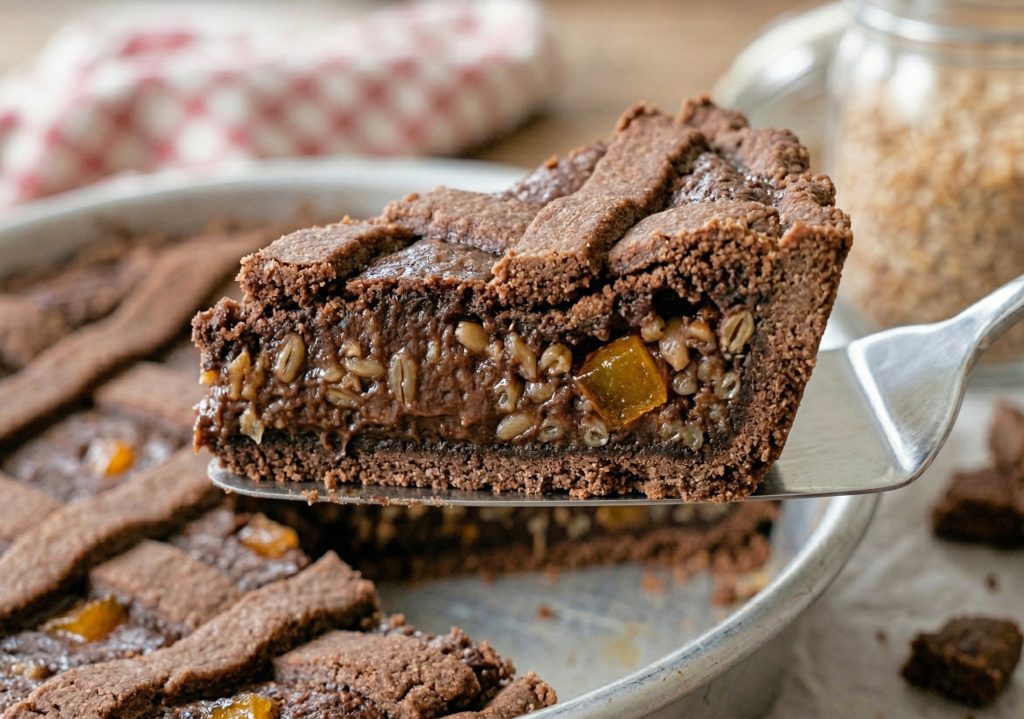
Roll out the remaining dough and cut 7 strips with a pastry wheel, arranging them over the filling to form the classic lattice diamond pattern.Bake in a preheated fan oven: cook at 338°F (170°C) for the first 50 minutes, then lower to 320°F (160°C) and continue for another 10 minutes. The pastiera is ready when the filling appears set but still slightly “jiggly” in the center; it will firm up as it cools. Let cool completely and wait at least 24 hours before serving. Texture and aromas improve significantly with resting.
Notes and Storage
Storage: Keeps at room temperature for 2 days or in the refrigerator for 4-5 days. The moist structure improves noticeably after the second day.
Variations: You can add whole chocolate chips for an extra textural bite under the teeth.
Never open the oven during the first half hour to avoid compromising the minimal aeration of the filling.
FAQ (Questions and Answers)
Why did my pastiera puff up too much in the oven?
You’ve probably overmixed the eggs with the ricotta, incorporating too much air. The filling should be mixed, not whipped, so it stays dense and silky.
Should the cooked wheat be blended?
It depends on your preference. If you love tradition, leave it whole to feel the grain’s texture; if you prefer a modern cake, blend it completely for a smoother, more uniform consistency.
