
How to make the perfect lemon risotto: creamy, balanced and without any bitter aftertaste
The lemon risotto dilemma: how to avoid a bitter aftertaste
Lemon risotto is an ode to delicacy, but it hides a pitfall that can ruin the whole experience: that sharp or, worse, bitter aftertaste that often dominates the dish.
The problem almost always arises from incorrect handling of the zest (which should never touch the white pith) or from adding the juice too early, which, when cooked for too long, loses its freshness and turns toward unpleasant notes.
Often you end up with rice that is too acidic or, conversely, too rich as a compensation for the citrus.
In this recipe we will solve the problem by focusing on an infusion and finishing technique with the heat turned off.
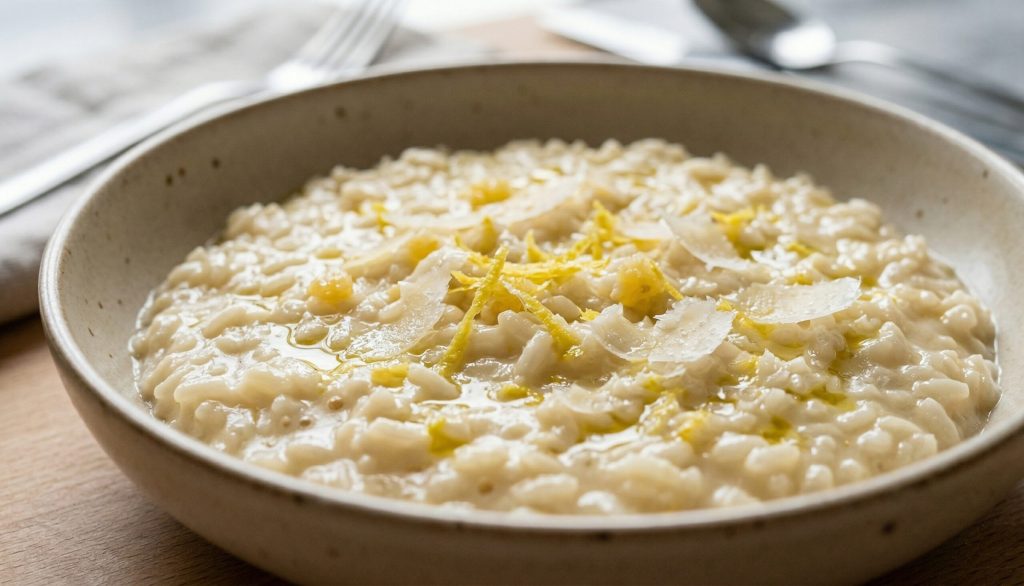
We will obtain a risotto with a texture that melts in the mouth, where the citrus note is a velvety caress that envelops every grain.
We will learn to toast the rice dry to keep its plump structure and to release the lemon’s essential oils only at the end, for a fragrance that smells of spring.
A refined dish in its simplicity, capable of surprising with a perfect balance between savoriness and freshness.
- Difficulty: Very easy
- Cost: Very inexpensive
- Preparation time: 10 Minutes
- Cooking time: 20 Minutes
- Portions: 4
- Cooking methods: Stovetop
- Cuisine: Italian
Ingredients
- 1 2/3 cups Carnaroli rice (or Arborio)
- 4 1/4 cups vegetable broth
- 1 shallot
- 3 tbsp butter (for finishing)
- 2/3 cup Parmigiano Reggiano PDO (for finishing)
- 1/2 glass dry white wine
- to taste extra virgin olive oil
- to taste fine salt
- 2 lemons (zest finely grated and juice strained)
- to taste thyme (fresh)
Tools
- Kitchen scale
- Food processor
- Pot
Procedure
Start by finely chopping the shallot and gently sweating it in a splash of oil with a tablespoon of broth until it becomes transparent and silky. In a separate pot, toast the rice dry for a couple of minutes until the grains are warm to the touch: this step is essential to seal the starch and keep the grain plump. Deglaze with the white wine and let the alcohol evaporate completely.
Begin adding the boiling broth, one ladle at a time, as it is absorbed. Stir regularly to encourage the release of starch, which will create that colloidal and silky texture typical of great risottos. Halfway through cooking, add half of the finely grated lemon zest (be careful not to include the white pith!).
When cooking is complete (the grain should remain al dente), turn off the heat. This is the moment of magic: add the strained lemon juice, the very cold butter straight from the fridge, and the Parmesan. Cover with a lid and let rest for 2 minutes. Then stir vigorously (wave-style finishing) until the risotto looks glossy, velvety and creamy.
Notes on ingredients and substitutions
The Rice: Carnaroli is ideal for maintaining a plump texture and releasing the right amount of starch for a silky cream.
Herb Touch: Fresh thyme pairs divinely with lemon, adding a fibrous, herbaceous note that cleanses the palate.
Storage
Risotto should be enjoyed immediately to appreciate its melting texture. If leftovers remain, you can transform them the next day into crispy lemon arancini pan-fried in a skillet.
Variations and tips
For an even more intense aroma without the risk of bitterness, steep the lemon zests in the boiling broth for 10 minutes, then strain it before starting to cook.
Gourmet Variation: Add quickly sautéed shrimp for a textural contrast between the softness of the rice and the plump firmness of the crustacean.
FAQ (Questions & Answers)
Can I use bottled lemon juice?
Absolutely not. This recipe requires fresh zest and the lively juice of the fruit to guarantee aroma and correct acidity.
Why did my risotto turn out too acidic?
You’ve probably used too much juice compared to the amount of butter and cheese. The fatty finishing is precisely meant to balance the lemon’s acidity.
Should the rice be rinsed?
Never rinse the rice for risotto: you would lose the starch needed to achieve that colloidal and silky texture we’re after.
