
How to make the two-tone loaf with a stand mixer: secrets for perfect proofing
Two-Tone Cocoa Loaf: Soft Marbled Sweet Bread
Dry loaf or slow proof? Here’s how to achieve the two-tone cloud
The main problem when making a risen loaf, especially when enriched with cocoa, is that it often comes out dry, compact, or the rising doesn’t happen correctly, leaving us with a hard and unappealing sweet bread.
Many think the only way to get a soft result is to use tons of butter or eggs, but the real secret lies in managing the temperature of the liquids, the order of adding ingredients and, above all, creating the cocoa emulsion.
In this recipe we’ll use the stand mixer to develop a strong, elastic gluten network, essential to trap carbon dioxide during the three planned proofing stages.
The real trick, however, is to prepare a cocoa-and-milk batter before incorporating it into the dark dough: this prevents the cocoa from absorbing too much moisture directly from the flour, keeping the loaf incredibly moist and soft for days.
By following these steps, you will obtain a loaf that is not only beautiful but will stay soft and fragrant as if just baked, solving once and for all the fear of a “brick” loaf.
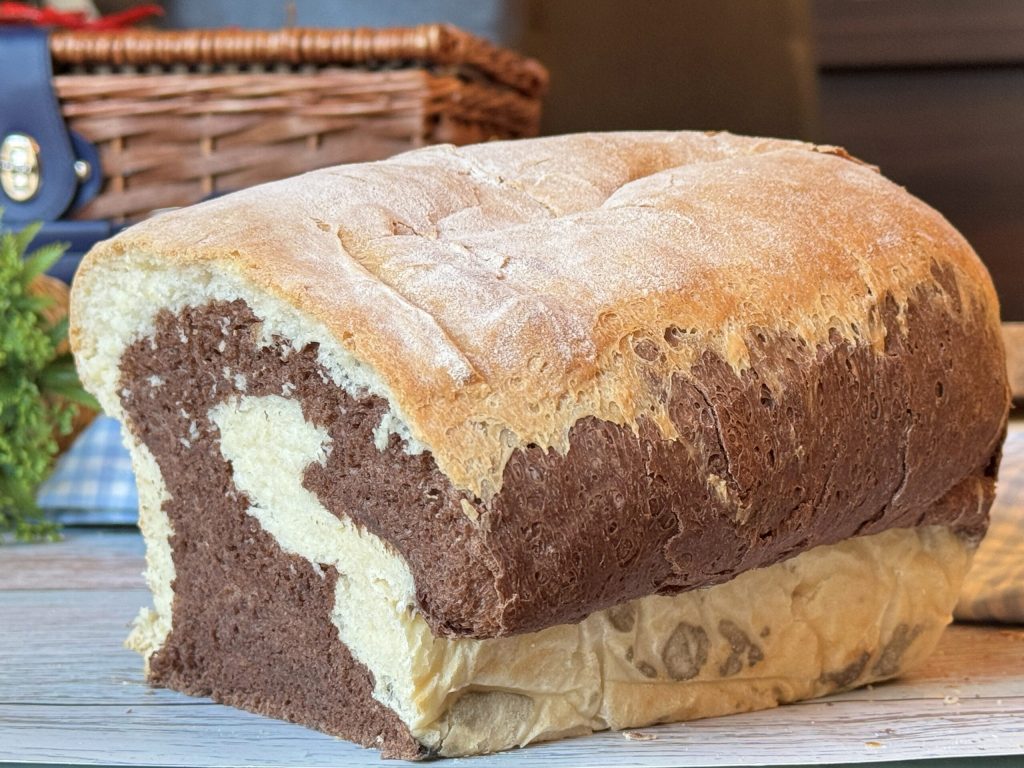
- Difficulty: Easy
- Cost: Very inexpensive
- Rest time: 7 Hours
- Preparation time: 20 Minutes
- Cooking time: 35 Minutes
- Portions: (loaf pan 9.8 x 4.3 in)
- Cooking methods: Oven
- Cuisine: Italian
Ingredients for Two-Tone Cocoa Loaf
- 3 3/4 cups all-purpose flour (type 00)
- 1/2 cup + 1 tbsp whole milk (divided: 1/2 cup + 1 tbsp)
- fl oz water
- 1/4 cup granulated sugar
- 2 tbsp butter (in soft pieces, at room temperature)
- 0.35 oz fresh yeast (about 1/2 cube)
- 3 tbsp unsweetened cocoa powder
- 1 tsp fine salt
- as needed milk (for brushing)
Tools
- Kitchen scale
- Stand mixer
- Small bowl
- Loaf pan
How to make the two-tone loaf: secrets for perfect proofing
In the bowl of the stand mixer (whisk removed) pour the water and 1/2 cup of the milk. Add the sugar and the crumbled fresh yeast. Mix on low speed for one minute until the yeast dissolves.
Add the flour and start the mixer fitted with the dough hook at medium speed for about 2–3 minutes, until the ingredients begin to come together. At this point add the salt and continue kneading.
While the mixer is running, add the soft butter piece by piece, making sure each piece is absorbed before adding the next. Continue to knead for 5–7 minutes, until the dough is smooth, elastic and completely detaches from the sides of the bowl.
Remove about 380 g of dough (the white portion), shape it into a ball, place it in a bowl covered with plastic wrap and let it rise in a warm place away from drafts (for example, an oven turned off with the light on) for about 2 hours, until doubled.
Mix the remaining 1 tbsp of milk with the unsweetened cocoa in a small cup until you obtain a smooth batter. Add the cocoa batter to the other half of the dough left in the mixer bowl and run the mixer at medium-low speed until the color is even and the cocoa is fully incorporated (about 3–4 minutes). If necessary, add a splash of milk or a little flour to reach the same consistency as the white dough.
Transfer the cocoa dough to a bowl, cover with plastic wrap and let it rise in a warm place for 2 hours, until doubled.
Line a loaf pan (9.8 x 4.3 in) with parchment paper. Transfer the two risen doughs to a work surface and, with a rolling pin, roll each into a rectangle (about 11.8 x 7.9 in). Lightly brush the white rectangle with a little milk, place the cocoa rectangle on top and gently roll the rolling pin over them to make them adhere well. Roll the dough up from the long side and place it in the prepared pan. Let it rise in a warm place until doubled (about 3 hours).
Preheat the oven to 356°F. Bake the loaf in the hot oven for 35–40 minutes, until well browned. If the surface browns too much, cover it with a sheet of aluminum foil halfway through baking. Remove from the oven, let cool for 10–15 minutes in the pan, then turn out and finish cooling on a wire rack before serving.
Ingredients Notes and Substitutions
Yeast: You can replace fresh yeast with 3 g of active dry yeast, mixed directly with the flour.
Butter: Make sure it is really soft (“at room temperature”) before adding; if used cold it will not incorporate well.
Flour: If you prefer, use 50% type 00 and 50% Manitoba flour for an even stronger gluten network.
Recipe Variations
Chocolate chips: For a more decadent version, add 30 g (about 1 oz) of chocolate chips to the cocoa dough during the final mixing stage.
Orange flavor: Add the grated zest of one organic orange along with the butter for a citrus aroma.
Storage
The two-tone loaf stays soft for 2–3 days in the refrigerator inside airtight food bags. It can be frozen, preferably sliced and placed in freezer bags.
Tips
Texture: If the dough is too soft or too stiff, add flour or milk little by little and knead for 30 seconds until you obtain an elastic dough.
FAQ (Questions & Answers)
Can I use sweetened cocoa instead of unsweetened?
No, it would alter the balance of the recipe and the loaf would be too sweet. In addition, sweetened cocoa absorbs liquids differently.
Why did the two layers separate after baking?
Probably you didn’t brush well with milk or didn’t press enough with the rolling pin. Make sure the two rectangles adhere perfectly.
Can I reduce the proofing times?
Not recommended. Long, slow proofs are essential to develop an incredibly soft and digestible loaf. Always respect the indicated times.
