
How to make perfect St. Joseph’s Zeppole: fried or baked
St. Joseph’s Zeppole: The secret to a light, airy choux pastry
Why do zeppole sometimes stay raw inside or collapse?
The main problem when making zeppole is handling the choux pastry. Many find themselves with zeppole that look beautiful during cooking but, once taken out of the oil or oven, collapse miserably and become flat fritters.
Or, worse, they remain heavy with an unpleasant raw egg taste inside. The frustration is high, but the secret to avoiding disaster lies in the “batter” and how the eggs are incorporated.
In this recipe we fix the problem starting from properly cooking the base (that white film on the pan is your best friend!) and gradually adding the eggs: not all eggs weigh the same and the dough has to “learn” to absorb them little by little.
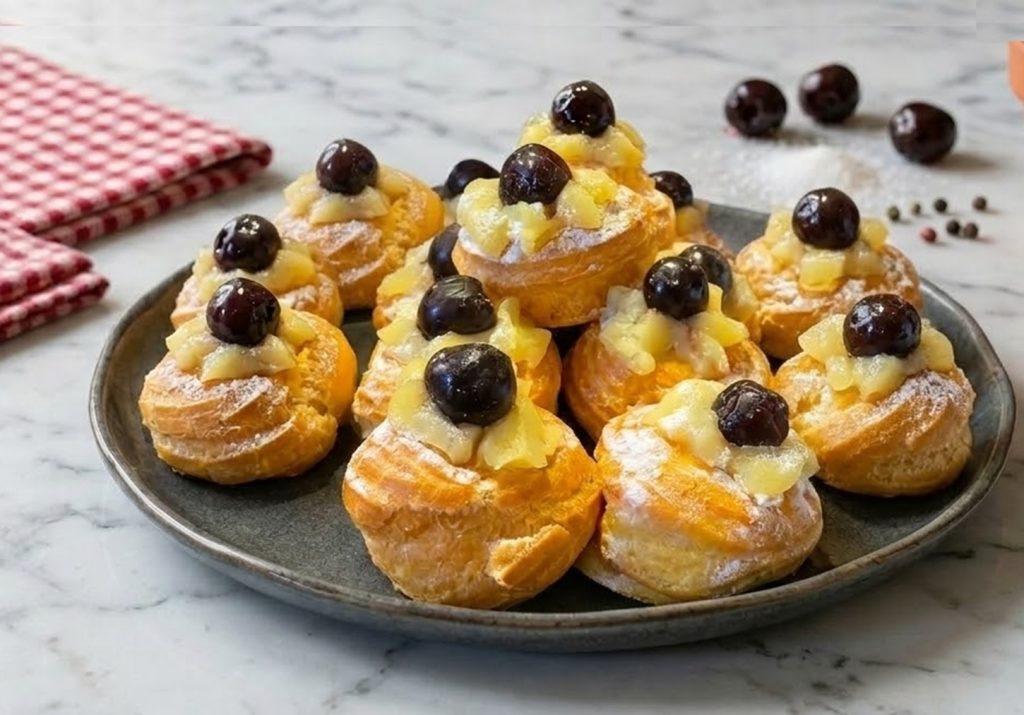
Whether you choose to fry them for tradition or bake them for a lighter version, with these tips you’ll get a perfectly airy interior ready to welcome a silky pastry cream and the classic sour cherry.
Let’s make this masterpiece of sweetness together!
- Difficulty: Medium
- Cost: Inexpensive
- Preparation time: 40 Minutes
- Cooking time: 20 Minutes
- Portions: 6 medium zeppole
- Cooking methods: Stovetop
- Cuisine: Italian
Ingredients for St. Joseph’s Zeppole
- 200 about 3/4 cup + 1 1/2 tbsp water
- 125 about 1 cup type 00 flour
- 50 3 1/2 tbsp butter
- 110 about 2 medium eggs (about 4 oz) eggs (about 2 medium, weighed without shell)
- 1 pinch fine salt
- 100 3.4 fl oz whole milk
- 25 1 2/3 tbsp heavy cream (liquid)
- 35 about 2 3/4 tbsp granulated sugar
- 1 egg yolk (medium)
- 10 1 tbsp cornstarch
- 1/2 lemon zest (organic)
- 1.5 about 6 1/3 cups (50.7 fl oz) peanut oil for frying
- to taste sour cherries in syrup
- to taste powdered sugar
Tools
- Kitchen scale
- Small saucepan
- Piping bag
- Star nozzle
- Thermometer
- Bowl
- Electric whisk
How to make perfect St. Joseph’s Zeppole: fried or baked
Heat the milk and cream with the lemon zest. Separately, whisk the egg yolk with the sugar and cornstarch. Pour the hot milk over the mixture through a sieve, stir and return to low heat. Thicken while stirring continuously with a whisk. Transfer to a bowl, cover with plastic wrap directly on the surface and refrigerate once lukewarm.
In a small saucepan put the water, butter and salt. When the butter has melted and the water is near boiling, remove from the heat and add all the flour at once. Stir vigorously and return to the heat until the mixture forms a ball and leaves a white film on the bottom of the pan. Let it cool slightly in a bowl, “spreading” the dough out.
Beat the eggs and add them to the choux paste little by little using an electric whisk. Do not add more egg until the previous one has been completely absorbed. The final dough should be glossy, thick and should “write” (falling from the spoon it should form a ribbon).
Transfer to a piping bag. On squares of parchment paper, pipe double concentric rings about 3 1/8–4 inches (8–10 cm) wide. Heat the oil to 329°F–338°F (do not exceed this, otherwise they’ll stay raw inside!). Immerse the zeppola with its paper, which will detach on its own after a few seconds. Turn them frequently for 10 minutes until they are puffed and golden.
Drain on absorbent paper. Once cold, work the pastry cream to soften it and fill the center with a generous piping of cream. Finish with a sour cherry and a dusting of powdered sugar.
Variations and Baking Method
If you prefer the baked version, preheat the oven to 392°F and bake for 20 minutes, then lower to 320°F for another 10–15 minutes with the door slightly ajar (use a wooden spoon to keep it cracked) to dry the interior.
Ingredient Notes and Substitutions
Eggs: Weighing them is essential. If too many eggs are added, the dough will become too loose and won’t hold its shape.
Flavors: You can also use vanilla for the cream, but lemon is the traditional flavor for zeppole.
Storage
Empty zeppole keep in a paper bag for 2 days. Once filled, consume within a few hours to avoid the choux pastry becoming soggy.
Tips
Oil temperature: If the oil is too hot, the zeppola will brown quickly on the outside but remain undercooked inside. Use a thermometer!
Double ring: When piping the zeppola, pipe one ring over the other leaving a small hole in the center: it will widen during cooking.
FAQ (Questions and Answers)
Why is my choux pastry too runny?
You’ve probably added the eggs too quickly or the dough wasn’t dry enough on the heat.
Can I use only milk for the cream?
Yes, but the cream makes it much silkier and more stable for decorating.
Why use parchment paper for frying?
It prevents the zeppola from losing its shape when you lower it into the hot oil.
