
How to make Iginio Massari’s Wonders thin and bubbly for Carnival
Iginio Massari’s Wonders: the recipe for perfect chiacchiere
Carnival brings with it a challenge every pastry enthusiast dreads: making chiacchiere that are not just “good”, but have that almost heavenly lightness that makes them unique.
The common problem many face is getting a dough that turns out hard, greasy or, worse, flat and lacking those iconic bubbles.
Often people think rolling the dough thin is enough, but the truth is that without the right balance of fats (like cream) and the correct frying oil temperature, the result will always fall short of expectations.
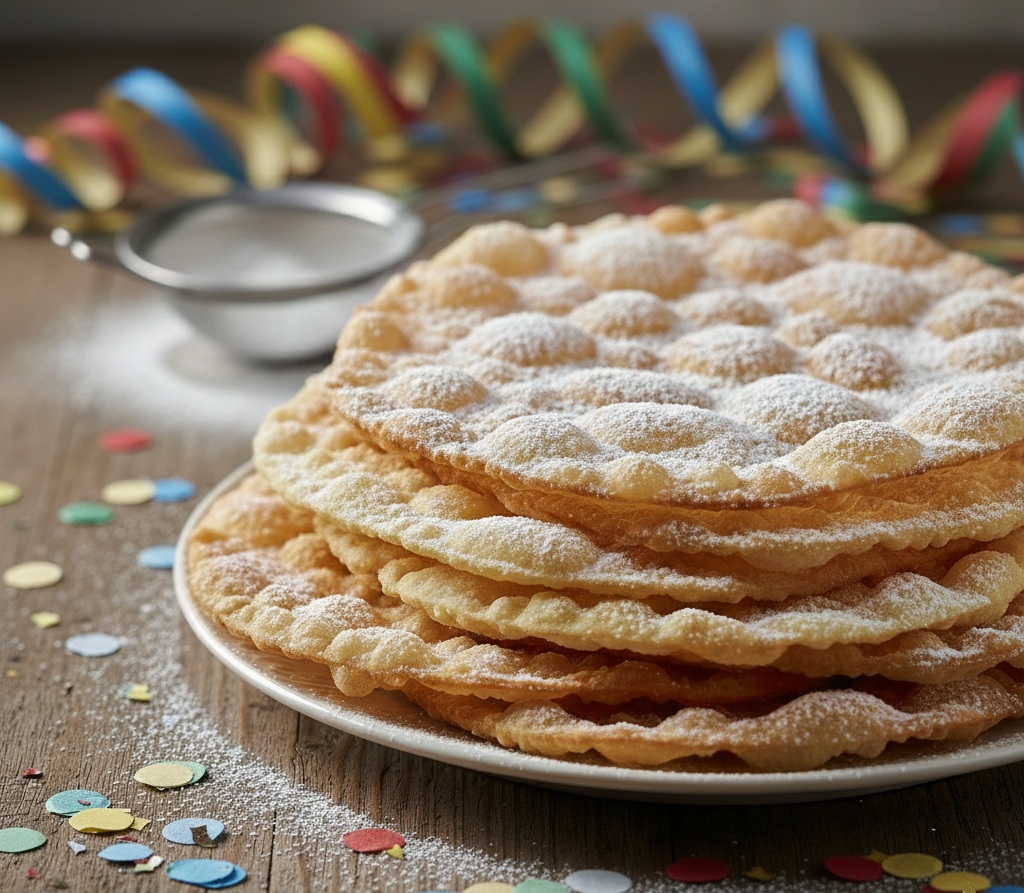
Massari’s “Wonders” solve these doubts at the root. Thanks to the addition of cream and a touch of rum, the dough gains plasticity that allows it to reach infinitesimal thicknesses, while the lemon aroma balances the sweetness.
In this version, I don’t just teach you how to knead, I reveal the trick of using wooden sticks to give structure to the disk during frying, creating that movement that captures the powdered sugar and makes every bite a sensory experience.
Forget the usual heavy frappe: with this method you’ll get golden, fragile and incredibly bubbly sheets that literally vanish in your mouth.
- Difficulty: Medium
- Cost: Very inexpensive
- Preparation time: 40 Minutes
- Cooking time: 10 Minutes
- Portions: about 40 pieces
- Cooking methods: Stovetop
- Cuisine: Italian
Ingredients
- 4 cups 00 flour
- 3 eggs eggs (whole)
- 1 egg yolk egg yolk
- 3 tbsp granulated sugar (about 40 g)
- 1 tsp salt (about 5 g)
- 1 2/3 tbsp heavy cream (about 25 ml)
- 1.7 fl oz rum (about 50 ml)
- 1 zest of 1 lemon
- as needed vegetable oil (for frying)
- powdered sugar (for decorating)
Tools
- Mixer
- Cling film
- Pasta machine
- Pastry wheel
- Pan
- Paper towels
- Skimmer
How to make Iginio Massari’s Wonders thin and bubbly
Start by placing the flour, eggs, yolks, sugar, salt, cream, rum and lemon zest into a stand mixer. Work the ingredients with the hook until you obtain a smooth, silky and homogeneous dough. Once ready, wrap it carefully in cling film and let it rest in the refrigerator for about 1 hour: this step is essential to let the gluten relax.
Take the dough and roll it out using the pasta machine. It’s necessary to pass the sheet several times, gradually reducing the thickness until you reach the last setting: the pasta should be almost transparent. With a pastry wheel (smooth or fluted) or using an espresso saucer as a guide, cut out regular discs.
Heat the vegetable oil and bring it to a steady temperature of 349 °F. Immerse a few discs at a time. If you don’t have the specific tool, shape the discs using two wooden sticks: place them in the center creating an imaginary circle of about 2 3/8–2 3/4 in and gently pinch inward to form folds. This will give the typical “wonder” shape and structure to the pastry.
Cooking is very quick: about 6–8 seconds per side, just long enough to see the bubbles appear and achieve a pale golden color. Drain the wonders holding them vertically with a skimmer and transfer them to paper towels. Once warm, arrange them on a tray and dust generously with powdered sugar.
Storage
The wonders are extremely delicate. Store them in a tin or airtight container in a cool, dry place. Consume within 1–2 days, as ambient humidity tends to make them lose their characteristic crispness.
Recipe Variations
Citrus Aroma: Replace the lemon zest with orange zest for a more wintery scent.
Classic Shape: If you find it difficult to shape them with the sticks, you can leave them as simple discs or cut them into classic strips with a central cut.
Tips
Oil temperature: Use a kitchen thermometer. If the oil drops below 338 °F, the wonders will absorb fat; if it rises above 356 °F, they will burn without cooking through.
Thinness: The sheet must be so thin that you should almost be able to see through it; only then will you get the giant bubbles typical of the Master.
Ingredient Notes and Substitutions
Rum: It helps make the dough more elastic and promotes bubble development during frying; it can be substituted with another aromatic spirit such as alchermes or Strega liqueur.
Cream: Provides the fat percentage necessary for flakiness. Make sure it is fresh liquid heavy cream.
Flour: Use a weak 00 flour, ideal for cookies and shortcrusts, to avoid the sheet becoming too elastic or rubbery.
FAQ (Questions & Answers)
Why don’t my wonders bubble?
This usually happens if the sheet is too thick or if the oil is not hot enough. Make sure you reach the last setting on the pasta machine.
Can I bake them instead?
The original recipe calls for frying to achieve the characteristic texture. Baking would yield something more like a dry cookie, losing the “cloud” effect.
Which oil is best to use?
Peanut oil is ideal for frying wonders thanks to its high smoke point and neutral flavor.
