
Pasta with Ash: a creamy, flavorful first course that wins everyone over
Is there a dish that can get everyone to agree? The answer is: yes, and it’s called Pasta with Ash.
The peculiar name refers to the visual effect created by finely chopped black olives, which are scattered over the plate.
The main issue in this preparation is that gorgonzola, a very fatty cheese, often does not melt evenly, creating lumps, or separates from the rest of the liquid (the sauce “breaks”), leaving the dish greasy and not very creamy.
I’ll reveal the secret to perfect creaminess:
Heat Off: You must turn off the heat or remove the pan from the flame before adding the gorgonzola.
The residual heat of the pan is sufficient to melt it, preventing the cheese from “curdling” or separating.
The Help of Milk (or Water): Always add a small splash of milk or a little of the pasta cooking water to help the gorgonzola melt and form a smooth, homogeneous base.
Once you have the cream, the combination with the salty taste of black olives creates a perfect balance. It’s prepared in the time it takes to cook the pasta, and it’s the classic dish that immediately feels like “home”.
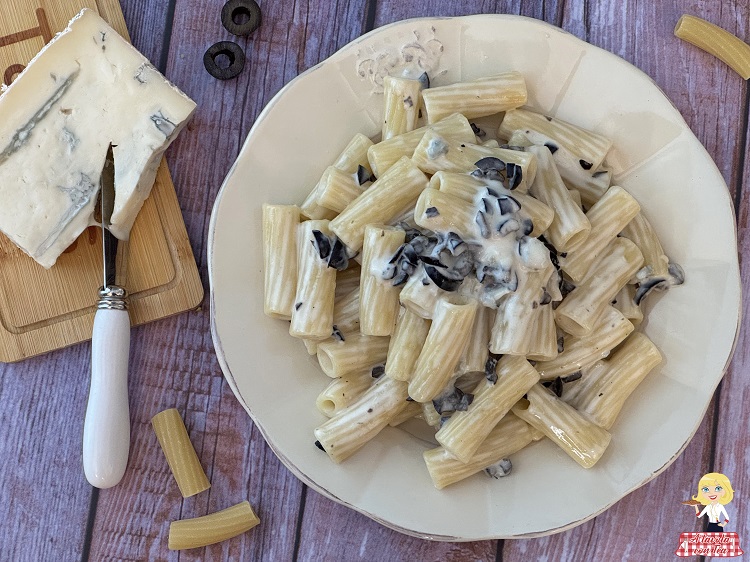
- Difficulty: Very easy
- Cost: Economical
- Preparation time: 5 Minutes
- Cooking time: 15 Minutes
- Portions: 4
- Cooking methods: Stovetop
- Cuisine: Italian
- Energy 508.13 (Kcal)
- Carbohydrates 30.98 (g) of which sugars 2.31 (g)
- Proteins 15.93 (g)
- Fat 35.57 (g) of which saturated 9.32 (g)of which unsaturated 6.90 (g)
- Fibers 2.00 (g)
- Sodium 655.85 (mg)
Indicative values for a portion of 125 g processed in an automated way starting from the nutritional information available on the CREA* and FoodData Central** databases. It is not food and / or nutritional advice.
* CREATES Food and Nutrition Research Center: https://www.crea.gov.it/alimenti-e-nutrizione https://www.alimentinutrizione.it ** U.S. Department of Agriculture, Agricultural Research Service. FoodData Central, 2019. https://fdc.nal.usda.gov
Ingredients PASTA WITH ASH
- 13 oz pasta
- 7 oz gorgonzola (sweet)
- 3 oz black olives
- 7 fl oz heavy cream
- 1 pinch black pepper (freshly ground optional)
Tools
- Kitchen scale
- Pasta pot
- Cutting board
- Knife
- Frying pan
- Spatula
Preparation: Pasta with Ash Step by Step
Bring water to a boil in a large pot. As soon as it reaches a boil, salt and add the pasta.
While the pasta cooks, finely chop the black olives. You can use a knife for a coarser chop that gives texture, or a food processor to achieve a finer powder that mimics the ash effect.
In a pan large enough to hold the pasta, warm the heavy cream over low heat. As soon as it starts to simmer, add the gorgonzola cut into pieces. Stir with a spatula until the cheese has completely melted, creating a smooth, homogeneous cream.
Drain the pasta very al dente and transfer it directly to the pan with the gorgonzola cream. Add the chopped black olives and stir vigorously to combine all the ingredients. If necessary, add a splash of the pasta cooking water to make everything even creamier. Serve immediately with a generous grinding of black pepper.
Notes on ingredients and possible substitutions
GORGONZOLA Sweet gorgonzola is essential for creaminess and a delicate flavor. If you prefer a stronger taste, you can opt for spicy gorgonzola, but in that case use a slightly smaller quantity so as not to overpower the other flavors.
OLIVES Pitted black olives are perfect. If you don’t have them, you can also use Taggiasca olives, which are smaller and more flavorful. Alternatively, for an extra touch, chopped oil-packed Taggiasca olives also add some good “fat”.
HEAVY CREAM If you want a lighter version, you can replace heavy cream with plant-based cream, or for a touch of extra tang, with a couple of tablespoons of Greek yogurt.
Storage
Pasta with Ash is a dish to enjoy just after preparation, because the creaminess of the gorgonzola and the texture of the pasta are at their best. If you have leftovers, you can store them in an airtight container in the refrigerator for up to 1 day. To reheat, add a splash of milk or water to restore creaminess and warm in a pan over low heat. Freezing is not recommended.
Alternatives and variations
Pasta with Ash and walnuts: add a handful of coarsely chopped walnut halves together with the olives. The walnuts will give a crunchy note and a flavor that pairs wonderfully with gorgonzola.
With speck or pancetta: for a smoky, flavorful touch, sauté 50 g (about 2 oz) of diced speck or pancetta in a small pan and add it to the pasta together with the olives.
Vegetarian version: for a cheese-free variant, you can use a plant-based gorgonzola alternative (often cashew-based) and plant-based cream. The flavor will be different, but the creamy effect remains.
With mushrooms: add 100 g (about 3.5 oz) of sliced champignon mushrooms sautéed in a pan with garlic and parsley before adding the cream.
Pairings and serving suggestions
This pasta is a first course on its own, but you can serve it as a main dish, perhaps accompanied by a light side such as a crisp green salad. For a wine pairing, choose an aromatic, not too structured white, such as a Sauvignon Blanc or a Falanghina, whose freshness will cleanse the palate from the cheese’s richness. A not-too-dry sparkling wine like a Prosecco or a Franciacorta will also work very well.
History and origins of the recipe
Despite its evocative name, Pasta with Ash does not have well-defined historical origins and is not part of the gastronomic tradition of a specific Italian region. It is a modern recipe, likely born in the 1980s or ’90s, when the cream-and-gorgonzola pairing was very popular. Its popularity is due to its simplicity, speed of execution and the balance of flavors that makes it irresistible. It is a dish that perfectly represents home-style creative cooking, made of intuition and ingredients you have on hand.
FAQ (Questions and Answers)
1. Can I use another type of cheese instead of gorgonzola?
Yes, but the flavor will change. If you want a similar effect, you can use fontina or another mild, meltable cheese, but the most iconic pairing remains gorgonzola for its distinctive taste and unique creaminess.
2. I don’t like black olives, can I skip them?
Of course, in that case you’ll have a classic cream-and-gorgonzola pasta. However, it is the olives that give the dish its name and distinctive character, adding a salty note that balances the cheese’s sweetness.
3. How can I make the sauce more fluid without adding water?
If the gorgonzola and cream sauce is too thick, you can add a couple of tablespoons of the pasta cooking water, rich in starch. This will help create a looser consistency suitable for tossing the pasta.
