
Spaghetti all’Assassina: the original Bari recipe that will “kill” you with pleasure!
There are dishes that tell a story, and spaghetti all’Assassina are a perfect example.
If you’ve never tasted them, prepare to discover a recipe that defies every traditional rule.
I was fortunate to see them prepared live by Chef La Forgia from Bari, who taught me all the tricks.
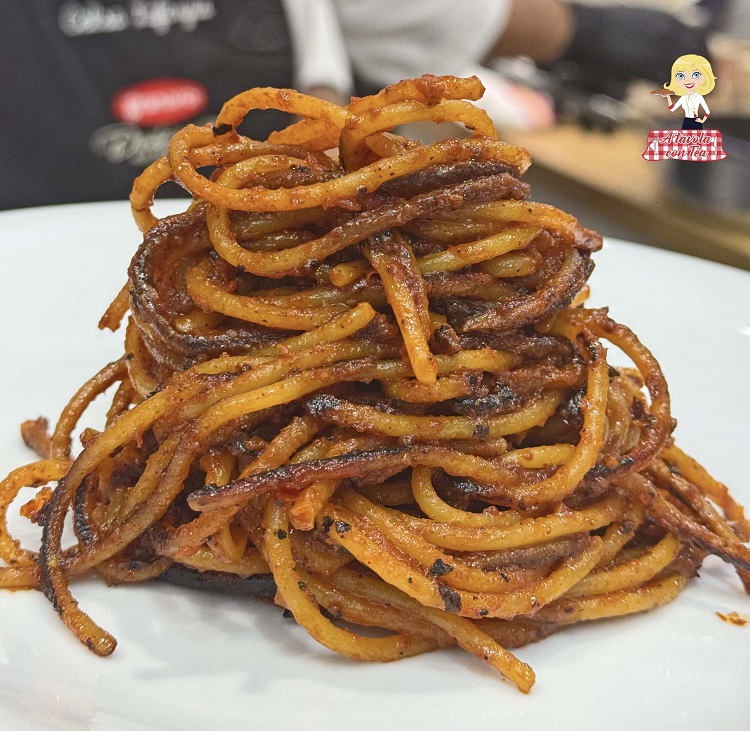
Born in Bari in the 1960s, these spaghetti are not boiled but cooked directly in a pan, almost “fried” in a light sauce. The magic is the crunchy crust that must form.
The main problem with this unique cooking method is that the pasta tends to stick too much and burn, or the crust doesn’t form at all.
I’ll reveal the secrets for perfect spaghetti all’Assassina:
The Right Pan: The pan must be cast iron or a very wide nonstick pan. This is essential to distribute heat and allow the crust to form.
The Initial Toasting: You need to toast the dry spaghetti briefly in the hot oil for 30-40 seconds without moving them.
This is when the starch sticks and begins to create the base of the crust.
The Hot Broth: The tomato broth you add must be hot and should be poured slowly, one ladle at a time, like when making risotto, only adding the next ladle when the previous one has been absorbed.
Cooking requires attention and a good dose of boldness, but I assure you the final result rewards every effort. It’s a flavorful dish that embodies the straightforward, passionate soul of Apulian cuisine.
- Difficulty: Very easy
- Cost: Very inexpensive
- Preparation time: 10 Minutes
- Cooking time: 12 Minutes
- Portions: 4
- Cooking methods: Stovetop
- Cuisine: Italian
- Energy 155.22 (Kcal)
- Carbohydrates 30.66 (g) of which sugars 0.50 (g)
- Proteins 5.75 (g)
- Fat 1.29 (g) of which saturated 0.22 (g)of which unsaturated 0.53 (g)
- Fibers 2.54 (g)
- Sodium 294.29 (mg)
Indicative values for a portion of 100 g processed in an automated way starting from the nutritional information available on the CREA* and FoodData Central** databases. It is not food and / or nutritional advice.
* CREATES Food and Nutrition Research Center: https://www.crea.gov.it/alimenti-e-nutrizione https://www.alimentinutrizione.it ** U.S. Department of Agriculture, Agricultural Research Service. FoodData Central, 2019. https://fdc.nal.usda.gov
Ingredients SPAGHETTI ALL’ASSASSINA
- 11 oz spaghetti
- 1 clove garlic
- 2 dried chili peppers
- 1 1/4 cup tomato passata
- 1 tbsp tomato paste
- to taste extra virgin olive oil
- to taste fine salt
- water (about 3 1/3 – 4 1/4 cups)
Tools
- Kitchen scale
- Frying pan
- Pot
How to prepare SPAGHETTI ALL’ASSASSINA
In a pot, bring the water to a boil and add the passata, the tomato paste and a pinch of salt. Let it simmer for a few minutes to create the broth that will be used to cook the pasta. Keep the broth hot over low heat.
In a cast iron pan (fundamental for the success of the dish) or a very wide nonstick pan, pour a generous amount of olive oil. Sauté the garlic clove and the crumbled dried chili peppers over medium-low heat.
When the garlic is golden, remove it. Add the dry spaghetti to the pan and let them toast for about 30-40 seconds without moving them. This is the secret for the crust!
Pour one ladle of the hot tomato broth directly over the spaghetti (not against the sides of the pan so you don’t ruin the crust forming) and let it evaporate. Continue adding broth, one ladle at a time, as it is absorbed by the pasta, stirring only occasionally. The process is similar to that of a risotto.
Continue like this for about 20-25 minutes, or until the pasta is al dente and the typical crust has formed on the bottom of the pan. The last broth should be almost completely absorbed. Serve immediately.
INGREDIENT NOTES AND SUBSTITUTIONS
Pan: Using a cast iron pan is a key element of the original recipe. If you don’t have one, a good heavy-bottomed nonstick pan can work, but the result will not be exactly the same.
Spaghetti: For this recipe, bronze-drawn spaghetti are ideal, as they release less starch and are better suited to the “risottatura” in the pan. If you use vermicelli, the result will still be excellent.
Tomato: Using both passata and tomato paste is essential for the intense flavor and bright color of the dish. Do not use only fresh cherry tomatoes or peeled tomatoes; the combination is what gives the authentic result.
Storage
This is a recipe to be enjoyed immediately. The “risottatura” technique tends to cook the pasta a lot, and it won’t stand up well to reheating. If you have leftovers, you can transform them into a pasta frittata, but the advice is to prepare and eat it on the spot.
Alternatives and Variations
Onion variation: In some versions, half a finely chopped onion is sautéed instead of garlic.
Assassina with stracciatella: A modern, indulgent variation adds a spoonful of fresh stracciatella at the end of cooking, creating a pleasant contrast with the spiciness.
Tuna Assassina: There are versions with tuna and swordfish, but they are far from the original.
Pairings and Uses
Spaghetti all’Assassina are a complete, all-in-one dish. They pair perfectly with an Apulian red wine, such as Primitivo or Negroamaro, whose structure and tannins complement the dish’s spiciness.
Origins and History of the Recipe
Spaghetti all’Assassina is a relatively young dish, born in Bari toward the end of the 1960s. Its “inventor” is widely recognized as chef Enzo Francavilla of the restaurant “Al Sorso Preferito.” Legend has it that a group of patrons, after tasting the dish, exclaimed: “You are a killer!”, referring not only to the generous use of chili but also to its irresistible goodness. From then on the name stuck, and today the dish has become an icon of Bari’s gastronomy.
