
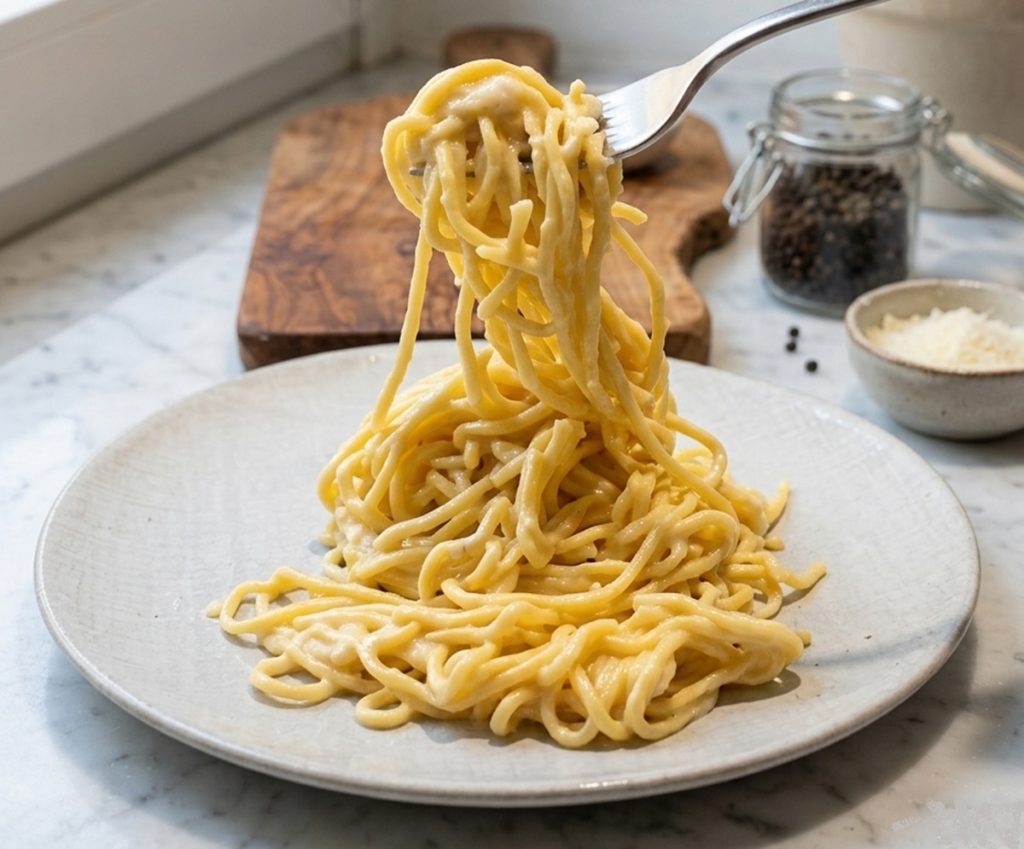
Pasta with Parmesan Cream: two easy and quick recipes for a creamy and flavorful first course, perfect for elegant dinners or family meals.
Hello everyone! Today I bring you a recipe that combines simplicity and elegance: Pasta with Parmesan Cream.
It’s not only a quick recipe (ready in just 10 minutes!), but it’s also extraordinarily versatile and sophisticated. Perfect for a family dinner or a meal with friends, this pasta tastes luxurious despite being made with very few ingredients.
The real challenge of this recipe is not speed, but obtaining a smooth, creamy and velvety sauce without the cheese breaking or becoming grainy.
That’s why I propose two versions: the Parmesan Cream without Heavy Cream, lighter and more traditional, which uses the starch in the pasta cooking water to create creaminess; and the version with Heavy Cream, inspired by chef Antonino Canavacciuolo, even richer and more indulgent.
In this guide I’ll reveal the secrets to avoid lumps, how to measure ingredients perfectly and which version to choose based on your mood and preferences.
You’ll also discover how to use this cream not only for pasta, but also for risottos, lasagnas and even as a topping for grilled meats.
Are you ready to make a pasta that will make you look like a chef? Let’s go!
- Difficulty: Very easy
- Cost: Medium
- Preparation time: 5 Minutes
- Cooking time: 10 Minutes
- Portions: 4
- Cooking methods: Stovetop
- Cuisine: Italian
- Energy 739.99 (Kcal)
- Carbohydrates 28.72 (g) of which sugars 3.22 (g)
- Proteins 43.23 (g)
- Fat 50.15 (g) of which saturated 23.31 (g)of which unsaturated 12.33 (g)
- Fibers 1.96 (g)
- Sodium 1,347.49 (mg)
Indicative values for a portion of 100 g processed in an automated way starting from the nutritional information available on the CREA* and FoodData Central** databases. It is not food and / or nutritional advice.
* CREATES Food and Nutrition Research Center: https://www.crea.gov.it/alimenti-e-nutrizione https://www.alimentinutrizione.it ** U.S. Department of Agriculture, Agricultural Research Service. FoodData Central, 2019. https://fdc.nal.usda.gov
Ingredients
- 320 g pasta
- sale grosso (for the pasta water)
- 300 g Parmigiano Reggiano DOP (aged 24/30 months)
- 3 ladles water (pasta cooking water)
- 1 pinch black pepper (freshly ground)
- as needed nutmeg (optional)
- 150 ml heavy cream
- 150 ml milk
- 1 pinch black pepper (freshly ground)
- 150 g Parmigiano Reggiano DOP (aged 24/30 months)
- 1 pinch nutmeg (optional)
Tools
- Pot
- Bowl
- Saucepan
- Whisk
Tip
First of all, I recommend using a tall non-stick saucepan and a hand whisk — essential tools to obtain a smooth and creamy Parmesan sauce.
In this case the Parmesan cream must be used to dress the pasta because the pasta water is essential to melt the cheese.
Put a pot of plenty of salted water to boil.
Separately, in a bowl pour the grated Parmigiano Reggiano, a grind of pepper and a pinch of nutmeg (optional).
When the water reaches a boil, add the pasta. With 2 minutes left in the pasta cooking time, take three ladles of water and pour them little by little into the bowl with the Parmesan, stirring regularly with the whisk to prevent lumps. Depending on the desired thickness of the Parmesan cream, adjust the amount of water (but do not exceed 3 ladles).
Drain the pasta al dente and immediately pour it into the bowl with the Parmesan cream. Stir quickly with a spoon, adjust salt (the cheese is already quite salty so taste first before adding salt). Serve the Pasta with Parmesan Cream immediately, sprinkling with freshly ground pepper to taste.
Put the milk and cream in a non-stick saucepan and heat over medium-low heat. Start adding the grated Parmesan, 1 tablespoon at a time, stirring with the hand whisk to avoid lumps. Continue stirring over low heat until all the Parmesan is incorporated. In the end you should obtain a consistency similar to custard. Finish with a pinch of pepper or nutmeg if desired. Drain the pasta al dente and pour it directly into the bowl with the Parmesan cream. Mix carefully and serve.
Follow my Instagram profile by clicking HERE
The Two Versions of Parmesan Cream: Which One to Choose?
There are several versions of Parmesan cream, but the two most appreciated are: the one without cream and the one with cream. Discover the differences and which suits you best.
Parmesan Cream Without Heavy Cream: Light and Traditional
This is the most classic and lighter version. It uses only Parmigiano Reggiano and the pasta cooking water, which contains natural starch. The starch acts as an emulsifier, creating a natural creaminess without the need for cream or flour. It’s perfect if you prefer a lighter but still flavorful and creamy dish.
Parmesan Cream With Heavy Cream: Rich and Indulgent
This version, inspired by chef Antonino Canavacciuolo’s recipe, is richer and creamier. It combines heavy cream, milk and Parmigiano Reggiano to create a velvety, luxurious sauce. It’s ideal for special occasions or when you want a more generous plate.
Secrets for a Perfect Parmesan Cream
The Fundamental Role of the Hand Whisk
One of the most important tools for this recipe is the hand whisk. By constantly stirring with the whisk you avoid the cheese breaking and annoying lumps forming. The circular motion of the whisk creates a smooth, homogeneous emulsion.
Measure the Cooking Water: the Trick for the Right Consistency
For the version without cream, the pasta cooking water is essential. Do not add all the water at once, but pour it little by little, stirring constantly. Adjust the amount of water depending on the desired density. Remember: it’s better to add water gradually than to add too much!
The Right Temperature: Avoiding the Cheese Breaking
The number one enemy of this recipe is too high a temperature. If the heat is too strong, the cheese can “seize” and become stringy or grainy. Always keep the heat medium-low and stir regularly. If you notice the cream becoming too thick, add a little warm water or milk.
Choosing the Right Parmigiano
Not all Parmigiano cheeses are the same! For this recipe I strongly recommend Parmigiano Reggiano DOP aged 24-30 months or more. A younger cheese will make the cream less flavorful, while a more aged one will give a more intense and complex taste. If you love stronger flavors, you can add a tablespoon of aged Pecorino Romano for an extra touch.
STORAGE
Put the Parmesan Cream in a container and lay plastic wrap directly on the surface of the cream; this will prevent a skin from forming as it cools. Cover the container with an airtight lid and store in the refrigerator for up to 2 days.
When ready to use again, simply take it out of the fridge and warm it slightly in a saucepan, preferably in a bain-marie.
FAQ (Questions and Answers)
Why did my Parmesan cream become stringy and grainy?
The most common cause is too high a temperature or insufficient stirring. Remember to keep the heat medium-low and to stir constantly with a hand whisk. If it happens, you can try to “save” the cream by adding a little warm water and mixing vigorously.
Can I prepare the Parmesan cream in advance?
Yes, you can prepare it up to 2 days in advance. Store it in an airtight container in the refrigerator, with plastic wrap touching the surface of the cream to prevent a skin from forming. When ready to use, warm it slightly in a saucepan over a bain-marie.
What other dishes can I make with this cream?
Besides pasta, this cream is perfect for risottos, oven-baked lasagnas, quiches, timbales, appetizers, finger food and as a topping for grilled meats. It’s a great base for many dishes!
Can I use Grana Padano instead of Parmigiano Reggiano?
Technically yes, but Parmigiano Reggiano is recommended for this recipe. It has a more complex flavor and a protein structure that emulsifies better with the pasta cooking water. Grana Padano is still a good alternative.
How many servings does this recipe yield?
The base recipe yields 4 servings. If you need more servings, you can easily double the ingredients while keeping the same proportions.
