
NEAPOLITAN STRUFFOLI Recipe Perfect: Crispy, Not Greasy and Soft Inside
Campania is not the only keeper of this recipe; in fact this delicious sweet is also prepared in Sardinia under the name “Giggeri”, in Molise, Marche or Abruzzo as “Cicerchia”, and in Taranto where it is known as “Sannachiudere”.
But what is the biggest problem when making Struffoli?
The fear of greasiness! How many times have you tried to make these lovely little balls only to end up with a heavy dessert tasting too much of oil and going soft within a few hours?
It’s a shame to ruin the magic of Struffoli at the last moment! This happens because two crucial steps are often underestimated: the dough and the frying temperature.
My secret, inherited from the legendary Signora Rosa (a true expert in Campanian sweets!), lies in balancing the ingredients so the dough is not only aromatic (thanks to the anise liqueur and orange zest) but also resistant to oil absorption.
But the real breakthrough is in cooking: the oil must be abundant and at the right temperature.
Not too hot to burn the exterior, but hot enough to immediately seal the dough so it doesn’t soak up oil.
This recipe will guide you step by step to obtain Struffoli crispy outside, soft inside and, importantly, dry, keeping their crunch even after days.
Once coated in warm honey and decorated with colorful nonpareils (mompariglia), they will be the sweetest centerpiece of your holidays. Get ready to say goodbye to the “greasy sponge” effect and honor the tradition with a masterpiece of lightness!
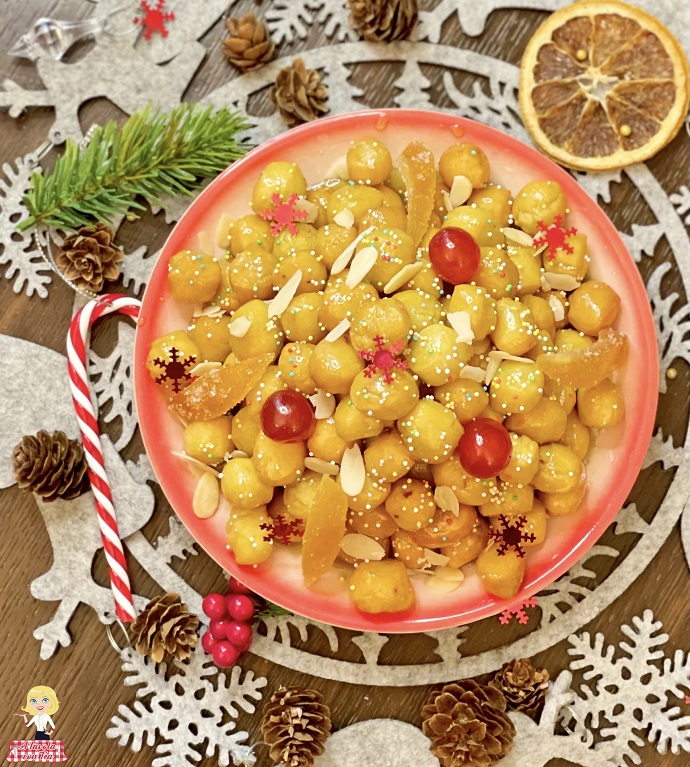
- Difficulty: Very easy
- Cost: Inexpensive
- Preparation time: 20 Minutes
- Cooking time: 10 Minutes
- Portions: 4 servings
- Cooking methods: Stovetop
- Cuisine: Italian
- Energy 421.35 (Kcal)
- Carbohydrates 48.06 (g) of which sugars 28.67 (g)
- Proteins 4.61 (g)
- Fat 24.58 (g) of which saturated 6.02 (g)of which unsaturated 17.40 (g)
- Fibers 0.78 (g)
- Sodium 107.63 (mg)
Indicative values for a portion of 40 g processed in an automated way starting from the nutritional information available on the CREA* and FoodData Central** databases. It is not food and / or nutritional advice.
* CREATES Food and Nutrition Research Center: https://www.crea.gov.it/alimenti-e-nutrizione https://www.alimentinutrizione.it ** U.S. Department of Agriculture, Agricultural Research Service. FoodData Central, 2019. https://fdc.nal.usda.gov
Ingredients for Neapolitan Struffoli
- 3 1/4 cups 00 flour (all-purpose flour)
- 4 tbsp butter (about 4 tbsp (1/4 cup))
- 4 eggs (3 whole + 1 yolk)
- 3 tbsp granulated sugar (about 3 tbsp + 1 tsp)
- 1 tbsp anise liqueur (or limoncello)
- 1 orange zest
- peanut oil (for frying)
- 1 pinch salt
- 1 cup honey (about 1 cup (≈10.6 oz / 300 g))
- 1 cup candied fruit (about 1 cup (≈5.3 oz / 150 g))
- to taste colored nonpareils (mompariglia)
Tools
- Deep frying pan or high-sided pot
Procedure NEAPOLITAN STRUFFOLI: Aromatic Dough and Dry Frying
Mix: In a large bowl (or in a stand mixer), put the flour, sugar, eggs, lukewarm melted butter, grated orange zest and the liqueur.
Work: Knead vigorously by hand for a few minutes until you get a smooth, homogeneous dough. It should be firm and not sticky.
Rest: Let the dough rest, covered with a cloth, for about 30 minutes at room temperature.Shape the Little Rolls: After resting, take the dough and divide it into 6 parts. From each part, roll out long, thin ropes (about the length of a finger).
Cut: With a knife, cut the ropes into many small pieces of dough about 3/8 inch long.
Fry Few at a Time: Heat abundant peanut oil in a narrow but high-sided pot. The secret is to fry only a few struffoli at a time so as not to lower the oil temperature.
Ideal Temperature: When the oil is hot, fry the struffoli for a few minutes. They should become slightly golden.
Drain Well: As they are ready, drain them with a skimmer and let them dry immediately on plenty of absorbent paper.Melt the Honey: In a small saucepan, put the honey and warm it slightly over the lowest heat (do not let it boil).
Combine and Mix: Remove from the heat and combine the cooled struffoli, the candied citron cut into cubes and the nonpareils.
Decorate: Gently mix so as not to break them and arrange them on a serving plate, giving them the classic doughnut shape or a mound.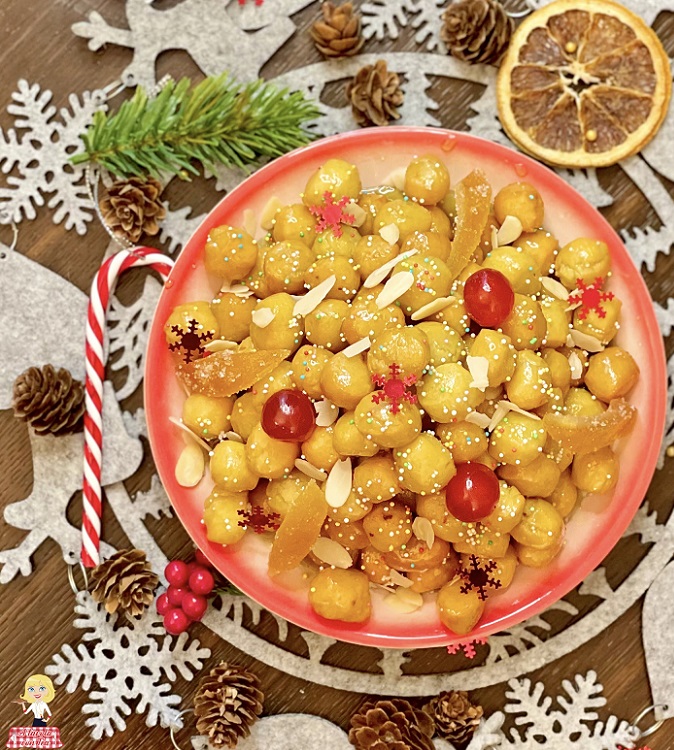
Follow my Instagram profile by clicking HERE
STORAGE
Once ready, Struffoli keep for up to 10 days at room temperature if stored in an airtight container. They are not suitable for freezing.
Tip for Freshness: Store them in a cool, dry place. Honey tends to soften the surface slightly, but the inside will remain crunchy if they were fried well.
TIPS
If you don’t like candied fruit, you can omit it.
If you don’t have or don’t like anise, you can comfortably use limoncello or any other liqueur you prefer as a substitute!
When frying remember, as my grandmother used to say, the more oil you use the less they will absorb.
Normally once ready they are arranged in a doughnut shape and can also be used as an edible centerpiece, perhaps with a decoration in the middle.
Notes on Ingredients and Substitutions
The Liqueur (Anise vs. Limoncello): Anise liqueur is traditional for the dough. If you don’t like it or can’t find it, limoncello (or a good rum) is an excellent substitute that gives a citrus aroma and still helps make the dough less tenacious.
Eggs (Temperature): Room temperature eggs mix better and create a more homogeneous dough.
Peanut Oil: Peanut (or other high-smoke-point) oil is ideal for frying. Anti-grease tip: do not reuse strained, spent oil and ensure it is at temperature before starting a new batch of struffoli.
Alternatives and Variations
Air Fryer Cooking: For a lighter version, you can cook the struffoli in an air fryer. Lightly spray them with oil and cook at 356°F for 8-10 minutes, shaking the basket halfway through, until golden.
Chocolate Glaze: For those who don’t like candied fruit, instead of part of the honey you can use a dark chocolate glaze for a modern twist.
Shape: Traditionally they are arranged in a doughnut shape; alternatively, you can make small individual piles for a buffet or a more modern table.
Pairings and Use
Struffoli are not only a dessert but also a decoration!
Centerpiece: The doughnut shape lends itself to being an edible centerpiece, perhaps with a candle in the middle.
Wine Pairing: The sweetness of the honey pairs perfectly with a southern Italian passito (such as a Passito di Pantelleria) or with a good dry Classic Method sparkling wine which will cleanse the palate.
Origins and History
Struffoli are an ancient sweet, dating back even to Magna Graecia, where they were known as Loukoumades. The modern recipe, which uses honey and the small-ball shape, is an undisputed symbol of Campanian Christmas. The name Struffoli (according to some) derives from the Greek strongoulos, meaning “round”. This dessert is so rooted in tradition that it appears in different regions under various names (like Cicerchi in Abruzzo or Pignoccata in Sicily), but the Campanian version, rich in honey and orange aromas, is by far the most famous.
FAQ (Questions and Answers)
Q: What is the ideal oil temperature to avoid greasiness?
A: The ideal temperature is about 338–347°F (170–175°C). If the oil is too cool, the struffoli will absorb it; if it’s too hot, they’ll burn on the outside and remain raw inside. If you don’t have a thermometer, dip a small piece of dough: if it immediately rises to the surface sizzling, it’s ready.
Q: Can I make the dough in advance?
A: Yes, you can prepare the dough and keep it wrapped in cling film in the refrigerator for up to 12 hours. Before working it, let it come back to room temperature for at least 30 minutes.
Q: Why do they deflate after frying?
A: Struffoli shouldn’t deflate drastically if the dough was well worked. If you notice significant deflation, it’s likely the oil wasn’t hot enough at the start and they absorbed too much oil, compromising the structure.
