
Soft, Cheesy Pizzoccheri: The Secret of the “Layered Cooking” and How to Prevent the Butter from Becoming Greasy.
The trick for stringy pizzoccheri that never get greasy
You know that heavenly sensation when you plunge a fork into a plate of Pizzoccheri Valtellinesi and get the perfect bite: the rough, granular texture of the buckwheat pasta wrapped in a molten cream of Casera and browned garlic butter?
The biggest challenge when making this iconic dish at home is achieving that exact textural balance.
To get a perfect result you must not underestimate elements such as the “layering technique” and the butter temperature, so you’ll avoid a separated, greasy, heavy plate where the cheese clumps instead of melting into a silky cream.
In this recipe, faithful to the specifications of the Accademia del Pizzocchero di Teglio, we will address how to balance the pasta cooking with the tender vegetables (evenly cooked savoy cabbage and potatoes) and, above all, how to manage the melting of Casera DOP cheese.
I’ll show you the “hot-pot trick” and the “noisette” butter technique to obtain a persistent hazelnut aroma and a cream that embraces every single ribbon. Note: when the recipe mentions water temperature of about 50°C, use roughly 122°F for hydration.
Get ready to bring the authentic flavors of Valtellina into your bright kitchen!
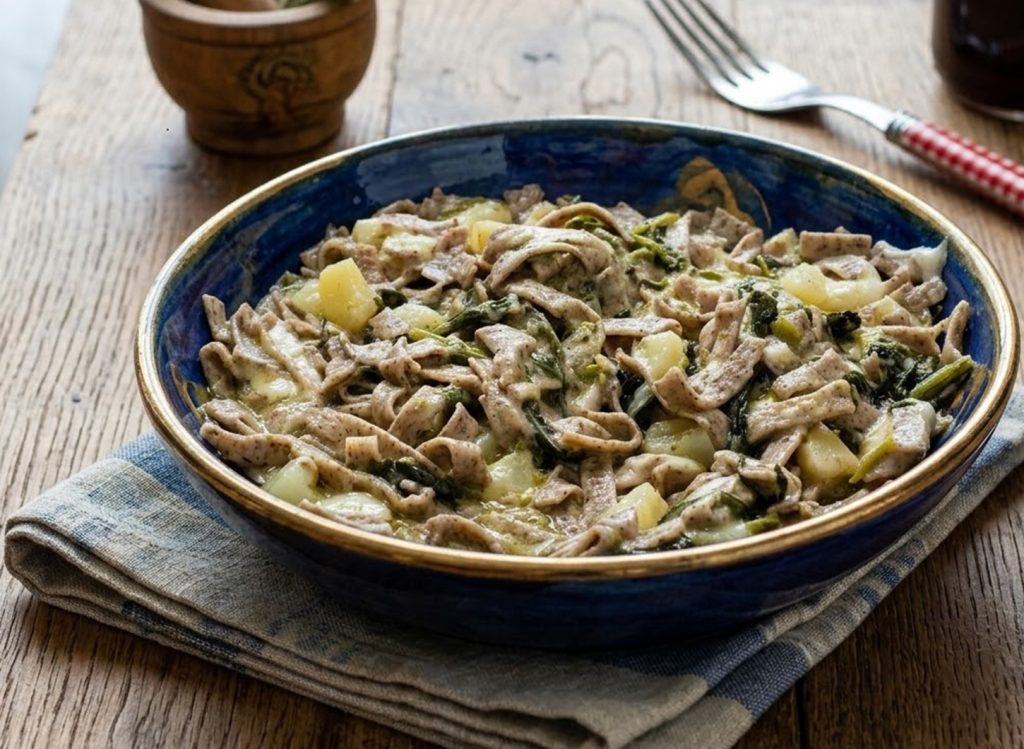
- Difficulty: Medium
- Cost: Inexpensive
- Preparation time: 50 Minutes
- Cooking time: 15 Minutes
- Portions: 4
- Cuisine: Italian
- Energy 1,372.12 (Kcal)
- Carbohydrates 107.99 (g) of which sugars 8.56 (g)
- Proteins 50.18 (g)
- Fat 85.50 (g) of which saturated 49.66 (g)of which unsaturated 35.45 (g)
- Fibers 12.31 (g)
- Sodium 1,991.77 (mg)
Indicative values for a portion of 220 g processed in an automated way starting from the nutritional information available on the CREA* and FoodData Central** databases. It is not food and / or nutritional advice.
* CREATES Food and Nutrition Research Center: https://www.crea.gov.it/alimenti-e-nutrizione https://www.alimentinutrizione.it ** U.S. Department of Agriculture, Agricultural Research Service. FoodData Central, 2019. https://fdc.nal.usda.gov
Ingredients
- 3 1/3 cups buckwheat flour (or 17.6 oz (about 3 1/2 cups) ready-made pizzoccheri)
- 3/4 cup + 1 tbsp cup type 0 flour (all-purpose)
- 1 cup + 3 tbsp cup water (hot (about 122°F) to better hydrate the buckwheat)
- 14 tbsp butter
- 9 oz cheese (Casera Valtellina DOP)
- 5.3 oz Grana Padano DOP
- 7 oz savoy cabbage leaves (about 3 cups shredded)
- 8.8 oz potato (about 1½ medium potato)
- garlic (1 clove)
- to taste salt
- 1 pinch black pepper (ground)
Tools
- Stand Mixer
- 1 Pot
- Frying Pan
- Slotted Spoon
- Dough cutter
The definitive guide to preparing real Pizzoccheri Valtellinesi
NOTES
If you don’t feel like making pizzoccheri from scratch or don’t have time, you can certainly buy them ready-made. In that case I recommend choosing the fresh ones found in the refrigerated section of supermarkets rather than the dry ones.
In a bowl (or in a stand mixer with the hook), mix the two flours (buckwheat and type 0). Add the hot water (about 122°F, to better hydrate the buckwheat) little by little, kneading for about 5 minutes until you get a compact but elastic dough. Work the dough vigorously on a floured board until it is smooth. Form a ball, flatten it and roll it with a rolling pin to a thickness of about 2–3 mm (about 1/16–1/8 inch). Cut strips 7 cm wide (about 2 3/4 inches), stack them and cut out ribbons about 5 mm wide (about 3/16 inch) to make the pizzoccheri.
Clean the savoy cabbage by removing the hard ribs and slicing the tender leaves thinly. Peel the potatoes and cut them into uniform cubes (about 1.5 cm, roughly 5/8 inch) so they cook evenly. Put a large pot of salted water on the heat and, when it boils, add the potatoes. Let them simmer for about 2 minutes. Add the cabbage leaves and continue cooking for another 4 minutes, until they start to become tender and airy. Meanwhile, cut the Casera DOP (compact and silky) into small cubes.
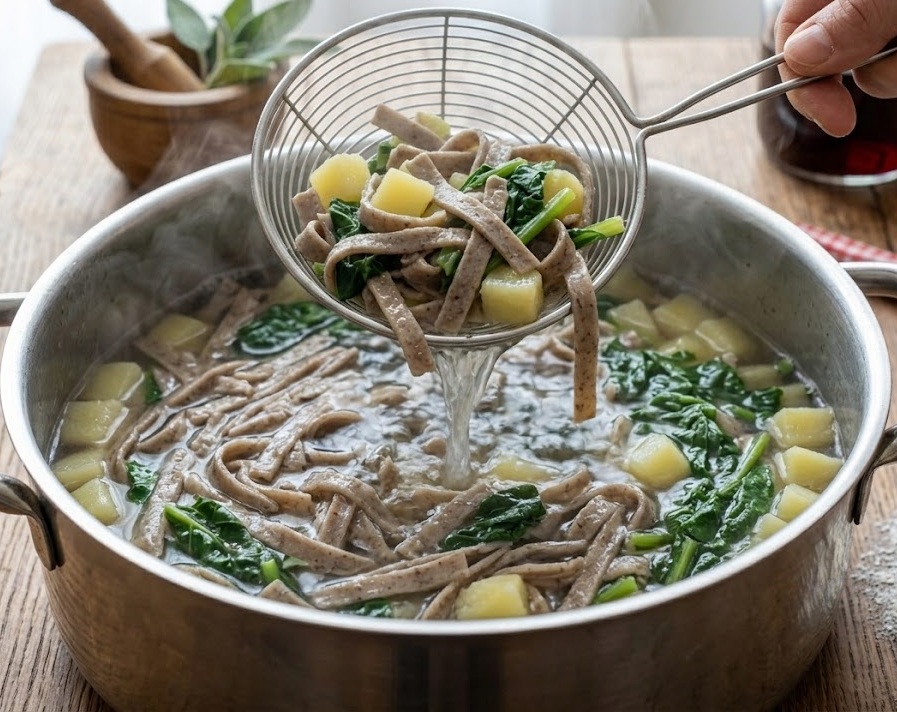
At this point, pour the rough-textured pizzoccheri directly into the pot with the cooking vegetables. Turn them gently with a slotted spoon so they don’t stick and cook them for about 4 minutes (they should remain plump and porous). At the same time, in a nonstick pan, melt the mountain butter (shiny and unctuous) over medium-low heat together with the garlic clove in its skin, until it turns a light hazelnut color and becomes fragrant (noisette). Turn off the heat and remove the garlic.
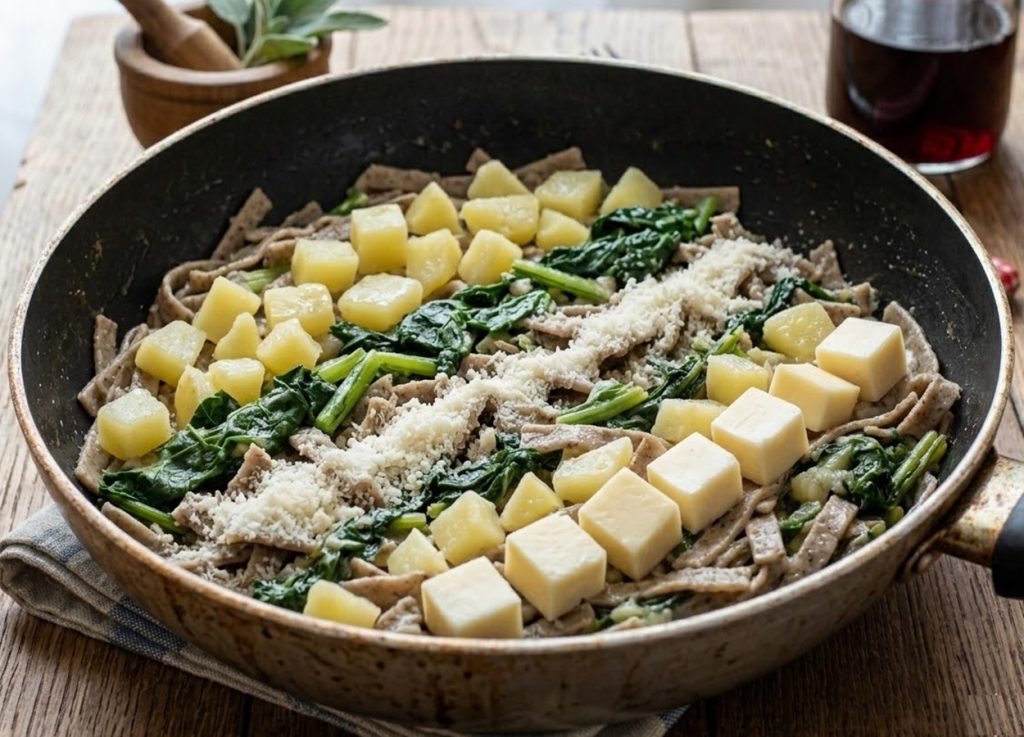
In a pre-warmed serving pan, begin creating layers: on the bottom put a portion of pizzoccheri with the just-drained (still moist and hot) cabbage and potatoes. Scatter a generous layer of small Casera cubes (silky) and sprinkle with Grana Padano (powdery). Repeat the operation until all ingredients are used. Rest the serving pan over the pot with the still-hot cooking water and cover with a clean cloth for 1–2 minutes. This gentle, indirect melting allows the Casera to turn into a creamy emulsion without separating.
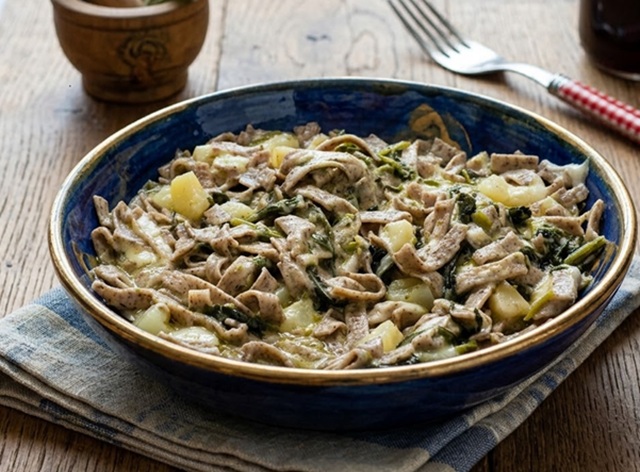
Stir gently, plate, and serve strictly hot.
Follow my INSTAGRAM profile by clicking HERE
Notes on Ingredients and Substitutions
Buckwheat Flour: It is the rough, granular heart of the dish. If you can’t find it, you can buy ready-made pizzoccheri (prefer the fresh refrigerated kind).
The Cheese: The specification requires Casera Valtellina DOP. If unavailable, a tested substitute is a well-aged alpine dairy cheese that still melts. Avoid Bitto (too aged and not meltable enough for this technique) or watery fresh cheeses (like mozzarella).
The Butter: Use high-quality mountain butter (shiny and unctuous): the “noisette” technique enhances its aroma without weighing the dish down. Seed oils are not a recommended substitute.
STORAGE
Pizzoccheri are a dish for “immediate consumption”, hot and stringy. We do not recommend storing them in the fridge (they become greasy and heavy) or freezing them. If you really have leftovers, reheat quickly in the microwave with a tablespoon of milk to reactivate internal moisture.
TIPS
Oven Variation: For a richer dish, place the layered serving pan in a preheated static oven at 392°F for 5–7 minutes (grill function) to achieve a crystalline surface gratin.
The hot-pot trick: Setting the serving pan on the steaming (but switched-off) pot is the critical step codified by the Academy for a silky, even melt of the Casera. Don’t skip it.
A bit of History and Curiosities
Did you know that Pizzoccheri were born in Teglio, a small town in Valtellina, and that their name may derive from the dialect “piz” (little piece) or “pinzochera” (simple/plain)? Despite their material simplicity (fibrous, golden, granular), the original recipe is codified by the “Accademia del Pizzocchero”, which protects its authenticity and balance. Balancing the plumpness of the buckwheat with the silky creaminess of Casera DOP is a material art that has been codified.
FAQ (Questions and Answers)
Why did my pizzoccheri clump together?
This happens if the cooking water was too weak (not salty enough) or if the cheese was exposed to excessively direct heat. Use the indirect heat technique (the hot-pot trick) and avoid over-stirring during simultaneous cooking.
Can I prepare the dough the night before?
Yes, but do not roll it out. Keep the compact dough ball wrapped in plastic in the fridge. Bring it to room temperature one hour before rolling.
Why did my brown butter turn bitter?
You probably burned the garlic or overheated the shiny butter. The butter should turn a light hazelnut color and be fragrant, not dark. Use a nonstick pan and medium-low heat.
