
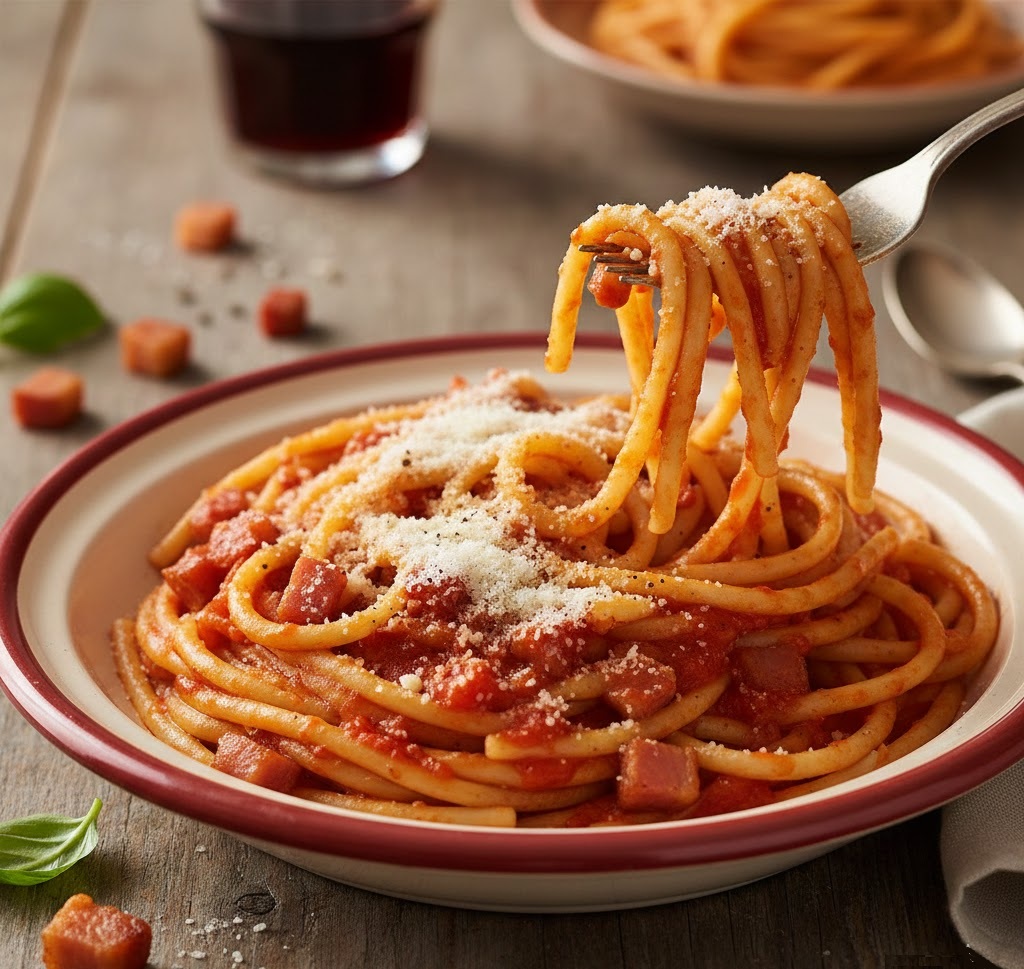
Traditional Roman Amatriciana recipe, how to cook the guanciale for amatriciana, the secret for a non-acidic amatriciana sauce, bucatini all’amatriciana tip with Pecorino.
The most common problem when preparing Amatriciana is ending up with rubbery guanciale and an overly greasy sauce.
Often the mistake is cooking the guanciale together with the tomato: the result is that the meat loses its crispiness and the fat doesn’t emulsify well, remaining separated on the surface.
The solution? The technique of separation and “deglazing”, which allows you to have a flavorful sauce and guanciale that “crisp” under the teeth.
- Difficulty: Very easy
- Cost: Inexpensive
- Preparation time: 15 Minutes
- Cooking time: 25 Minutes
- Portions: 4 SERVINGS
- Cooking methods: Stovetop
- Cuisine: Italian
- Energy 417.14 (Kcal)
- Carbohydrates 37.65 (g) of which sugars 3.91 (g)
- Proteins 24.45 (g)
- Fat 18.54 (g) of which saturated 7.16 (g)of which unsaturated 2.96 (g)
- Fibers 4.49 (g)
- Sodium 2,596.51 (mg)
Indicative values for a portion of 200 g processed in an automated way starting from the nutritional information available on the CREA* and FoodData Central** databases. It is not food and / or nutritional advice.
* CREATES Food and Nutrition Research Center: https://www.crea.gov.it/alimenti-e-nutrizione https://www.alimentinutrizione.it ** U.S. Department of Agriculture, Agricultural Research Service. FoodData Central, 2019. https://fdc.nal.usda.gov
Perfect Amatriciana Ingredients
- 11 oz pasta (bucatini, spaghetti, or other shapes)
- peeled tomatoes (14 oz (one 14-oz can), crushed)
- pork jowl (guanciale) (5 oz)
- Pecorino Romano (about 1 cup (3.5 oz), grated)
- salt (to taste)
- black peppercorns (freshly ground, to taste)
traditional Roman Amatriciana recipe
Start by removing the rind from the guanciale. Cut it into slices about 3/8 inch thick and then cut those into strips about 1/4 inch wide. Heat a nonstick pan without adding any extra fat. When it’s hot, add the guanciale. Let it brown over medium heat until the fatty parts become translucent and the lean parts are crisp. Chef’s touch: deglaze with white wine, raise the heat to evaporate the alcohol, then drain the strips and keep them warm. Leave the rendered fat in the pan.
In the same pan with the cooking fond (the guanciale fat), add the crushed peeled tomatoes. This step allows the tomato to absorb all the guanciale’s flavor. Cook over medium heat for about 10 minutes until the sauce reduces. Only at this point taste and adjust salt if necessary, then add back the crispy guanciale so it can flavor with the tomato for the last 2 minutes.
Drain the pasta very al dente and toss it directly in the sauce. If the sauce dries out too much, add a ladleful of the pasta cooking water: the starch will help bind the guanciale fat and the tomato. Turn off the heat, sprinkle with Pecorino Romano and a generous grind of black pepper. Mix vigorously to create the final emulsion.
-
Storage
Amatriciana keeps in the refrigerator for up to 24 hours. To reheat, add a splash of water in a pan. Avoid freezing because the texture of the guanciale and the pasta would suffer greatly.
Recipe Variations
Yellow Amatriciana: Use yellow peeled tomatoes for a sweeter, more modern version.
Spicy version: Add a fresh chili sautéed in the guanciale fat if you like strong flavors.
Seafood Amatriciana: Replace the guanciale with smoked swordfish (obviously this isn’t the original recipe, but a creative variation).
Tips
The temperature of the Pecorino: As with Cacio e Pepe, add the cheese always with the heat off to avoid it becoming stringy or clumping.
Don’t throw away the rind: Clean it well of excess pepper and boil it together with the pasta water: it will give an incredible aroma.
Follow A Tavola con Tea on Instagram https://www.instagram.com/atavolacontea_
You might also be interested in these quick and tasty first-course recipes
1 – PASTA WITH TURNIP GREENS: quick first course
2 – OVEN-BAKED PASTA: simple and delicious recipe
3 – SAUCE with FRESH CHERRY TOMATOES, BASIL and bruschetta
4 – PENNE al BAFFO: recipe in 15 MINUTES
Why is my sauce too greasy?
You’ve probably not removed the excess fat or you haven’t tossed the pasta enough with the cooking water to create the emulsion.
Can I use passata di pomodoro (tomato purée)?
You can, but crushed peeled tomatoes provide that grainy texture typical of a true Roman trattoria.
Should the guanciale be added immediately to the sauce?
No, if you want it to remain crispy remove it after browning and add it back only at the end.
