
How to make the original French Tarte Tatin: the upside-down tart of caramelized apples
TARTE TATIN: The Original French Recipe, Easy and Crunchy
The Tarte Tatin is an icon of French pastry, a dessert I loved from my first trip to France and have been making successfully for over ten years.
It’s an “upside-down” apple tart, featuring a low, super-crisp shortcrust pastry base (pâte brisée) that holds tender wedges of Reinette apples wrapped in a dark, thick caramel.
Legend has it it was created in the late 19th century by the Tatin Sisters: they forgot to put the pastry under the apples while cooking and remedied it by placing the pastry on top! The result was a tremendous success at their restaurant.
Today I share with you the Original Tarte Tatin Recipe explained to me by a dear friend of my French mother: Monique.
The preparation is very simple: the pâte brisée takes 5 minutes and the apples only need to be peeled and cut into large pieces. The real challenge is the caramel: be careful not to burn it and, above all, not to scald yourself when pouring it into the pan or when flipping the tart!
I reveal all my (actually her) tricks so you can make a Tarte Tatin that is not only delicious but also visually perfect.
How to serve it? It’s excellent when cold, once the flavors have settled. I adore it with a quenelle of crème fraîche (as shown in the picture), but it’s divine plain or with a scoop of vanilla ice cream.
And if there’s any left? Just like a classic apple cake, it’s perfect for an afternoon snack or breakfast!
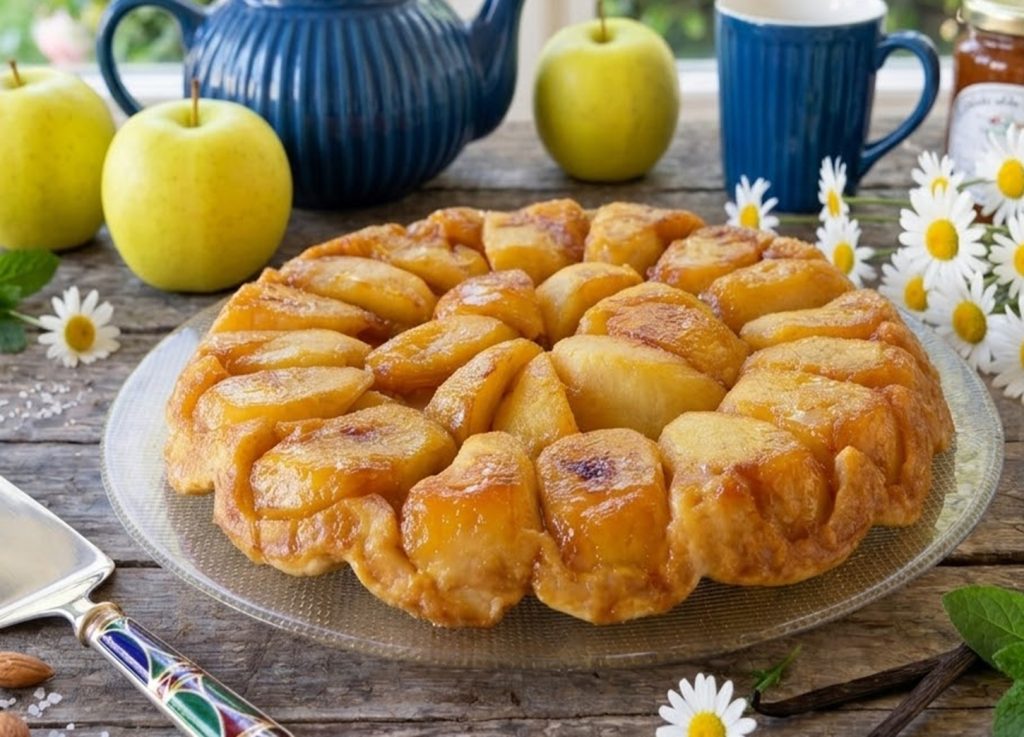
- Difficulty: Easy
- Cost: Budget-friendly
- Preparation time: 20 Minutes
- Cooking time: 30 Minutes
- Portions: nonstick pan 9.5 in (24 cm)
- Cooking methods: Oven
- Cuisine: Italian
- Energy 4.27 (Kcal)
- Carbohydrates 0.35 (g) of which sugars 0.22 (g)
- Proteins 0.02 (g)
- Fat 0.31 (g) of which saturated 0.20 (g)of which unsaturated 0.11 (g)
- Fibers 0.01 (g)
- Sodium 218.06 (mg)
Indicative values for a portion of 150 g processed in an automated way starting from the nutritional information available on the CREA* and FoodData Central** databases. It is not food and / or nutritional advice.
* CREATES Food and Nutrition Research Center: https://www.crea.gov.it/alimenti-e-nutrizione https://www.alimentinutrizione.it ** U.S. Department of Agriculture, Agricultural Research Service. FoodData Central, 2019. https://fdc.nal.usda.gov
Ingredients TARTE TATIN
- 1 2/3 cups all-purpose flour
- 7 tbsp butter (cold, cut into pieces)
- 1/3 cup water (chilled)
- 1 pinch salt
- 5 apples (Renette or Pink Lady, cut into large wedges)
- 3/4 cup sugar (+ 2 tbsp extra)
- 5 tbsp butter (about 3 1/2 tbsp for the caramel + 1 1/2 tbsp in small knobs)
Tools
- Kitchen scale
- Saucepan
- Hand whisk
- Rolling pin
- Baking pan
- Plate
How to make the original French Tarte Tatin: the upside-down tart of caramelized apples
In a bowl, or directly on the work surface, combine the flour, the cold butter cut into small pieces, a pinch of salt and the ice-cold water. Work everything quickly with your hands: in a few seconds the dough will come together. Shape into a ball (use a pinch of flour if needed), wrap it in cling film and refrigerate.
Peel the apples, remove the core and first cut them into quarters. Then cut each quarter in half to obtain large, meaty wedges. 💡 Tip: Do this while preparing the caramel to save time.
In a heavy-bottomed small saucepan, add the sugar with the 2 tbsp of water. Cook over very low heat without stirring at first. It will take about 7–10 minutes: the sugar will liquefy, then become grainy and finally turn into a nice brown caramel. Tilt the pan occasionally to check, but do not stir constantly. ⚠️ Important: keep the heat very low to avoid burning it.
When the sugar is caramel-colored, turn off the heat and move the pan away. Immediately add 3 1/2 tbsp of cold butter and whisk vigorously and quickly by hand. In a few seconds you’ll obtain a dense, shiny, fragrant caramel. Voilà!
Lightly butter the 9.5 in (24 cm) pan and warm it in the oven for a few minutes to slightly heat it (this trick helps the hot caramel glide without solidifying instantly).
Pour the hot caramel into the warmed pan and, taking great care not to burn yourself (use oven mitts), tilt the pan quickly to spread the caramel evenly over the bottom. 💡 Note: It’s normal that within a few seconds the caramel will firm up a bit and become like a soft candy. That’s how it should be!Start immediately arranging the apple wedges in the pan, placing the rounded side down, starting from the outer edge and working toward the center. Create a tight, gap-free spiral. Finally, sprinkle the apples with the remaining sugar (2 tbsp) and dot with the remaining butter (about 1 1/2 tbsp) in small pieces.
Prick the surface of the pâte brisée in a few places with a fork. Bake in a preheated static oven at 428°F (or 392°F fan) on the middle rack for about 30 minutes, or until the pâte brisée is well golden and crisp.
⚠️ Essential trick: you must flip the Tarte Tatin while the caramel is still fluid! If it cools down, the apples will stick to the bottom.
Take the tart out of the oven and wait only 4–5 minutes. Place parchment paper on the work surface to catch any juices. Position a serving plate (that fits perfectly!) over the pan. With a quick, confident motion (using thick oven mitts!), invert the tart.If caramel drips onto the plate or remains in the pan, immediately scrape it up with a metal spatula and spread it over the still-warm apples. Let the tart cool on the plate for at least half an hour before serving.
Storage
The Tarte Tatin keeps at room temperature, under a glass dome, for 1–2 days. Freezing is not recommended because the base would lose its crispness.
Recipe Variations
Non-alcoholic soak: Replace the Cointreau with fresh orange juice added cold.
Modern touch: Add a thin layer of bitter orange marmalade on the first sponge disc before the cream.
Savory Tatin: Try a version with caramelized shallots and thyme, perfect as an appetizer!
OTHER APPLE CAKE RECIPES
If you love apple desserts, also check out
1 – APPLE CAKE with cornmeal and custard sauce
2 – Sister Germana’s Apple Cake
Can I use puff pastry instead of pâte brisée?
Yes, it’s a common variation. Puff pastry will make the base more airy and light, while pâte brisée (as in the original) gives a more rustic and compact crispness.
Which apples are best for Tarte Tatin?
Reinette apples are ideal because they hold up well during cooking, becoming tender without falling apart. Alternatively, Pink Lady or Fuji work well. Avoid very mealy apples.
Why did my caramel become bitter?
It cooked too long or at too high a heat. The caramel should be brown, not black. Remember to cook over very low heat and remove from the heat as soon as it reaches the desired color before adding the butter.
Why did my Tarte Tatin release too much liquid after flipping?
This usually happens if the apples used are very juicy or if they were not cooked enough in the caramel before covering with the pastry. One trick is to let the tart rest for 4–5 minutes after baking before flipping: this allows the caramel to stabilize slightly and the apples to reabsorb some juices. If you still see too much liquid on the plate, carefully pour it into a small pan, reduce over the heat for a minute and brush it back over the apples.
Can I prepare the Tarte Tatin in advance and reheat it later?
The Tarte Tatin is best when slightly warm and the pâte brisée is still crisp. If you need to prepare it in advance, store at room temperature. Before serving, warm it in a hot oven at 302°F (150°C) for about 5–8 minutes: this will revive the caramel and remove moisture from the base, preventing it from becoming soggy.
What if I don’t have a nonstick pan? Can I use a springform pan?
Absolutely not! A springform pan is not leakproof: the liquid caramel and apple juices would escape during baking, dirtying the oven and draining the tart of its sauce. If you don’t have a specific Tatin pan, use a regular fixed-edge aluminum or ceramic tart pan, or a cast-iron skillet that can go in the oven. The important thing is to butter it very well to help the apples release.
