

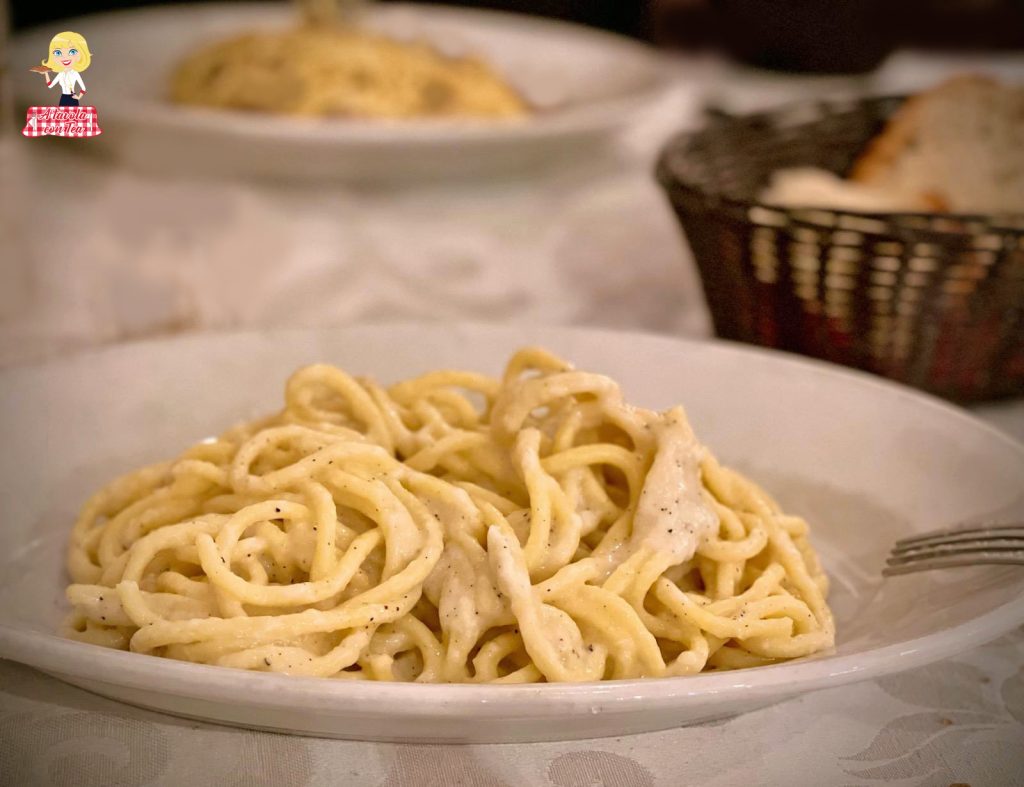
CREAMY CACIO E PEPE PASTA with all the TRICKS from a famous Roman restaurant
Cacio e pepe pasta is the symbol of Rome and Roman cuisine, alongside PASTA ALLA CARBONARA and AMATRICIANA. It’s a dish that masterfully combines pasta, Pecorino Romano and spices. Here’s how it originated and how to make it.
The ingredients of Cacio e Pepe are only three, as in the original recipe: pasta, Pecorino Romano and black pepper, which must be used strictly as whole peppercorns and freshly ground. Another fundamental ingredient is the pasta cooking water, rich in starch, which will be used to create the famous Pecorino cream.
Cacio e pepe may seem like an easy recipe, but it’s not quite so. The success of the dish depends on the quality of the Pecorino used, the balance of flavors between the cheese and the pepper, and the right creaminess of the sauce.
Rich and tasty, CACIO e PEPE is now appreciated and loved all over the world despite its simplicity. A first course of peasant origin that owes its name to the cheese once commonly called “cacio”.
Although this is an EASY recipe, to obtain a perfectly creamy and error-free cacio e pepe you will need to follow a few simple tips revealed to me by a famous Roman chef: from choosing the raw ingredients, to toasting the pepper, the pasta cooking and the finishing technique.
For example: choose a medium-aged Pecorino Romano because it melts more easily, while the black peppercorns should be ground at the moment and toasted in a pan to release all their aroma.
Now all you have to do is follow the Cacio e Pepe recipe! For other Lazio recipes and more, also see:
- Difficulty: Very easy
- Cost: Economical
- Preparation time: 5 Minutes
- Cooking time: 10 Minutes
- Portions: 4 servings
- Cooking methods: Stovetop
- Cuisine: Italian
- Energy 324.51 (Kcal)
- Carbohydrates 26.94 (g) of which sugars 0.47 (g)
- Proteins 15.71 (g)
- Fat 16.93 (g) of which saturated 9.12 (g)of which unsaturated 0.43 (g)
- Fibers 2.39 (g)
- Sodium 2,886.37 (mg)
Indicative values for a portion of 125 g processed in an automated way starting from the nutritional information available on the CREA* and FoodData Central** databases. It is not food and / or nutritional advice.
* CREATES Food and Nutrition Research Center: https://www.crea.gov.it/alimenti-e-nutrizione https://www.alimentinutrizione.it ** U.S. Department of Agriculture, Agricultural Research Service. FoodData Central, 2019. https://fdc.nal.usda.gov
INGREDIENTS FOR CACIO E PEPE
- 11 oz pasta (tonnarelli, spaghetti)
- 7 oz Pecorino Romano (finely grated (about 2 cups))
- 1 tablespoon black peppercorns (ground)
- 1 ladle pasta cooking water (of pasta cooking)
Tools
- Pot
- Pan
- Bowl
HOW TO PREPARE CACIO E PEPE
Bring plenty of salted water to a boil in a pot. When it boils, add the pasta (follow the cooking time indicated on the package). Meanwhile, in a non-stick pan put a teaspoon of freshly ground pepper (read the note at the end of the recipe) and toast it over low heat, stirring to release all the flavors. Add a ladle of pasta cooking water and continue to stir. The combination of the starch in the water and the pepper will react and form a white foam. Turn off the heat and prepare the Pecorino cream.
To prepare the Pecorino cream, pour the grated Pecorino Romano into a large bowl (preferably freshly grated) and add 2 small ladles of pasta cooking water little by little, mixing continuously preferably with a spatula. You should obtain a pasty consistency. Once ready, set it aside.
When there are 2 minutes left of the pasta’s cooking time, put the pan with the toasted pepper back on the stove and add the drained pasta (al dente) directly into it. Finish cooking it “risotto-style” with the liquids present in the pan, stirring from time to time. Don’t discard the pasta cooking water as you’ll need it to finish the dish.
Now that the pasta is cooked, remove it from the heat and add the Pecorino cream together with about 1 scant ladle of pasta cooking water. Add the water little by little because you may not need it all. Stir vigorously so the Pecorino melts and forms a beautiful creamy sauce. The cacio e pepe is ready; serve immediately!
-
TIPS FOR A CREAMY CACIO E PEPE
WHICH PEPPER TO USE FOR CACIO E PEPE: Do not use pre-ground black pepper powder if you want a perfect cacio e pepe. Use whole black peppercorns and grind them at the moment. If you have one, you can use a mortar and grind the pepper with the pestle in a rotating motion; alternatively a meat tenderizer or a pepper mill will do. Finally, remember that the resulting powder should be fairly coarse.
TOASTING THE PEPPER: After grinding the pepper and while the pasta is cooking, heat a non-stick pan and add a heaping tablespoon of pepper. Toast it for a few minutes over medium heat until it releases its aroma (you’ll clearly smell it). Then add 3 ladles of pasta cooking water to the pan with the pepper. The combination of the starch in the water and the pepper will react and form a white foam.
PECORINO CREAM: To prevent the cheese from becoming stringy or forming lumps, it is essential to add the Pecorino cream and perform the finishing step away from the heat, so that the Pecorino does not “break” when in contact with a high heat source.
PASTA WATER: The pasta cooking water, unsalted or very lightly salted, should be added little by little: the starch will dissolve the Pecorino preventing the proteins from coagulating, thus obtaining a smooth, velvety cream.
NOTES
PECORINO ROMANO: In this case no alternatives or variations are allowed; to prepare cacio e pepe you must use only Pecorino Romano. Why? Because this cheese once warmed can transform into a cream, especially if mixed with hot water. Aged cheeses need higher temperatures to break the bonds between proteins. That is why very aged Pecorino heated with a little water becomes soft and velvety.
TYPE OF PASTA FOR CACIO E PEPE: The pasta shape matters a lot in this recipe. Tonnarelli is the perfect shape for cacio e pepe and, in general, all long durum wheat pasta, but you can also use rigatoni, classic penne or mezze maniche.
When and how should you finish (mantecatura) the CACIO E PEPE?
In the classic recipe the grated Pecorino Romano is added at the end of cooking, almost with the heat off, because it must not reach too high a temperature and should melt with the residual heat of the pasta and the addition of a small amount of pasta cooking water.
Does cacio e pepe use oil, butter or cream?
None of those are used in cacio e pepe. Neither oil, butter nor cream are needed. The cheese and the starch released by the pasta during cooking give this dish the right creaminess, so there is no need to add other fats.
Cacio e pepe: which pasta shape to choose?
The pasta shape is very important in this recipe. Tonnarelli is the perfect shape for cacio e pepe and, generally, all long durum wheat pasta, but don’t dismiss rigatoni, classic penne or even mezze maniche.
How to plate cacio e pepe
In some Lazio restaurants, cacio e pepe is served inside a hollowed-out Parmesan wheel to pick up extra cheese flavor after serving. Obviously you can’t do the same easily at home, but you can prepare a crispy Parmesan basket to serve the pasta if you want a more theatrical presentation.
