
CARBONARA with Pasteurized EGGS
On April 6th we once again celebrated Carbonara Day, a day dedicated to one of the most loved and debated Italian dishes in the world. Between culinary challenges, debates between purists and innovators, and the eternal question “guanciale yes, pancetta no”, carbonara keeps generating conversation. Everyone agrees on celebrating it, but the preparation triggers real “wars” in the kitchen!
I also joined the celebrations, sharing my passion for this iconic dish during a long live webinar with Sonia Peronaci and Pasta De Cecco, cooking huge amounts of carbonara together with a hundred other food bloggers.
The recipe I present today is the one that, in the choice of ingredients, comes as close as possible to the authentic tradition: crispy guanciale, intense Pecorino Romano PDO, fresh eggs, freshly ground black pepper and, of course, high-quality spaghetti.
My only “poetic license” compared to the original recipe concerns the pasteurization of the eggs, a key precaution to enjoy this dish safely. If you don’t have pasteurized yolks available, I’ll guide you through a couple of foolproof methods to make them easily at home in no time.
But what is the magic that makes carbonara so special? The secret for a creamy, enveloping result, where all ingredients bind perfectly without creating a “scrambled egg” effect, lies primarily in preparing a perfect cream of yolks, Pecorino and pasta cooking water. There are also other little tricks that I’ll reveal step by step in the method.
Get ready to cook the best spaghetti alla carbonara you’ve ever tasted: a symphony of authentic flavors and a creaminess that will win you over at the first bite!
CARBONARA with Pasteurized EGGS
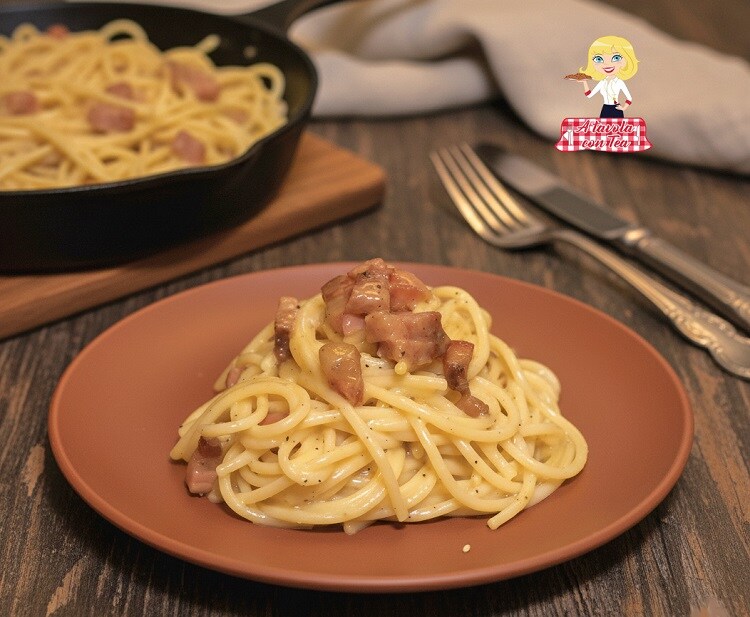
- Difficulty: Easy
- Preparation time: 15 Minutes
- Cooking time: 15 Minutes
- Portions: 4 servings
- Cooking methods: Stovetop
- Cuisine: Italian
- Energy 713.49 (Kcal)
- Carbohydrates 25.34 (g) of which sugars 0.46 (g)
- Proteins 21.19 (g)
- Fat 58.17 (g) of which saturated 23.55 (g)of which unsaturated 29.17 (g)
- Fibers 1.76 (g)
- Sodium 1,569.85 (mg)
Indicative values for a portion of 200 g processed in an automated way starting from the nutritional information available on the CREA* and FoodData Central** databases. It is not food and / or nutritional advice.
* CREATES Food and Nutrition Research Center: https://www.crea.gov.it/alimenti-e-nutrizione https://www.alimentinutrizione.it ** U.S. Department of Agriculture, Agricultural Research Service. FoodData Central, 2019. https://fdc.nal.usda.gov
The Essential Ingredients for Your Creamy Carbonara
- 11 oz spaghetti (or rigatoni)
- 7 oz guanciale
- 3.5 oz Pecorino Romano (PDO, grated)
- to taste black pepper (a generous grind)
- 4 egg yolks (+ 2 whole eggs)
Preparation
Carefully clean the guanciale: remove all the rind and some of the pepper and spices from the surface.
Slice it about 1 cm thick (about 3/8 inch) and then cut into 1 cm cubes (about 3/8-inch cubes).
Place it to brown in a very hot pan over high heat, WITHOUT oil or butter.
Wait, without stirring, until the first fat has melted, then stir, lower the heat and let the fat finish rendering and the guanciale cubes become crispy (this will take about 15 minutes).
After this time, drain the guanciale, keeping the rendered fat in a bowl and the cubes on a plate, and let both cool.
For EGG PASTEURIZATION see the note at the end of the recipe.
Once the eggs are pasteurized, put the yolks and whole eggs in a large bowl and whisk them by hand.
Add the rendered fat from the guanciale, a generous grind of black pepper and finally the grated Pecorino.
Mix everything well with a whisk or a fork: it should become a thick, homogeneous cream.
Meanwhile, cook the pasta in abundant water, not too salty since the seasoning is already quite savory.
At half cooking, take two ladles of the cooking water and put them in a bowl to cool; you’ll need them later to finish the pasta (the water should be taken at half cooking to have time to cool, otherwise in contact with the eggs it would create a nice scramble!).
Drain the pasta al dente.
Pour the reserved pasta cooking water into the bowl with the egg cream, add the warm guanciale and mix quickly.
Transfer the just-drained pasta into the bowl and blend with a spoon.
It is important to perform this operation quickly to avoid the yolk from setting and taking on the texture of scrambled egg.
Ideally, if possible, move the bowl initially with circular motions to emulsify the egg-cheese-guanciale cream with the pasta without using tongs or ladles.
REMEMBER: The magic of a perfect carbonara is all in this demanding minute of emulsifying the eggs, cheese and the guanciale fat with the pasta cooking water and with the pasta’s gluten itself.
Be sure to serve immediately on very warm plates.
-
CARBONARA with Pasteurized EGGS
HOW TO PASTEURIZE THE EGGS
PASTEURIZATION is the process that reduces bacteria present inside raw eggs, such as salmonella.
This is an essential procedure for anyone who wants to prepare carbonara, but also for all other recipes that use raw eggs, such as tiramisù.
It is important to know that pasteurizing eggs does not alter their characteristics; it simply makes them safe to use.
How to pasteurize whole eggs
Heat the eggs in a bain-marie to a temperature of 149°F (65°C) for about 5 minutes. Then cool the eggs immediately by placing them in the refrigerator until you use them.
How to pasteurize only the yolks
For carbonara it is often sufficient to pasteurize only the yolks. To do this, add two or three tablespoons of warm water (the same water you will later use to boil the pasta works fine) to the yolks and pasteurize in a bain-marie at 140°F (60°C), whisking lightly with a whisk for a couple of minutes. At this point the yolks are ready to use.
STORAGE
It is recommended to consume spaghetti alla carbonara immediately. It is not suitable to be stored in the refrigerator nor to be frozen. If you do have leftovers, recycle them by preparing a Carbonara Pie, a savory tart: you can find the recipe HERE
Follow A Tavola con Tea on Instagram https://www.instagram.com/atavolacontea_/?hl=it
To view more recipes return to the homepage by clicking here https://blog.giallozafferano.it/atavolacontea/
VARIATIONS (very few are allowed!)
As an alternative to spaghetti you can also use rigatoni or mezze maniche. I used thick spaghetti (spaghettoni) but you can try classic spaghetti as well.
If you really can’t find guanciale try using lean pancetta, although I must say… the result is not the same.
Please note, to make your carbonara richer there is NO need to add cream! Simply a little pasta cooking water, rich in starch, is enough to reach the right consistency.
Do NOT add the egg sauce into a hot pan or, even worse, into a pan on the heat; otherwise you’ll ruin all the work done so far and you’ll end up with scrambled egg!!!!
CHOOSING INGREDIENTS AND MISTAKES TO AVOID
GUANCIALE: For the traditional recipe, pancetta or bacon should not even be considered. That said, the choice of guanciale is important. First of all, buy it in a whole piece, not already cubed or sliced. In theory, the amount of guanciale should be about the same weight as the pasta (for reference: 200 g of pasta is about 7 oz). Remove the rind and scrape off some of the surface seasonings (pepper and spices) because they can make it too salty. Then cut the guanciale into cubes of about 1 cm (about 3/8 inch).
PECORINO Romano PDO: is an indispensable ingredient for its typical rustic and salty flavor.
YOLKS: In this recipe I used 4 yolks and 2 whole eggs for 4 people. I know it seems like a lot but I assure you it’s necessary. If you don’t buy pasteurized eggs you can pasteurize them at home by whisking them in a bowl over a bain-marie, being careful that the egg temperature does not exceed 140°F/149°F (60°C/65°C), otherwise it may curdle.
TYPE OF PASTA: Whatever shape you choose, use a high-quality pasta; you can opt for Spaghetti or Rigatoni, preferably bronze-extruded and that hold their texture well.
PEPPER: Black or white pepper! Freshly ground on the plate, or added to the eggs.
